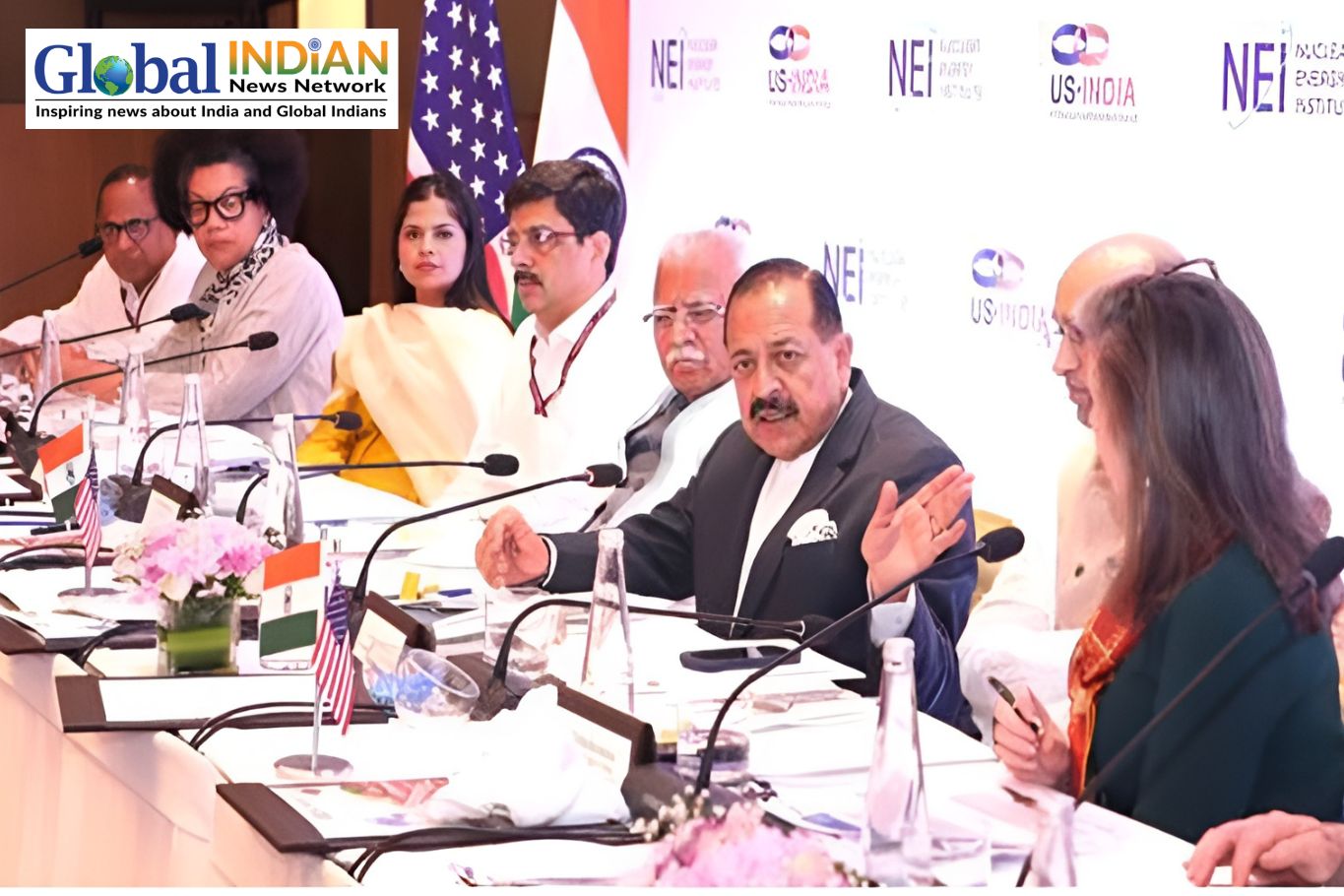
 A senior delegation from the United States nuclear industry met Union Minister of State for Science and Technology Dr. Jitendra Singh in New Delhi to discuss investment prospects and deeper collaboration in India’s rapidly expanding nuclear energy sector. The discussions focused on strengthening industry partnerships, clean energy cooperation, and technological innovation between the two countries.
The delegation included representatives from the Nuclear Energy Institute and the U.S.-India Strategic Partnership Forum, along with business leaders and stakeholders involved in civil nuclear energy and advanced technology cooperation. The visit was facilitated by the U.S.-India Strategic Partnership Forum as part of ongoing efforts to strengthen bilateral engagement in strategic sectors.
During the interaction, Dr. Jitendra Singh highlighted the growing importance of India-US cooperation in science, technology, and clean energy. He noted that civil nuclear collaboration has become increasingly significant from both economic and strategic perspectives. According to the minister, the launch of the US-India TRUST Initiative during the meeting between Prime Minister Narendra Modi and President Donald Trump in February 2025 created fresh opportunities for cooperation in emerging technologies and innovation-driven industries.
The TRUST initiative focuses on trusted technology partnerships, resilient supply chains, and innovation ecosystems. It aims to encourage stronger collaboration among governments, industries, startups, and academic institutions in areas including artificial intelligence, semiconductors, biotechnology, quantum technology, advanced materials, critical minerals, energy systems, and space technologies.
Referring to India’s long-term development vision for 2047, Dr. Singh said the country plans to expand its nuclear energy capacity from the current 8.8 gigawatts to nearly 100 gigawatts through a phased strategy. He added that the country’s growing nuclear program offers major opportunities for international cooperation in manufacturing, research, supply chain development, and advanced technologies.
The minister also informed the delegation about the recently enacted SHANTI Act 2025, a major reform designed to increase private sector participation, including foreign investment, in India’s nuclear industry. The legislation is expected to create a more investment-friendly environment and encourage greater industrial collaboration and technology partnerships under India’s Nuclear Energy Mission.
India is also moving forward with the development of Small Modular Reactors, supported by an allocation of nearly $2.4 billion. Officials said there is significant scope for India-US cooperation in areas such as micro-reactors, AI-driven nuclear safety systems, scientific computing, and advanced nuclear modelling.
The meeting also reviewed progress on ongoing bilateral projects, including the proposed Westinghouse AP1000 nuclear project at Kovvada, cooperation under the Civil Nuclear Energy Working Group, hydrogen energy initiatives, rare earth partnerships, and scientific research collaborations involving Fermilab technologies.
Participants additionally discussed the LIGO-India project, a major India-US scientific collaboration supported by an estimated budget of over $300 million. Officials described it as one of the most advanced examples of scientific cooperation between the two nations.
The discussions concluded with both sides reaffirming their commitment to expanding practical and industry-led partnerships in clean energy, advanced manufacturing, innovation, and nuclear technology development.