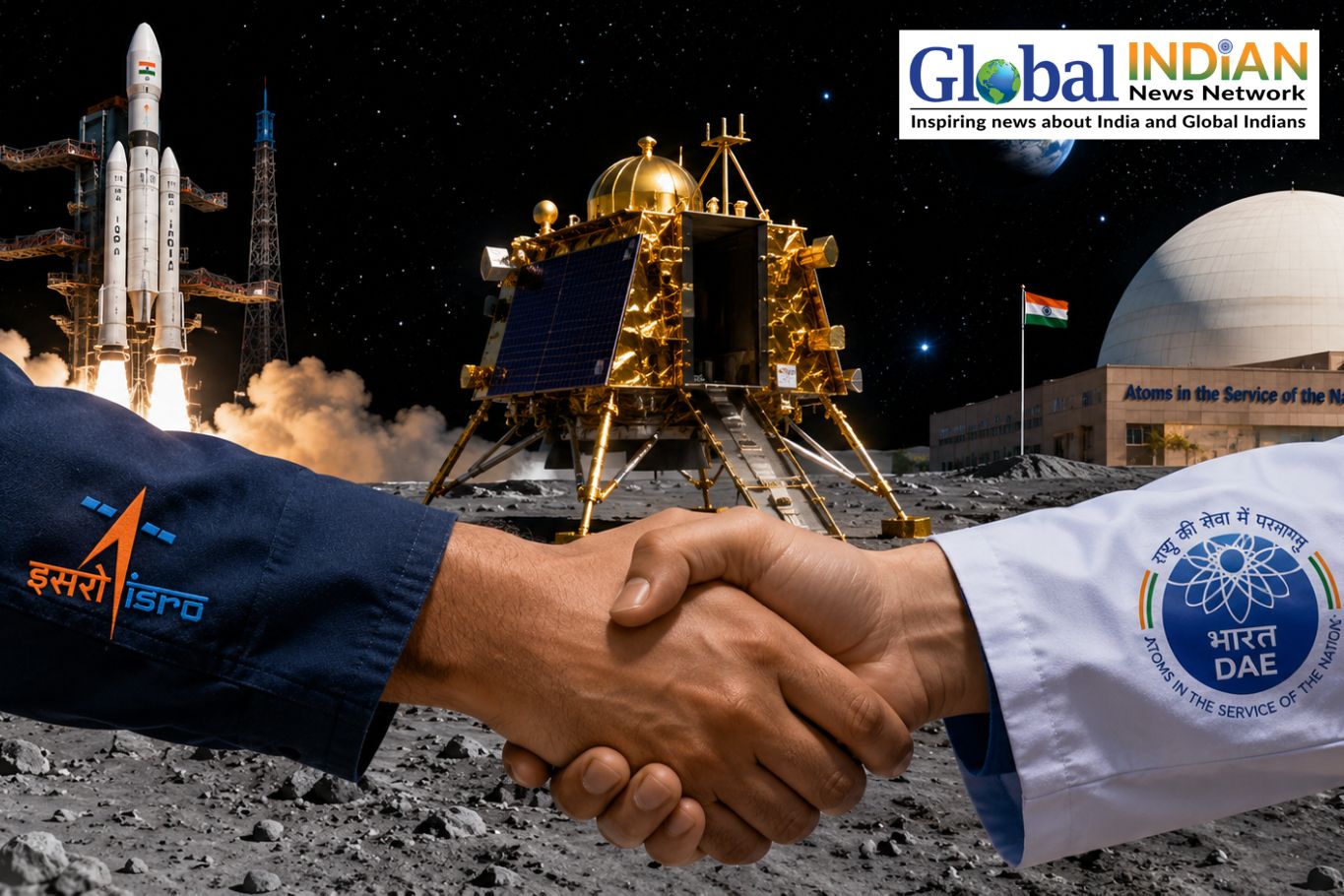
 The Indian Space Research Organisation (ISRO) is working on a breakthrough technology that could significantly extend the lifespan of future lunar missions. According to ISRO Chairman V Narayanan, the space agency has joined forces with the Department of Atomic Energy to develop advanced artificial heating systems designed to protect lunar landers from the Moon’s severe temperature fluctuations.
Speaking at the CSIR-RISE Conclave in Bengaluru, Narayanan explained that Chandrayaan-3’s Vikram lander, which relied primarily on solar energy, was able to function on the lunar surface for approximately 14 Earth days. The mission’s operational timeline corresponded with the duration of a single lunar day, after which the extreme cold of the lunar night posed substantial challenges to the spacecraft’s survival.
Drawing on the experience gained from Chandrayaan-3, ISRO is now focused on building a next-generation lunar lander capable of remaining operational for nearly 200 days. The proposed heating technology is expected to shield onboard systems from freezing temperatures, allowing spacecraft to withstand the Moon’s harsh environment for extended periods. Such an advancement could open the door to longer scientific investigations and more ambitious exploration objectives.
The Moon experiences dramatic temperature variations because its day-night cycle differs considerably from that of Earth. A lunar day and night each last about 14 Earth days. During daylight hours, temperatures can climb to nearly 121 degrees Celsius, while nighttime conditions can plunge to approximately minus 129 degrees Celsius. These extreme conditions make thermal management one of the most critical aspects of designing sustainable lunar missions.
Narayanan also highlighted the importance of collaboration in advancing India’s space ambitions. ISRO and the Council of Scientific and Industrial Research (CSIR) have identified 40 areas for joint technological development. Of these, 17 projects have already received approval for implementation during the initial phase of cooperation.
Beyond lunar exploration, ISRO has expanded its partnerships with other scientific organizations, including the Department of Science and Technology and private-sector entities, to develop space medicine capabilities for the upcoming Gaganyaan human spaceflight mission. The agency has also collaborated with the Department of Biotechnology on microgravity research conducted during the Axiom-4 mission to the International Space Station, where experiments were carried out by Group Captain Subhanshu Shukla.
These initiatives reflect India’s growing emphasis on innovation, interdisciplinary research, and long-term space exploration capabilities as it prepares for future missions beyond Earth’s orbit.