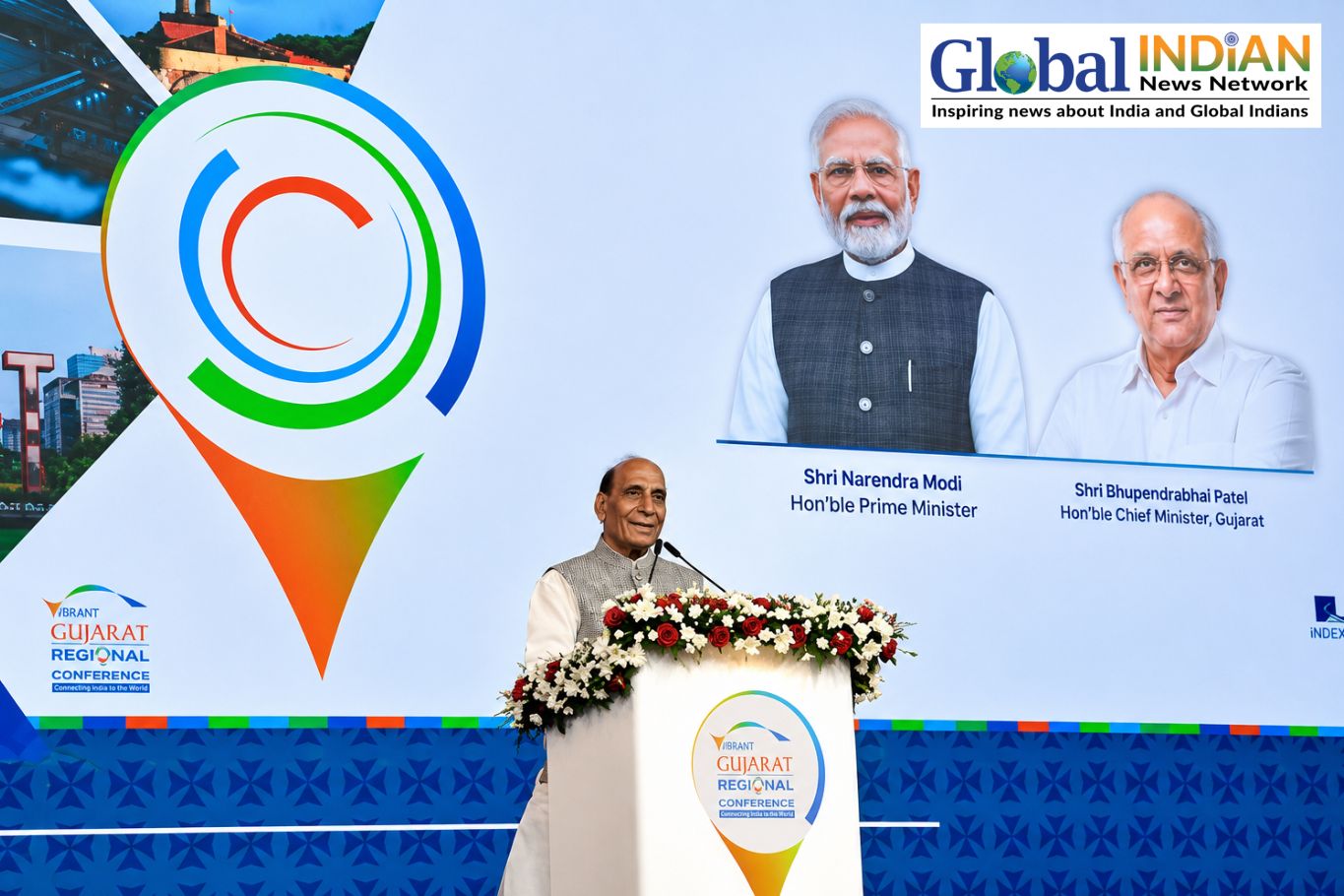
 Defence Minister Rajnath Singh has emphasized that India’s future position in the global order will be shaped by its ability to strengthen self-reliance, expand technological capability, and ensure robust national security. Speaking at the valedictory session of the Vibrant Gujarat Regional Conference (VGRC) in Vadodara, he said these three pillars are becoming increasingly critical in a rapidly evolving geopolitical environment.
Singh noted that India’s long-term vision of becoming a developed nation by 2047 goes far beyond economic expansion. He explained that the goal includes building a country that is not only economically strong but also technologically advanced and socially empowered, capable of standing confidently on the world stage.
According to the Defence Minister, successful nations throughout history have relied on a strong connection between economic strength, technological advancement, and national security. He said that when a country makes progress in industry and innovation, it naturally strengthens its security framework, and in turn, a secure environment allows innovation and economic activity to grow further.
Singh also highlighted that the defence sector contributes much more than military capability alone. He said it plays a major role in driving broader economic development by creating opportunities in infrastructure, logistics, manufacturing, and employment. Defence corridors, he added, help build entire ecosystems that support industrial growth and innovation.
He pointed to several government initiatives aimed at boosting indigenous defence production and reducing dependence on imports. These include the Atmanirbhar Bharat mission, Make in India, the Defence Acquisition Procedure, and the Technology Development Fund. Programs such as the Srijan Portal, iDEX, Defence Testing Infrastructure, Green Channel Certification, and Self-Certification schemes have also increased participation from MSMEs and start-ups in the defence manufacturing sector.
Reinforcing India’s approach to self-reliance, Singh clarified that the goal is not isolation but collaboration. He said India seeks to work as an equal partner with global companies while ensuring that technological and economic benefits are developed within the country.
He further underlined the importance of emerging technologies such as artificial intelligence, semiconductors, quantum computing, cybersecurity, and space systems, stating that these fields will play a decisive role in both economic growth and national security in the coming decades. He added that industrial ecosystems developing in regions like Sanand and Dholera will contribute significantly to India’s technological sovereignty.
Concluding his remarks, Singh urged industry leaders to convert regional industrial strengths into national capabilities, ensuring that local innovation contributes to India’s long-term strategic and developmental goals.