 Two Indian-American teenage sisters are playing a transformative role in reshaping education in one of India’s most remote and environmentally challenging regions—the Sundarbans. Through their youth-led nonprofit organization, they are introducing modern, hands-on learning methods that are replacing traditional chalk-and-talk teaching in local classrooms.
At Swapnopuron Shiksha Niketan in Hingalganj, a gradual but powerful shift is taking place. Students who once depended solely on textbooks and blackboards are now being introduced to technology-driven education that encourages creativity, experimentation, and critical thinking. The initiative is helping rural learners experience a more interactive and skill-based approach to education.
This transformation is being driven by a partnership between the US-based nonprofit With Our Hearts (WOH) and the Katakhali Swapnopuron Welfare Society in India. Founded in 2020 by sisters Nisha Tara Saraiya and Nimisha Saraiya along with collaborators Alexis Jain, Andrew Jain, and Gavin Bender, WOH focuses on expanding access to quality education for underserved communities globally.
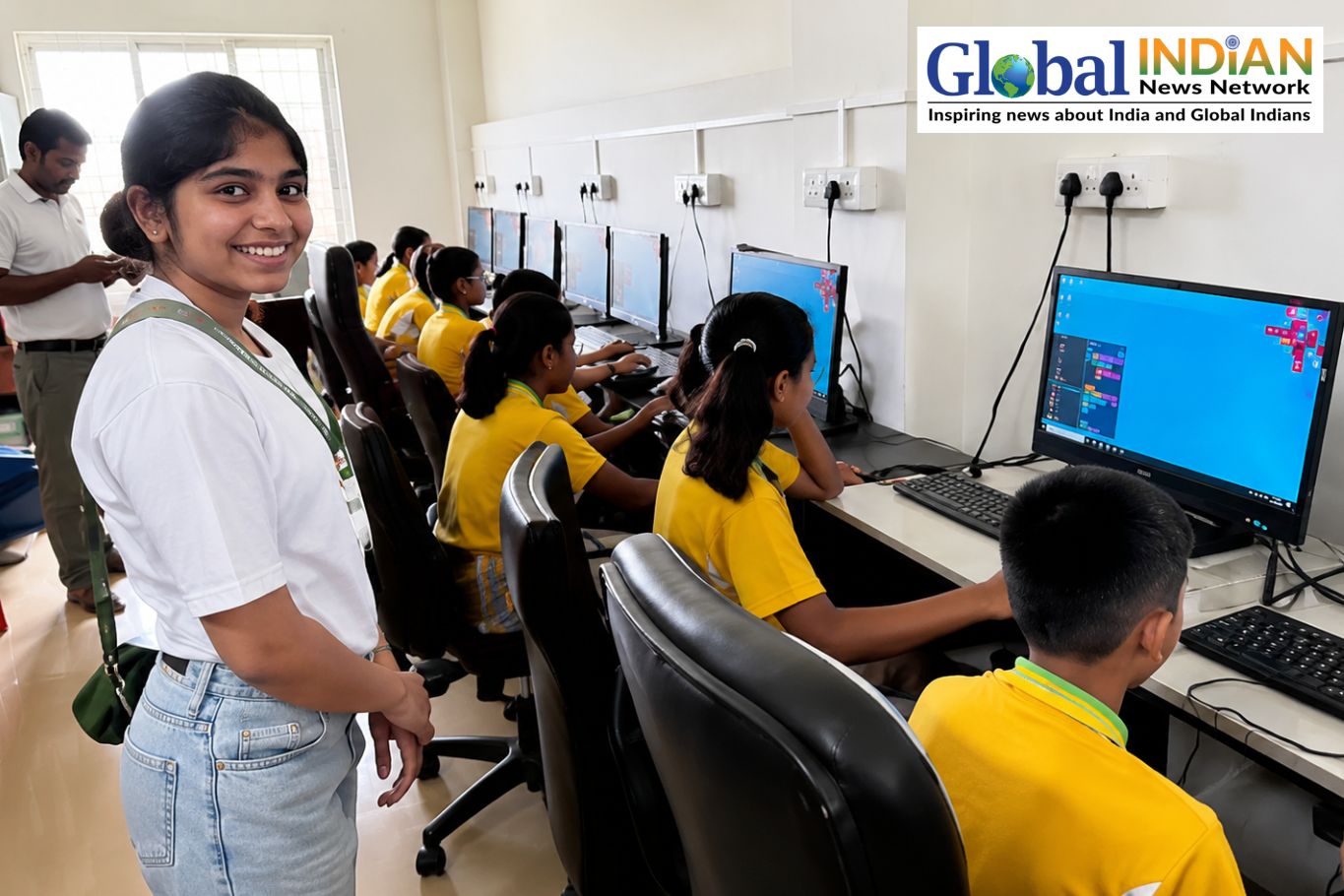
Since 2023, the organization has been actively working with the Sundarbans school through both physical visits and continuous remote engagement. Their efforts have supported infrastructure development and fundraising initiatives that have enabled the creation of permanent classrooms, installation of a computer lab with internet connectivity, provision of laptops for teachers, distribution of uniforms, and arrangement of transportation facilities for students.
In a region where schools once operated under extremely limited conditions—sometimes even in temporary bamboo structures—the initiative is helping redefine what rural education can look like. The goal is not only to improve facilities but also to reshape how students learn and engage with academic subjects.
A key focus of the program is the transition from traditional STEM education to STEAM, integrating arts into science and technology learning. Plans are underway to establish fully equipped STEAM and composite science laboratories aligned with CBSE standards. These labs will allow students to conduct physics, chemistry, and biology experiments, use scientific instruments, and explore real-world scientific concepts in a structured environment.
The STEAM lab will also introduce coding, electronics, design thinking, and even 3D printing technology, enabling students to convert ideas into physical models. Early exposure to robotics is also part of the curriculum, helping students build problem-solving skills, teamwork, and confidence through practical learning experiences.
Educators involved in the initiative believe that this hands-on approach is essential for long-term academic growth and career readiness. School representatives emphasize that the focus is shifting from rote learning to curiosity-driven education, allowing students to actively apply knowledge rather than simply memorize it.
Beyond infrastructure, With Our Hearts has also supported curriculum development by helping integrate technology into everyday teaching practices. Students have even created digital presentations on global issues such as artificial intelligence and presented their work during online sessions with the organization.
Despite these advancements, challenges remain, particularly in retaining students in higher grades due to socioeconomic constraints. Efforts are now focused on improving engagement, providing mentorship, and strengthening community involvement to ensure more students continue their education.
The initiative continues to evolve with a clear vision: to empower children in remote regions with modern skills, stronger confidence, and greater opportunities for the future.