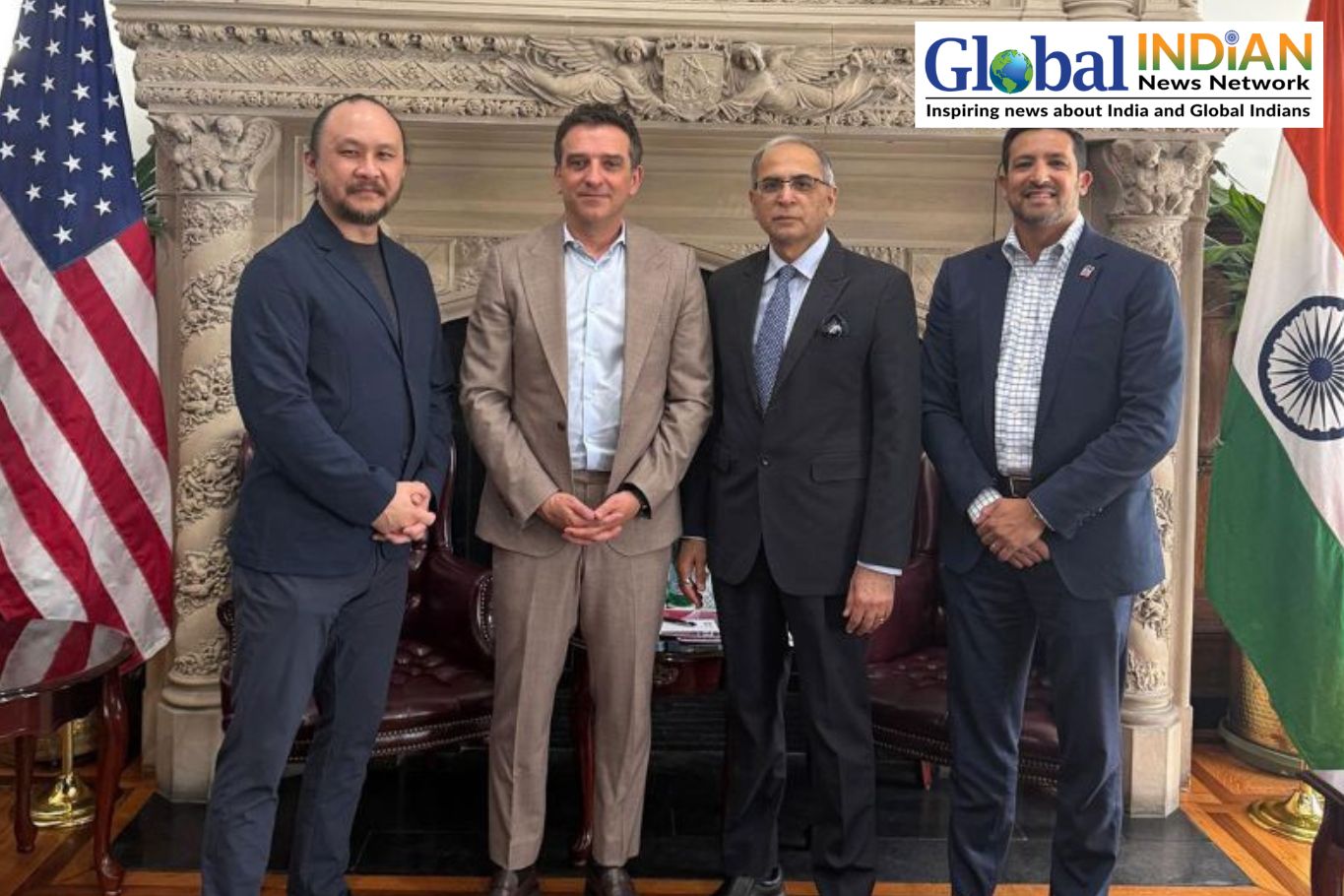
 India’s Ambassador to the United States, Vinay Mohan Kwatra, has engaged in a series of high-level meetings with influential corporate executives and technology leaders as part of ongoing efforts to deepen economic, technological, and strategic cooperation between New Delhi and Washington. The discussions focused on investment expansion, supply chain resilience, and emerging frontier technologies.
In one of his key interactions, the ambassador met Chris Nicholas, President and Chief Executive Officer of Walmart, to review the company’s growing investment footprint in India. The discussions centered on long-term business strategies, market expansion opportunities, and strengthening resilient supply chains that can support global trade stability. Walmart’s continued engagement in India reflects the broader trend of increasing corporate interest in one of the world’s fastest-growing major economies.
Kwatra also held a forward-looking discussion with Ylli Bajraktari, President and CEO of the Special Competitive Studies Project (SCSP), an organization focused on advanced technology policy and innovation. Their conversation explored the future trajectory of emerging technologies such as artificial intelligence, quantum computing, and advanced “physical AI” systems. The meeting took place ahead of Bajraktari’s planned visit to New Delhi for the India-US Forum, where technological collaboration is expected to be a central agenda item.
The ambassador emphasized the expanding scope of India-US cooperation in the digital and innovation space, highlighting the importance of joint progress in critical technologies that are shaping the global economy. Both sides discussed how deeper collaboration could support innovation ecosystems and strengthen technological competitiveness in both nations.
Alongside economic and technology-focused engagements, Kwatra also met senior US counter-terrorism official Sebastian Gorka to discuss shared security concerns. The talks underscored ongoing cooperation between India and the United States in addressing global terrorism and evolving security threats. The discussions referenced frameworks established in recent bilateral agreements aimed at enhancing intelligence sharing and coordinated counter-terrorism efforts.
The meeting also reflected broader commitments made by both countries to combat extremist networks and prevent the use of their territories for terrorist activities. These commitments include cooperation against groups such as Al-Qaida, ISIS, and Pakistan-based terror organizations, as well as efforts to disrupt financing and logistical networks supporting such groups.
Recent developments, including the extradition of individuals linked to major terror attacks, were highlighted as evidence of growing operational coordination between the two nations. Both sides reiterated their intent to strengthen joint efforts against terrorism while expanding cooperation on weapons non-proliferation and global security challenges.
Collectively, these engagements illustrate the multi-dimensional nature of the India-US partnership, spanning technology, trade, investment, and security cooperation, and reinforcing a shared commitment to long-term strategic alignment.