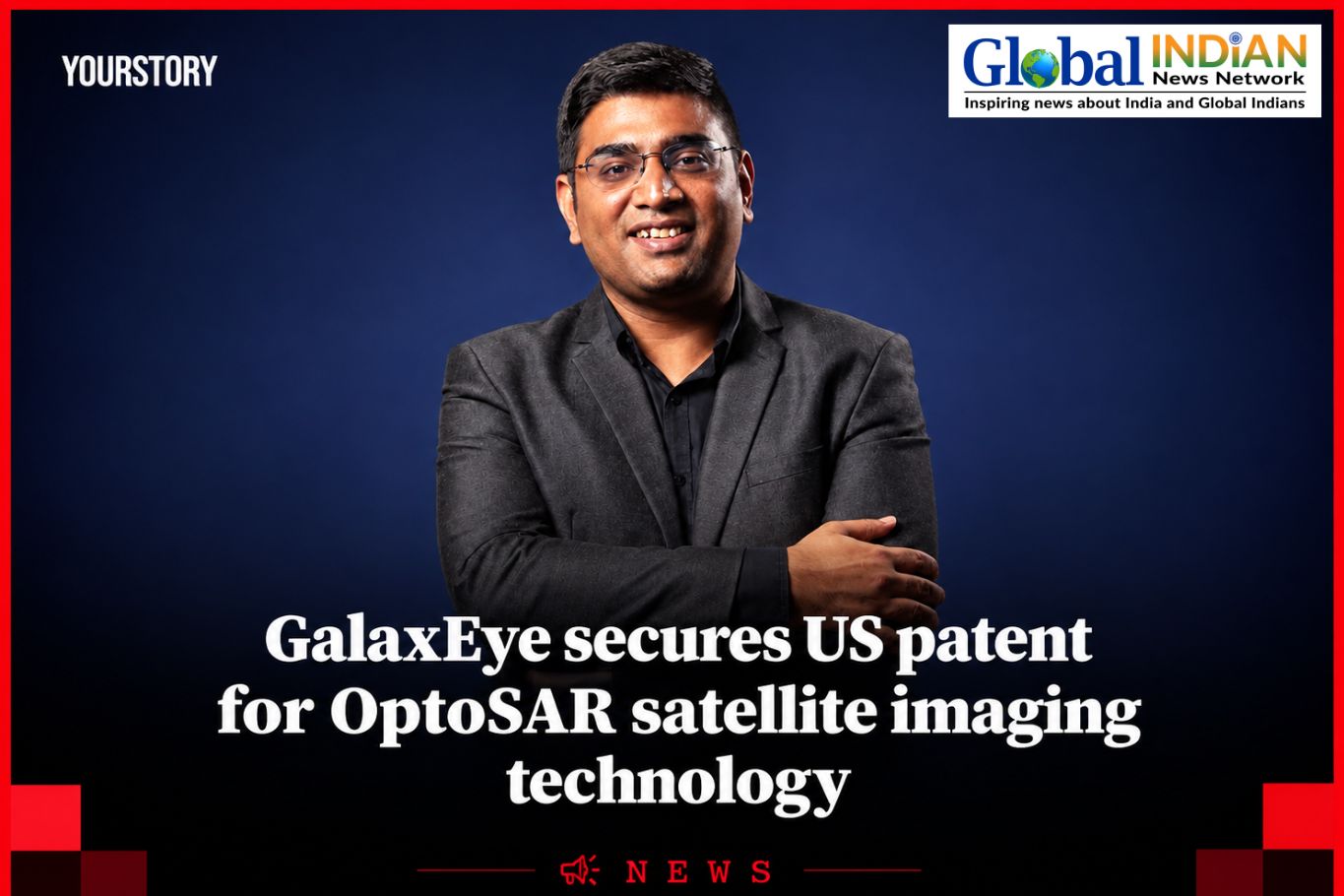
 Indian space-tech company GalaxEye has reached a significant milestone after obtaining a United States patent for the technology powering its proprietary OptoSAR imaging system. The achievement strengthens the startup’s intellectual property portfolio and marks an important step in its plans to take its satellite-imaging capabilities to international markets.
The newly secured patent protects the underlying architecture that allows optical and microwave sensors to operate together in a coordinated manner. The technology builds on an invention that GalaxEye has also patented in India, giving the company additional protection as it works to commercialize its Earth-observation platform beyond the domestic market.
GalaxEye says its approach addresses a long-standing challenge in satellite imaging by combining optical imagery with Synthetic Aperture Radar (SAR) data at the sensing stage. This enables the system to capture information that is matched both spatially and temporally, potentially producing a more comprehensive view of conditions on Earth.
A key advantage of the technology is its ability to operate regardless of weather or lighting conditions. By bringing optical and radar capabilities together, the company aims to provide reliable imaging in situations where conventional optical satellite systems can be limited by clouds, darkness or other environmental factors.
Established in 2021 by IIT Madras alumni Suyash Singh, Denil Chawda, Pranit Mehta, Kishan Thakkar and Rakshit Bhatt, GalaxEye has positioned itself around the development of advanced space technology originating in India. The founders’ focus is not only on building satellites but also on creating intellectual property that can compete in global deep-tech markets.
The startup has already taken its technology into orbit through Mission Drishti, which launched on May 3. The mission demonstrated GalaxEye’s capabilities in Earth observation and represented a major achievement for India’s privately developed space sector.
Looking ahead, GalaxEye has an ambitious expansion plan. Over the next five years, the company intends to establish a 30-satellite constellation designed to serve government, defense and commercial customers. Its targeted applications include national security, agriculture, infrastructure monitoring, insurance, maritime intelligence and disaster management.
The US patent could give GalaxEye an added advantage as it seeks partnerships and commercial opportunities overseas. More broadly, the achievement highlights the growing ability of Indian private space companies to develop proprietary technologies and pursue intellectual property protection in major global markets.