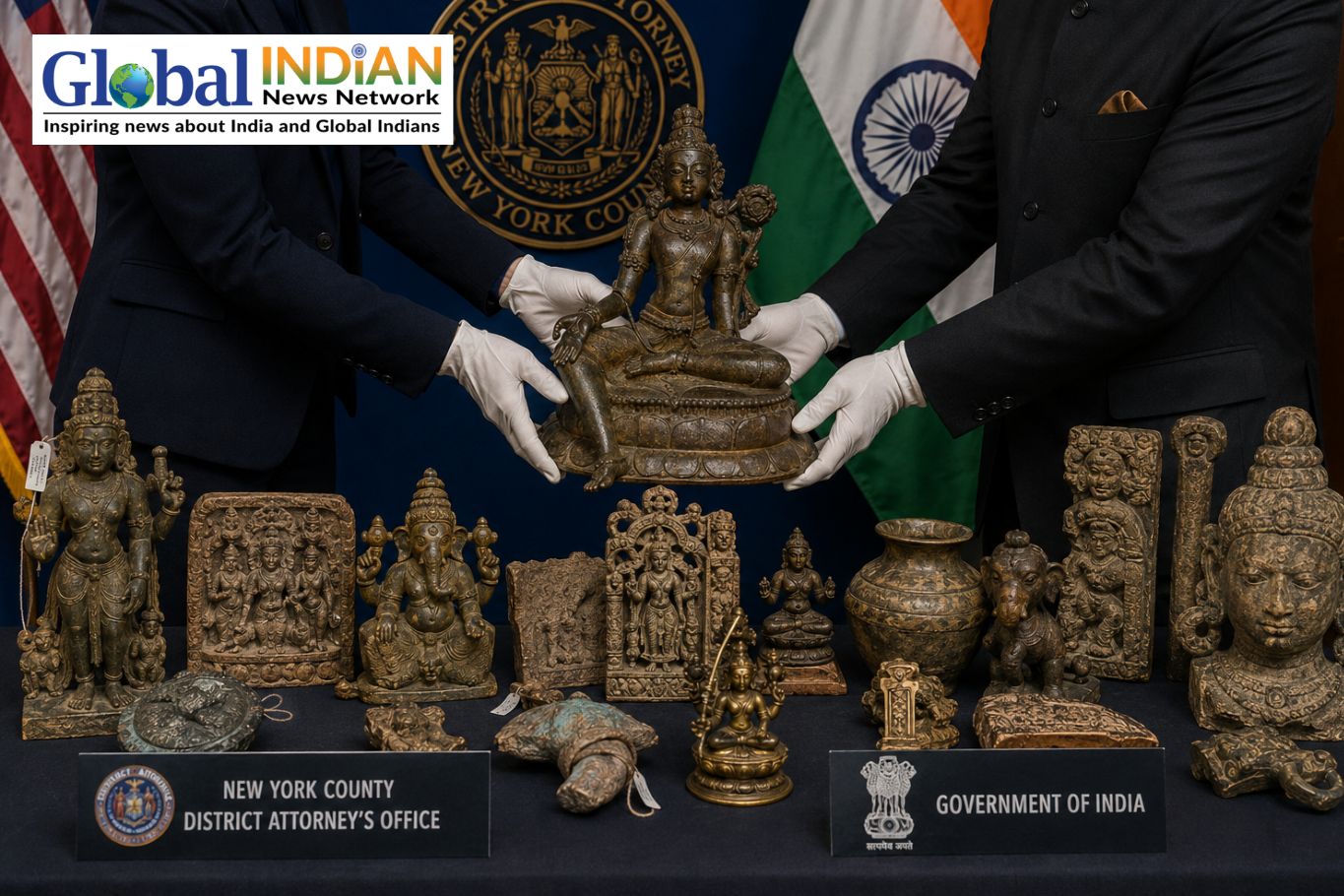
 New York authorities have returned hundreds of stolen Indian antiquities valued at nearly $14 million, marking one of the largest recent recoveries of cultural artifacts linked to international smuggling operations. The handover included 657 items of historical and religious significance, many of them connected to long-running investigations involving alleged antiquities traffickers.
The return was officially announced by Manhattan District Attorney Alvin Bragg Jr., who stated that the recovery demonstrates the enormous scale of trafficking networks that targeted India’s cultural heritage over several decades. The ceremony for the repatriation took place at the Consulate General of India in New York and included artifacts connected to multiple ongoing investigations into illicit art smuggling.
The announcement came during a period of renewed global discussion surrounding the ownership and return of historical artifacts. It also coincided with comments by New York City Mayor Zohran Mamdani regarding the controversial possession of the Koh-i-noor diamond by the British royal family, although officials clarified that the timing of the antiquities ceremony had been planned months earlier and was unrelated to recent royal events.
Among the returned objects were several rare Hindu and Buddhist sculptures with deep historical and spiritual significance. One notable artifact was a bronze representation of Avalokiteshvara, a revered Buddhist deity, seated on a lotus base above a lion-supported throne. Investigators said the sculpture had been stolen from India and illegally smuggled into the United States by 1982 before eventually surfacing in a private New York collection decades later.
Another important piece included a red sandstone Buddha statue depicting the figure with one hand raised in a traditional gesture of protection. Authorities linked the artifact to alleged smuggler Subhash Kapoor, who has been accused of operating a vast international trafficking network involving stolen antiquities from South Asia. Kapoor remains under indictment in connection with multiple smuggling-related charges.
The recovered collection also featured a sandstone sculpture of the Hindu deity Ganesha in a dancing pose. Investigators said the item was looted with the involvement of alleged co-conspirator Ranjeet “Shantoo” Kanwar, who has also been tied to antiquities trafficking operations.
Officials noted that the return of these artifacts reflects increasing international cooperation aimed at restoring stolen cultural treasures to their countries of origin. Over recent years, India has intensified efforts to recover looted antiquities from museums, private collections, and galleries around the world. The latest repatriation is expected to add pressure on other institutions and collectors to voluntarily return disputed cultural objects acquired through questionable channels.
Legal experts and historians say the growing focus on restitution represents a broader shift in global attitudes toward cultural ownership and accountability. The recovery of these artifacts is being viewed not only as a diplomatic success for India but also as a significant step toward preserving and restoring the country’s historical and religious heritage.