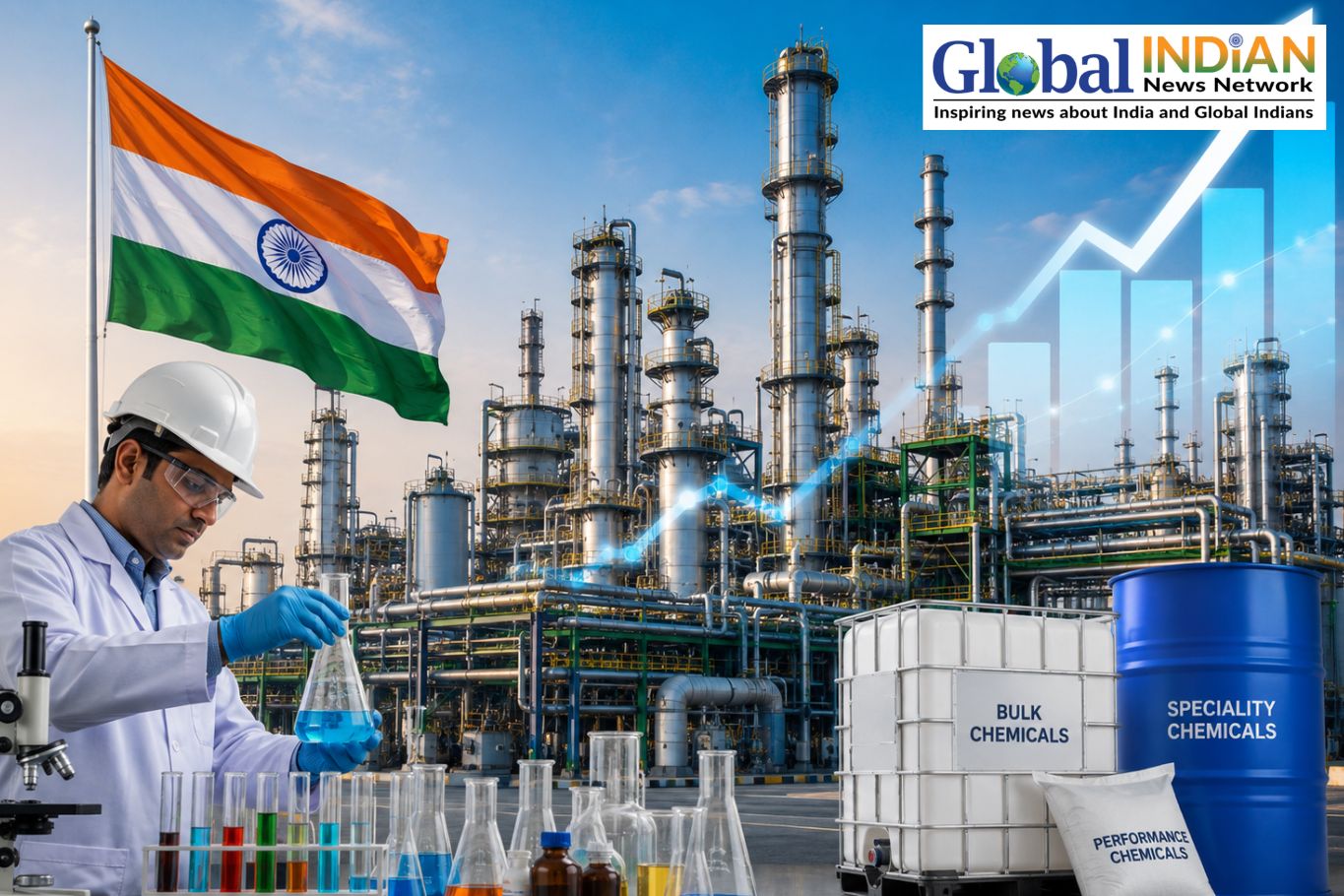
India’s chemicals and petrochemicals sector has recorded substantial growth over the past 12 years, supported by government reforms, infrastructure expansion, investment initiatives, and efforts to strengthen domestic manufacturing. The sector has played an important role in advancing the goals of a self-reliant India and the broader vision of Viksit Bharat 2047.
The Department of Chemicals and Petrochemicals has introduced several measures to improve production capacity, encourage innovation, and create a stronger industrial ecosystem. Three operational Petroleum, Chemicals and Petrochemicals Investment Regions (PCPIRs) located in Dahej, Gujarat; Visakhapatnam-Kakinada, Andhra Pradesh; and Paradeep, Odisha, have attracted investments worth $40.54 billion. These regions have supported the development of more than 2,200 chemical manufacturing units and created employment opportunities for nearly 370,000 people.
The sector has also witnessed a rise in foreign investment during the 2014-2026 period. Foreign Direct Investment (FDI) inflows reached $12.51 billion, compared with $8.78 billion between 2004 and 2014, reflecting increased confidence among global investors in India’s chemical manufacturing potential.
To improve product quality and reduce the entry of low-standard imports, the government has implemented 37 Quality Control Orders (QCOs). Additionally, 10 Plastic Parks have been approved across the country, with four already having fully developed infrastructure to support industry growth and encourage advanced manufacturing.
Alongside infrastructure development, India has focused on research, technology advancement, and workforce training. The Central Institute of Petrochemicals Engineering & Technology (CIPET) has expanded its presence to 51 centers nationwide, including 19 established since 2014. The institute has trained nearly 672,000 professionals and completed over 853,000 technology support assignments for industries.
The Institute of Pesticide Formulation Technology (IPFT) has also contributed to innovation by transferring 64 pesticide formulation technologies to businesses. The institute received $3.01 million from the Department of Biotechnology to establish a Biofoundry Facility focused on developing biopesticides and advanced biological formulations.
Further strengthening the industry, the Union Cabinet approved the BHAVYA Rasayan Scheme with an investment of $317.58 million. The initiative aims to establish three plug-and-play Chemical Parks, helping reduce import dependence, encourage manufacturing, and improve India’s competitiveness in global markets.
With continued investments, skill development, and innovation-driven policies, India’s chemicals and petrochemicals sector is expected to expand further, creating new employment opportunities, increasing exports, and strengthening the country’s position as a major global manufacturing hub.