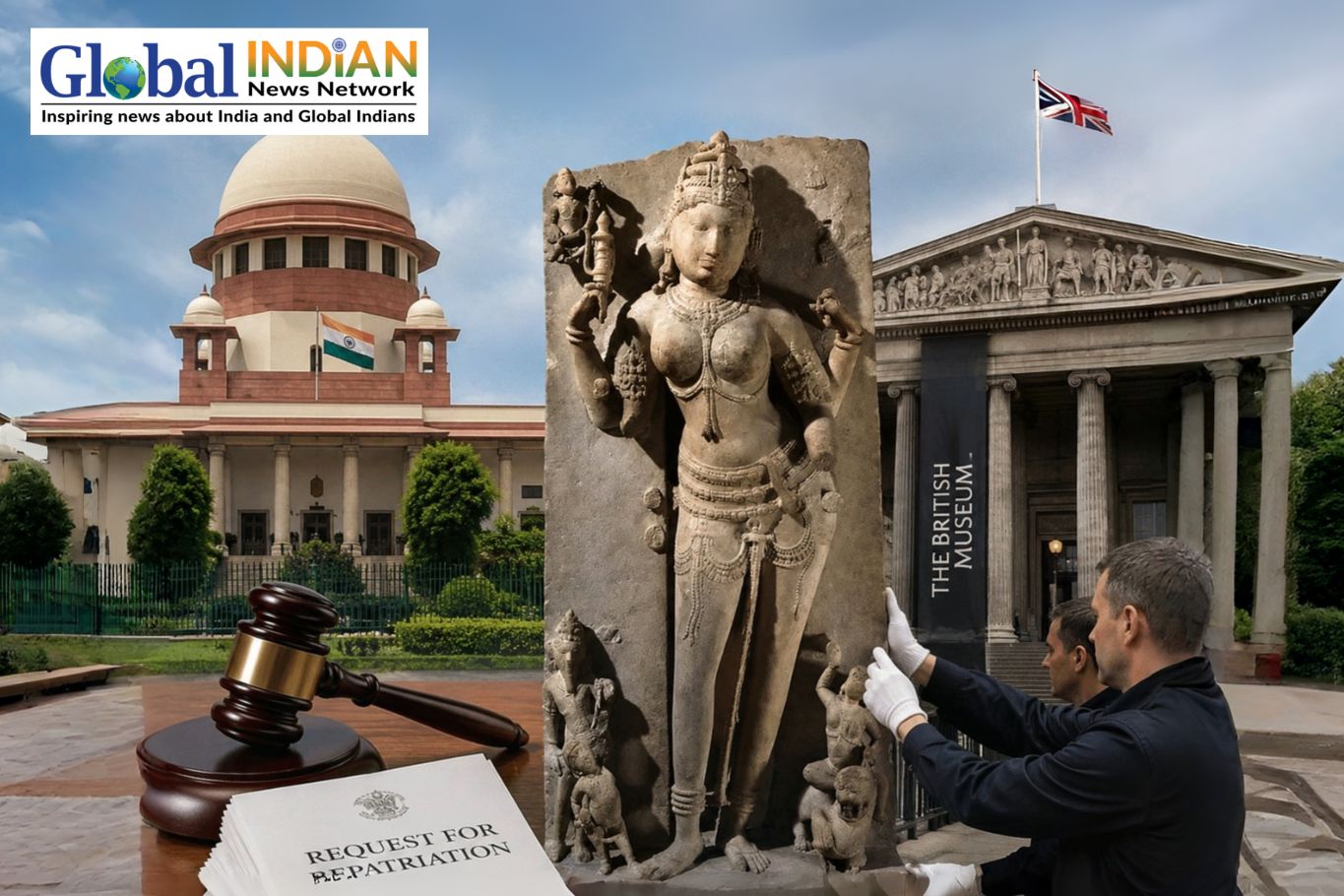
 A recent ruling by the Madhya Pradesh High Court regarding the disputed Bhojshala complex has brought renewed focus to an important 11th-century sculpture of Goddess Saraswati currently housed in London’s British Museum. The court identified Bhojshala as a temple dedicated to Goddess Saraswati, also known as Vagdevi, and stated that any requests seeking the return of the historic idol to India could be reviewed by the government.
The observation has reignited discussions surrounding India’s cultural heritage, colonial-era artefacts, and the broader issue of repatriation. Historians, conservation experts, and art scholars consider the Saraswati sculpture far more than a religious figure. It is widely viewed as one of the finest surviving examples of medieval Indian temple sculpture associated with the Paramara dynasty and the intellectual legacy of King Bhoj, the celebrated 11th-century ruler after whom Bhojshala is believed to have been named.
The stone sculpture, standing nearly four feet tall, portrays Goddess Saraswati, the Hindu deity associated with knowledge, music, wisdom, and learning. Art historians have noted the elegance and calm expression characteristic of central Indian temple craftsmanship from that era. The statue also contains Sanskrit inscriptions written in Devanagari script, strengthening its historical connection to the scholarly traditions encouraged during King Bhoj’s reign.
Its continued presence in London has placed the sculpture at the center of a larger international debate concerning the ownership of cultural and religious artefacts removed during colonial rule. Across Europe and North America, museums have increasingly faced pressure to return objects acquired under imperial systems, unequal political conditions, or historical conflicts. The Saraswati statue is now being discussed within that broader global conversation about restitution and historical justice.
India has intensified efforts in recent years to recover antiquities and sacred objects taken abroad over the past two centuries. Several historical items linked to Indian heritage have already been repatriated through diplomatic negotiations and international cooperation. The renewed attention surrounding the Bhojshala ruling is expected to strengthen demands for the return of culturally significant artefacts connected to India’s spiritual and artistic history.
Beyond legal and political debates, scholars say the sculpture represents a rich period of intellectual and artistic achievement in medieval India. The statue reflects the deep connection between spirituality, education, literature, and temple architecture during the Paramara period. Supporters of repatriation argue that returning such artefacts would help preserve cultural continuity and restore important symbols of India’s civilizational heritage to their historical context.