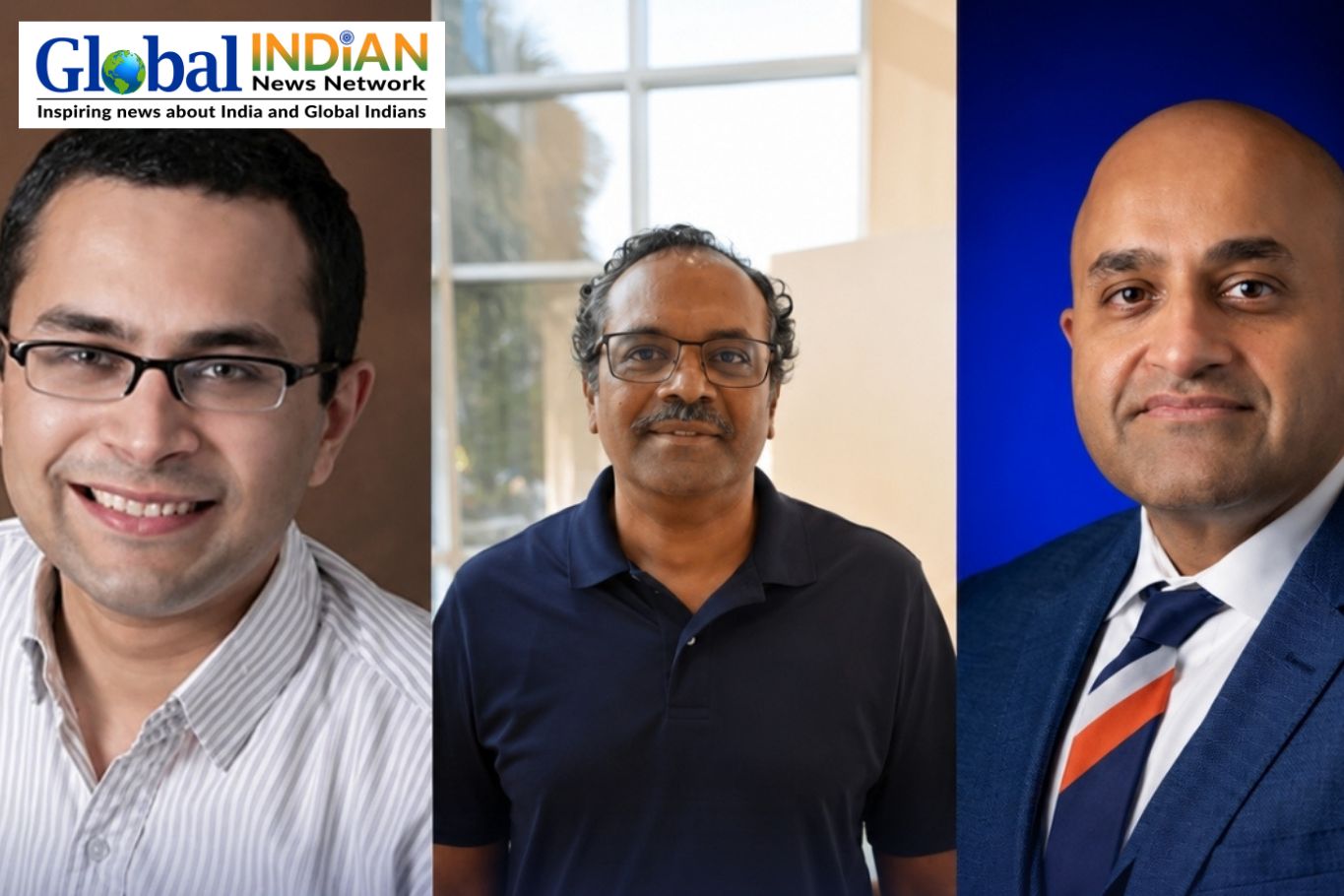
Three Indian-American researchers have earned a place among the 18 innovators chosen by NASA for its 2026 Innovative Advanced Concepts (NIAC) Phase I program, an initiative that supports bold, early-stage ideas that could influence the future of space exploration. The selected scientists are Saptarshi Bandyopadhyay from NASA’s Jet Propulsion Laboratory in California, Anish Damodaran from the University of Central Florida, and A.C. Charania from Zeno Power Systems in Washington.
The three researchers are leading independent studies focused on solving some of the most complex challenges in space science. Their proposals range from addressing climate-related concerns to improving astronomical observations and enhancing astronaut safety during long-duration missions beyond Earth.
Bandyopadhyay’s project, known as DimSun, will investigate whether a carefully controlled cloud of dust positioned in space could reduce the amount of sunlight reaching Earth. The study will examine the practicality of using space-based dust as a potential method for lowering solar radiation, offering a fresh perspective on climate-related research.
Damodaran’s proposal, called PS21, centers on advanced photonic technology designed to improve submillimeter space interferometry. If successful, the concept could significantly strengthen the performance of future space observatories, allowing scientists to capture more detailed observations of distant celestial bodies and expand our understanding of the universe.
Charania’s research focuses on improving astronaut survival in extremely cold environments. His concept proposes integrating radioisotope-powered heating systems into spacesuits, helping astronauts remain protected during the Moon’s extended nights, which last nearly two weeks, as well as during missions to other icy regions in deep space.
NASA selected 18 proposals for this year’s NIAC Phase I program, committing approximately $3.2 million to support the studies. Each project is eligible to receive up to $0.18 million over a nine-month period to evaluate its technical feasibility. While these projects are not official NASA missions, they represent promising concepts that could shape future exploration efforts.
The program also supports a diverse range of ideas, including technologies for exploring lunar lava tubes, extending the lifespan of scientific instruments on Venus, studying Saturn’s rings, collecting samples from planetary rings, developing power systems for interstellar spacecraft, mapping continents on distant exoplanets, improving black hole observations, detecting gravitational waves, and strengthening space debris monitoring.
According to NIAC Acting Program Executive Phillip Williams, groundbreaking advances often begin as ambitious ideas. He emphasized that the program provides researchers with an opportunity to test visionary concepts that may eventually contribute to future space missions while strengthening the nation’s aerospace innovation ecosystem.