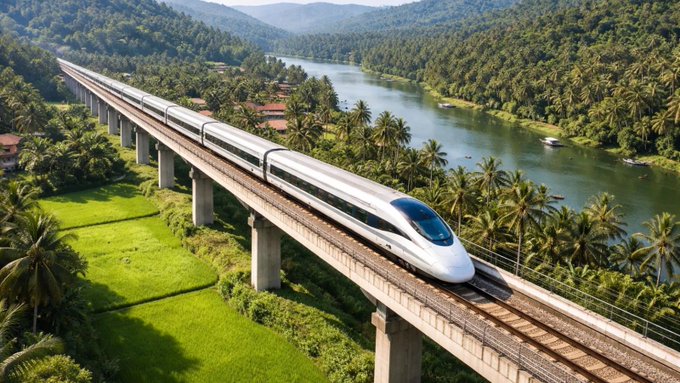
 India is moving closer to launching its first high-speed rail service as the Mumbai–Ahmedabad High-Speed Rail (MAHSR) corridor enters its final stages of development. The project marks a major milestone in the country’s transportation modernization efforts and is expected to serve as the blueprint for a wider national bullet train network.
According to the Ministry of Railways, the 508-kilometer corridor has been designed to operate at speeds of up to 320 kmph, with maximum design capabilities reaching 350 kmph. Once fully operational, the line will reduce travel time between Mumbai and Ahmedabad to approximately 1 hour and 58 minutes, connecting 12 key stations along the route. Officials have indicated that the first operational segment between Surat and Vapi is expected to begin service in August 2027.
The project is also being viewed as a foundation for standardizing high-speed rail construction across India. Engineers and planners have developed repeatable design models, construction methods, and operational systems that can be applied to future corridors. This approach is intended to accelerate project execution, reduce overall costs, and maintain consistent quality across the expanding network.
A major focus of the initiative is domestic manufacturing and technological self-reliance. Under national programs such as Make in India and Aatmanirbhar Bharat, Indian institutions and public sector companies are working to develop indigenous high-speed train sets capable of operating at 280 kmph. These efforts aim to reduce dependency on foreign technology while building local expertise in advanced rail systems and components.
Building on lessons from the Mumbai–Ahmedabad corridor, India has also identified seven additional high-speed rail routes covering nearly 4,000 kilometers. These proposed corridors include major city pairs such as Delhi–Varanasi, Chennai–Bengaluru, Bengaluru–Hyderabad, Mumbai–Pune, and others, forming a long-term blueprint for a nationwide high-speed rail grid.
The planned expansion is expected to attract investments worth approximately $168.05 billion, creating a large-scale infrastructure ecosystem and supporting industrial growth. Authorities believe that standardized engineering practices and indigenous technology adoption will not only reduce travel time between major cities but also strengthen India’s manufacturing base and improve long-term economic efficiency.
Overall, the high-speed rail program represents a strategic shift in India’s transportation planning, aiming to build a faster, more connected, and technologically advanced rail network that can support the country’s future economic growth.