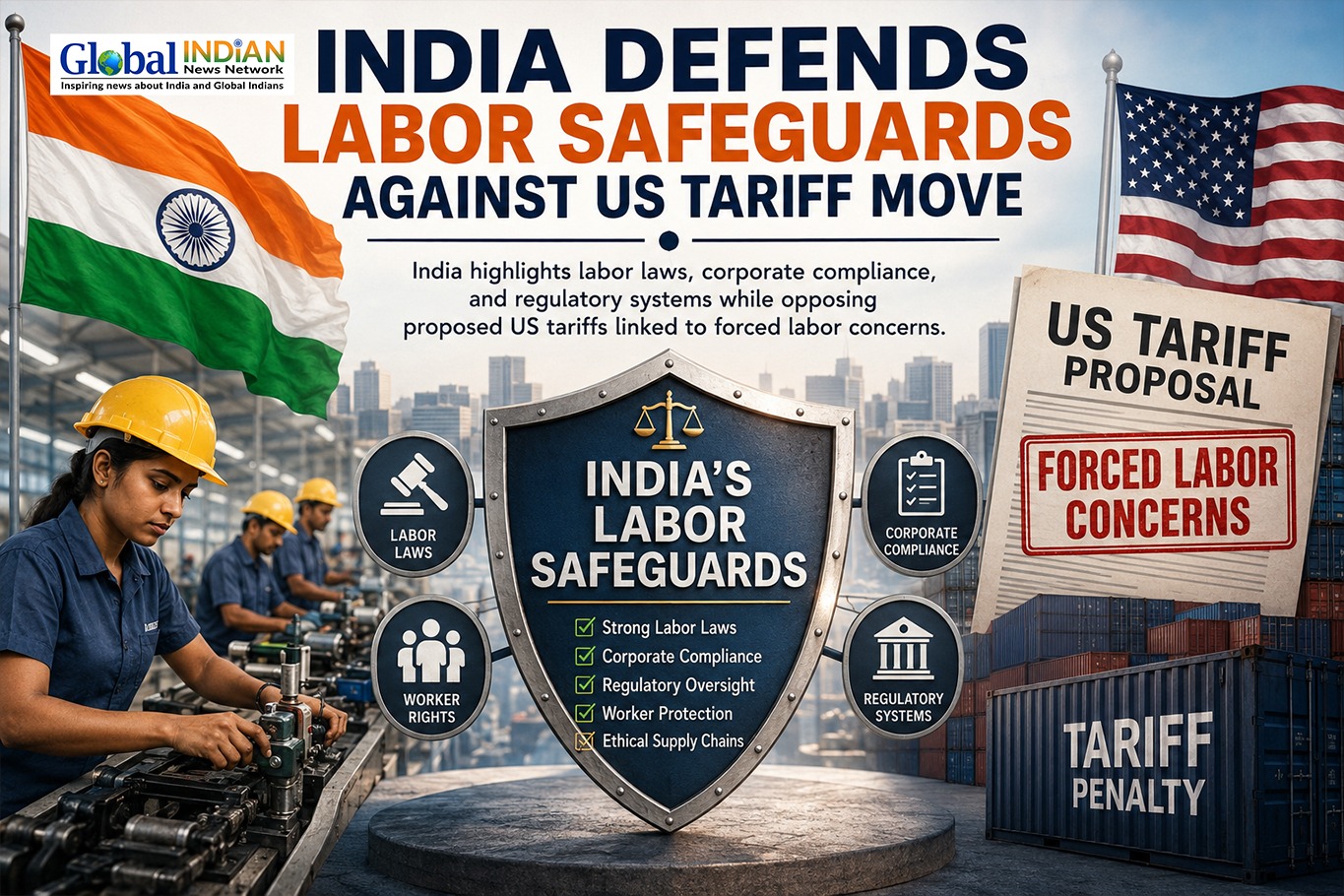
 India has presented a strong defense of its labor protection framework before the United States Trade Representative (USTR), arguing that the country already has comprehensive laws, regulatory institutions, and corporate compliance mechanisms to prevent forced labor. The statement was made during a public hearing on July 8 regarding Washington’s proposed Section 301 tariff action.
Representatives from India’s Ministry of Commerce and Industry, the Agricultural and Processed Food Products Export Development Authority, the Confederation of Indian Industry, and the Federation of Indian Chambers of Commerce and Industry told the USTR that India’s approach combines constitutional guarantees, labor regulations, enforcement systems, and private-sector initiatives aligned with global standards.
The Indian delegation highlighted Article 23 of the Constitution, which prohibits forced and bonded labor and provides legal protection against such practices. Officials also pointed to laws including the Bonded Labor System (Abolition) Act, updated labor codes, criminal provisions under the Bharatiya Nyaya Sanhita, and India’s commitments under International Labor Organization conventions addressing forced labor.
Industry groups emphasized that India’s corporate sector has developed stronger accountability systems in recent years. The Confederation of Indian Industry noted that the Securities and Exchange Board of India requires the country’s top 1,000 listed companies to submit Business Responsibility and Sustainability Reports. These reports include disclosures on human rights practices, worker grievances, forced labor concerns, supply-chain monitoring, and corrective measures.
CII also referred to the BRSR Lite framework for smaller businesses and voluntary industry programs designed to support responsible business practices.
The Federation of Indian Chambers of Commerce and Industry stated that many Indian exporters serving the US market already follow strict compliance requirements established by international buyers and multinational companies. These measures include supplier audits, ethical sourcing policies, worker complaint systems, and detailed due diligence procedures.
Industry representatives explained that compliance requirements often come from both domestic regulations and expectations set by global customers. They also highlighted specific sector protections, including human rights assessments conducted by aluminum producers and frequent audits faced by textile exporters from US buyers and international certification organizations.
The Agricultural and Processed Food Products Export Development Authority said agricultural shipments to the United States follow additional safeguards. It noted that rice exports are allowed only through mills registered with India’s Ministry of Agriculture and Farmers Welfare, while exporters must meet labor and ethical sourcing standards demanded by major retailers, including Walmart.
Indian officials argued that the proposed 12.5 percent tariff would not improve labor conditions because existing legal and business systems already address these concerns. Instead, they encouraged the US to pursue cooperation through dialogue, technical partnerships, and bilateral engagement, stating that collaborative solutions would be more effective than broad trade restrictions.