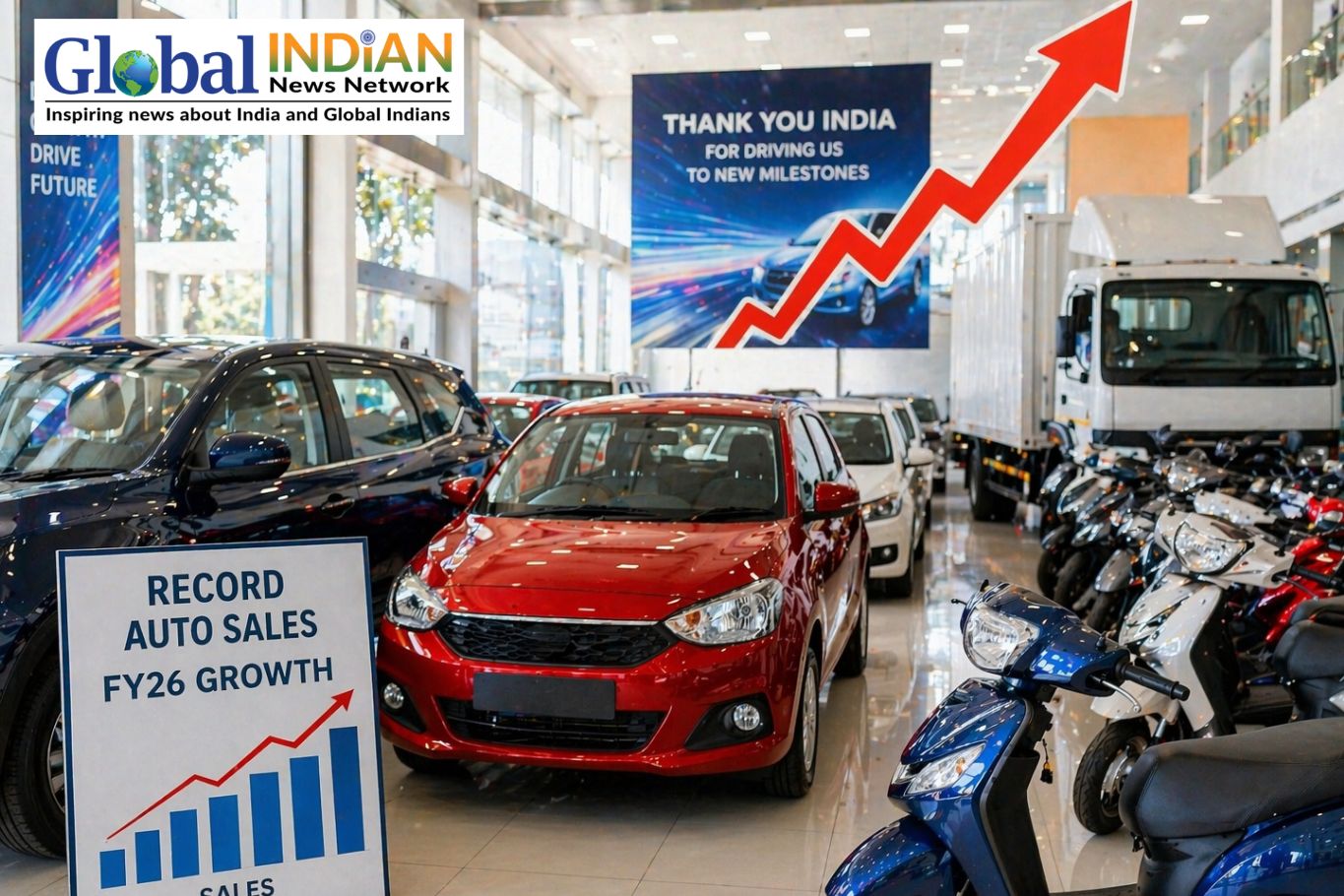
 India’s automobile industry achieved its highest-ever annual sales across all major vehicle categories in the financial year 2025–26, marking a strong recovery and expansion phase for the sector. The surge in demand was supported by recent policy measures such as GST 2.0 reforms, multiple reductions in repo rates, and revised income tax slabs, all of which improved affordability and boosted consumer confidence.
According to data from the Society of Indian Automobile Manufacturers, passenger vehicle sales increased by 8% to reach 4.64 million units during the year. Commercial vehicles recorded a growth of 12.6%, totaling 1.08 million units, while three-wheelers expanded by 12.8% to 0.84 million units. The two-wheeler segment, which represents the largest share of the market, rose by 10.7% to 21.71 million units, reflecting strong demand across both urban and rural regions.
Overall, FY26 marked the first time since FY19 that the Indian automobile industry registered record-breaking sales across categories. This milestone highlights a full-scale recovery from the pandemic-related slowdown and signals renewed momentum in domestic consumption and mobility demand.
Exports also played a major role in the sector’s growth story. Vehicle shipments across categories surged by 24% to 6.65 million units, strengthening India’s position as a key global manufacturing and export hub for automobiles. This expansion reflects increasing international demand for Indian-made vehicles and components, supported by competitive production capabilities and improving supply chain efficiency.
The strong performance of the automobile sector is expected to have wide-ranging effects on the broader economy. Rising vehicle demand is likely to drive fresh investments in areas such as auto components, electric vehicle systems, financing services, dealership networks, and rural transportation infrastructure. The sector also supports growth in allied industries including steel, tyres, batteries, electronics, and logistics.
Industry experts noted that although the year began on a relatively slow note, momentum picked up strongly due to improving financial conditions and supportive policy measures. Lower borrowing costs and tax relief contributed significantly to increased consumer spending on vehicles.
However, despite the positive outlook, industry stakeholders remain cautious about external risks, including geopolitical tensions and fluctuations in global commodity prices, particularly those linked to developments in West Asia. Overall, the FY26 performance underscores India’s growing strength as one of the world’s fastest-expanding automobile markets.