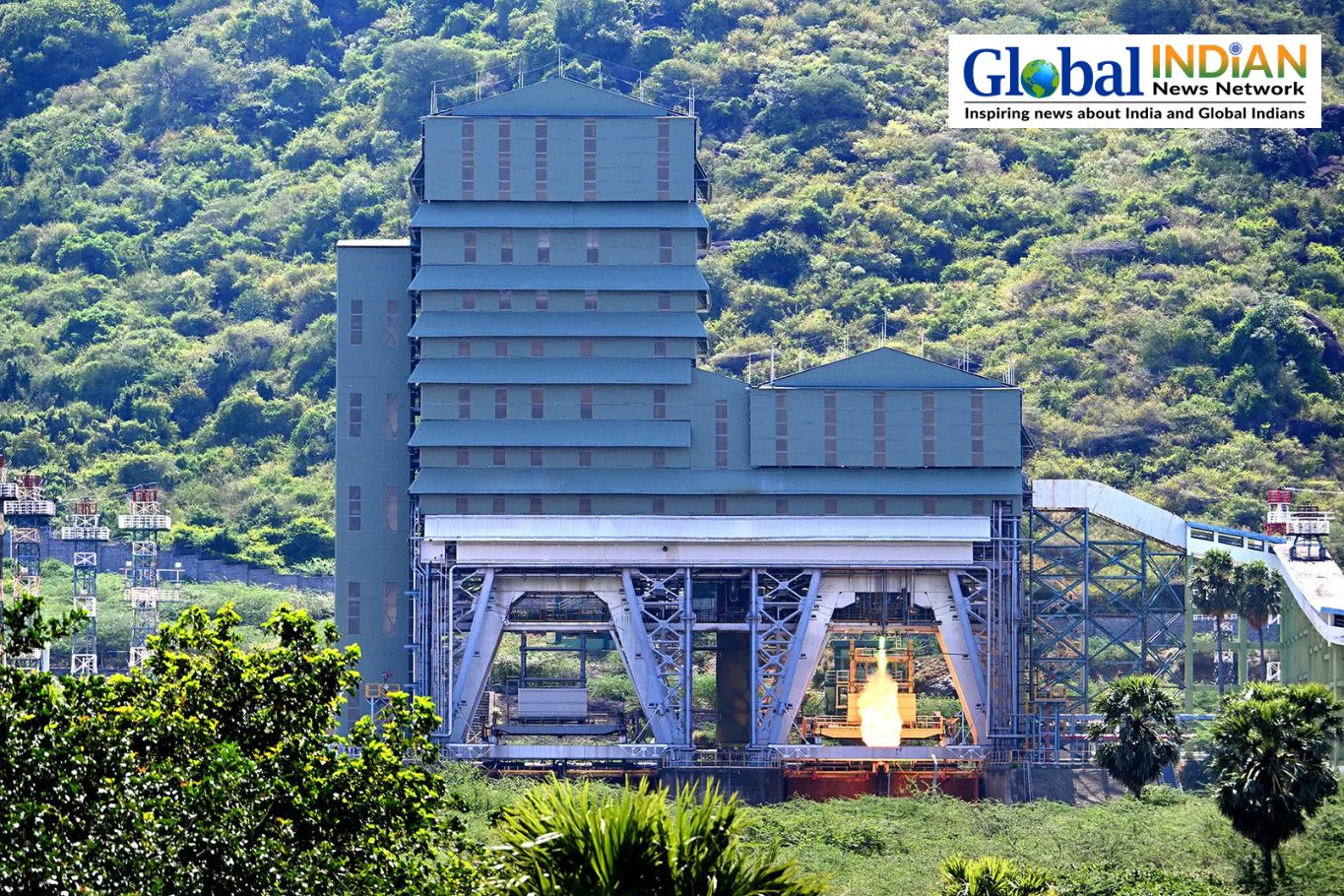
The Indian Space Research Organisation (ISRO) has successfully carried out a full-thrust test of the Power Head Test Article (PHTA) for its semi-cryogenic engine, marking another important milestone in the development of propulsion technology for India’s next-generation launch vehicles.
The test was conducted on September 5 at the ISRO Propulsion Complex in Mahendragiri, Tirunelveli district. During the hot test, the PHTA was operated at its maximum thrust level of 200 tons. The overall test lasted 35 seconds, with the engine power head running at the full 200-ton thrust for five seconds.
The test included all major engine components except the thrust chamber associated with the power head test article. ISRO said the parameters recorded throughout the test were in line with expectations.
This was the ninth hot test conducted as part of the PHTA testing series. Earlier trials had successfully demonstrated operation at 47% thrust, equivalent to 94 tons; 60% thrust, or 120 tons; and 88% thrust, corresponding to 175 tons. The latest trial was significant because it was the first time the system was tested at its full 100% thrust level of 200 tons.
The test also successfully demonstrated the transfer of fuel supply from a low-pressure starting tank to a medium-pressure operating tank. This capability is important for enabling longer-duration tests of the propulsion system in future development phases.
The semi-cryogenic propulsion technology is being developed for the SC120 stage, which will be powered by the 2,000-kilonewton SE2000 engine. The new stage is intended to replace the L110 core stage currently used on ISRO’s LVM3 rocket.
The SE2000 engine uses liquid oxygen and highly refined kerosene as propellants. Once integrated with the improved C32 cryogenic upper stage, the semi-cryogenic propulsion system is expected to increase the LVM3’s payload-carrying capability.
The successful full-thrust demonstration gives ISRO additional confidence in the performance of the power head and related systems as development progresses. The test series is part of the broader effort to develop more capable propulsion systems and enhance the performance of India’s future launch vehicles.