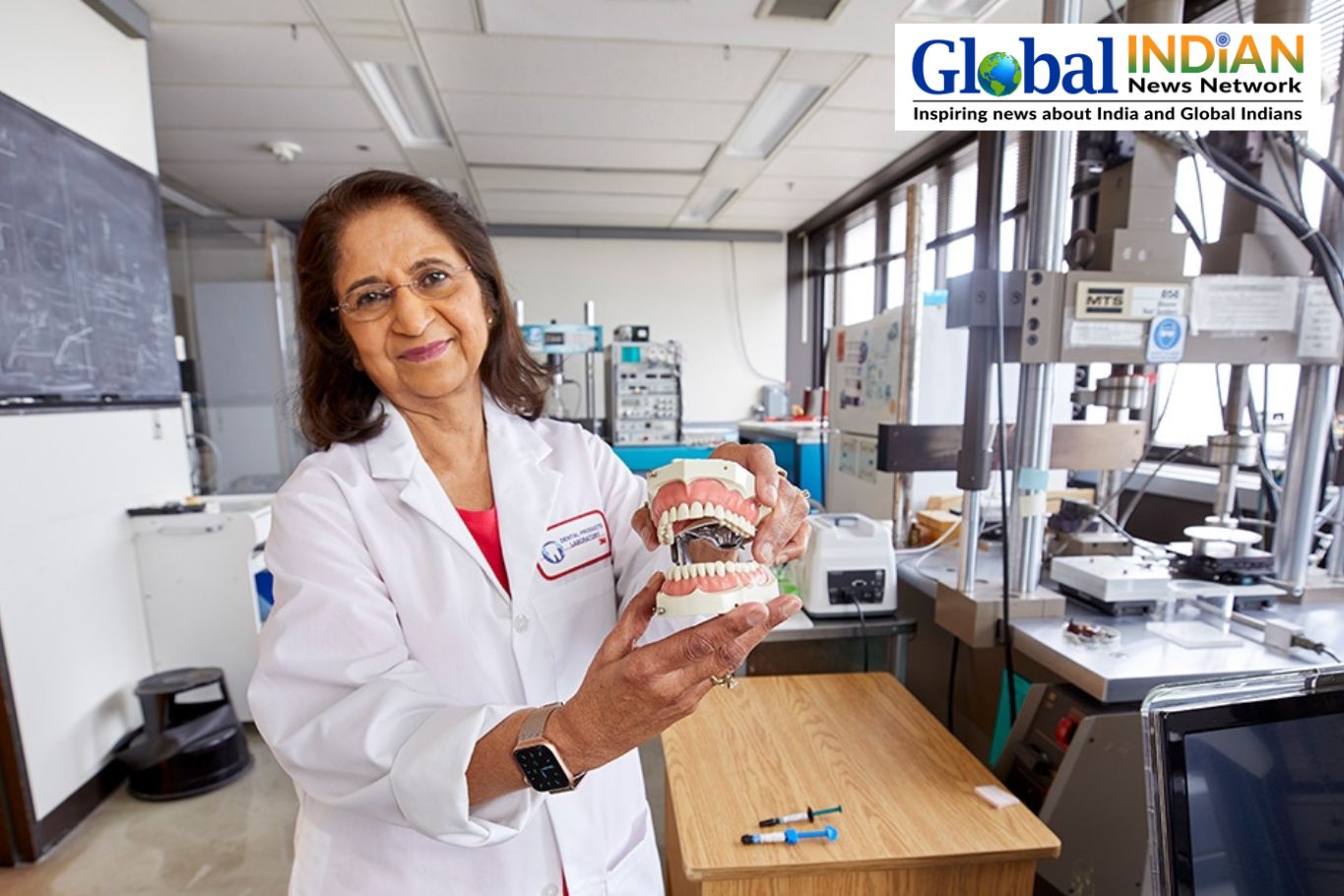
A simple observation of a cluster of grapes led Indian-American scientist and inventor Sumita Mitra to develop a revolutionary dental material that changed modern tooth restoration. Her nanotechnology-based innovation has helped restore more than 1 billion teeth worldwide and has become a landmark achievement in dental care.
While working at 3M’s Dental Products Division in the 1990s, Mitra focused on solving a long-standing challenge faced by dentists. Existing tooth-colored filling materials often required compromises. Some offered excellent strength but became rough over time, while others provided a smoother and more natural appearance but lacked the durability needed for areas exposed to heavy chewing.
Mitra believed patients needed a universal dental material that could combine strength, durability, and a natural appearance. Her breakthrough came when she noticed how a bunch of grapes remained structurally connected even after one grape was removed. The idea inspired her to rethink how nanoparticles could be arranged.
Instead of using particles of the same size, Mitra developed the concept of nanoclusters — groups of tiny particles designed to work together while maintaining flexibility and strength. This approach became the foundation for a new type of dental composite material.
Working with her colleagues at 3M, Mitra combined silica nanoparticles for improved bonding with zirconia nanoparticles to provide visibility during dental X-rays. These materials were integrated with resin to create a strong and realistic-looking dental restoration solution.
The research process involved years of testing and collaboration with experts, including researchers at the University of Minnesota’s Minnesota Dental Research Center for Biomaterials and Biomechanics. Advanced evaluation techniques helped the team identify formulations that could meet the demanding requirements of dental applications.
In 2002, 3M introduced Mitra’s innovation commercially as Filtek Supreme Restorative. The technology later evolved into a wider family of dental products with improved appearance, durability, and performance. According to 3M, these materials have since been used in restoring more than one billion teeth across the world.
Mitra’s achievement has earned recognition from leading scientific and innovation organizations. In 2018, she was inducted into the National Inventors Hall of Fame. She was later elected to the National Academy of Engineering, became a Fellow of the National Academy of Inventors, and received the European Inventor Award.
Born in Kolkata, India, Mitra developed her curiosity for science at an early age, influenced by her parents and her exposure to laboratory work. She later moved to the United States, earned her doctorate in organic/polymer chemistry from the University of Michigan, and built a successful career focused on creating practical innovations.
Even after retiring from 3M, Mitra continues mentoring young scientists and encouraging innovation. Her journey demonstrates how curiosity, persistence, and scientific thinking can transform a simple idea into a global breakthrough that improves millions of lives.