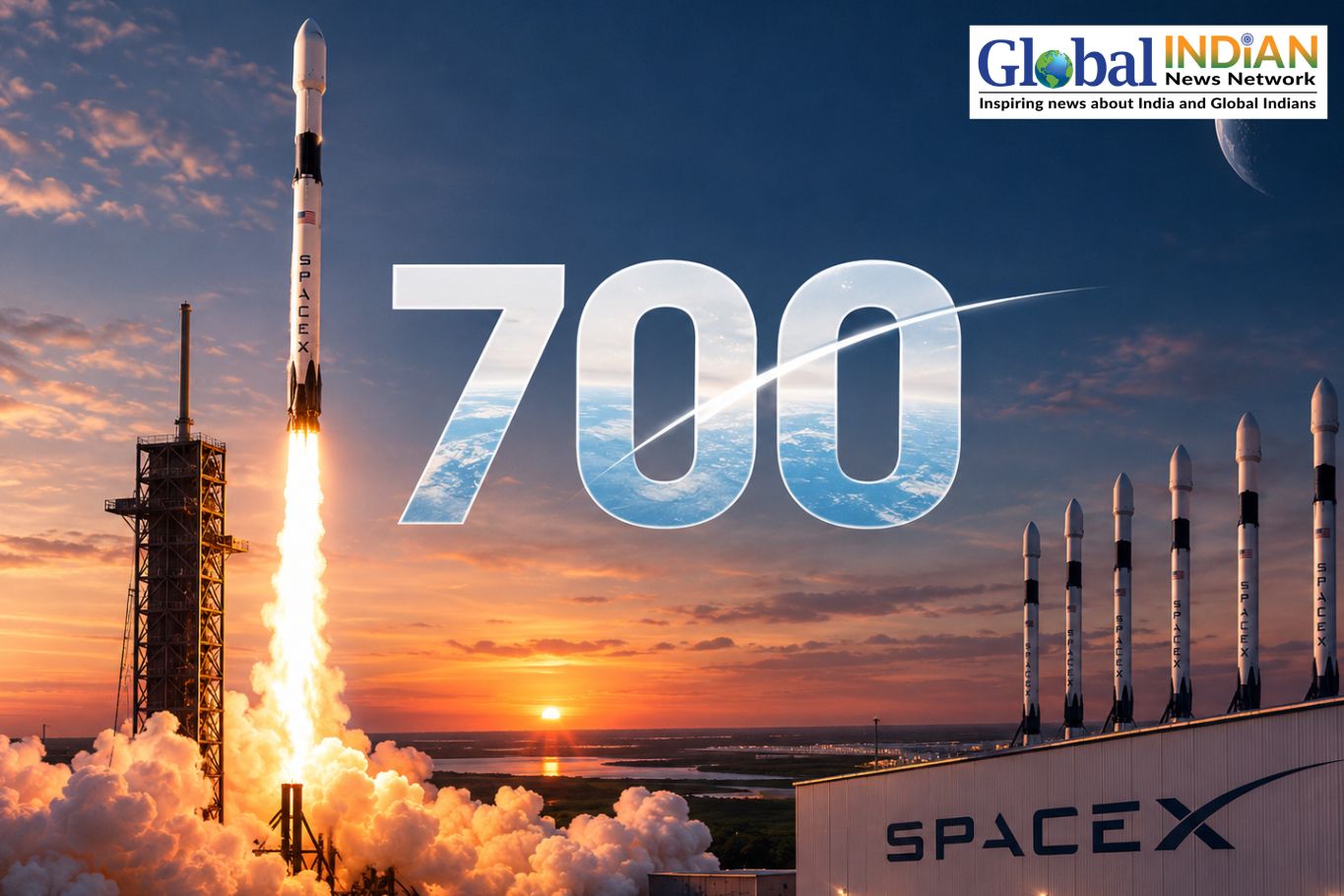
 SpaceX has reached a major milestone in its launch history, completing the 700th mission involving its Falcon rocket family. A Falcon 9 lifted off from Cape Canaveral, Florida, on Monday carrying three telecommunications satellites for Luxembourg-based satellite operator SES.
The milestone reflects nearly two decades of Falcon development, beginning with the Falcon 1’s first launch in March 2006. Since then, SpaceX has operated three Falcon variants: Falcon 1, Falcon 9 and Falcon Heavy. Together, they have completed 700 missions, with Falcon 9 accounting for 685 launches.
Monday’s flight was also Falcon 9’s 105th launch of 2026. The rocket deployed three satellites intended for SES’s O3b mPower network, which operates in medium Earth orbit at an altitude of approximately 8,000 kilometers.
A key feature of the mission was the recovery of Falcon 9’s first-stage booster. Roughly nine minutes after liftoff, the reusable stage returned to Earth and landed on a SpaceX droneship positioned in the Atlantic Ocean. The booster had already flown 28 missions before Monday’s launch, bringing its total to 29 flights.
Falcon 9’s reusability has become central to SpaceX’s approach to space transportation. First introduced in 2010, the rocket demonstrated that portions of an orbital launch vehicle could be recovered and flown repeatedly. This approach has contributed to a substantial increase in launch frequency while reducing the cost associated with repeated missions.
The road to the 700-mission milestone began with Falcon 1, whose first three launches ended unsuccessfully. The fourth attempt in September 2008 finally placed the rocket into orbit. Falcon 1 completed one additional successful flight before SpaceX moved its attention toward the more powerful Falcon 9.
Falcon 9 subsequently became a major part of SpaceX’s operations. In 2012, it became the first commercial spacecraft to deliver cargo to the International Space Station, helping establish SpaceX as a NASA contractor. The rocket has since carried astronauts to the ISS, Starlink satellites and commercial spacecraft for customers around the world, including Indian space startups such as Dhruva Space, Pixxel and Digantara.
Falcon Heavy, introduced in 2018, expanded SpaceX’s launch capacity by combining Falcon 9-derived components to carry heavier payloads. It can transport up to about 63,000 kilograms to low Earth orbit and has completed 13 flights.
As the Falcon family reaches 700 missions, SpaceX is developing Starship, a fully reusable two-stage system designed to eventually handle many missions now performed by Falcon 9 and Falcon Heavy. Standing about 123 meters tall, Starship is being developed for future missions involving the Moon and Mars.