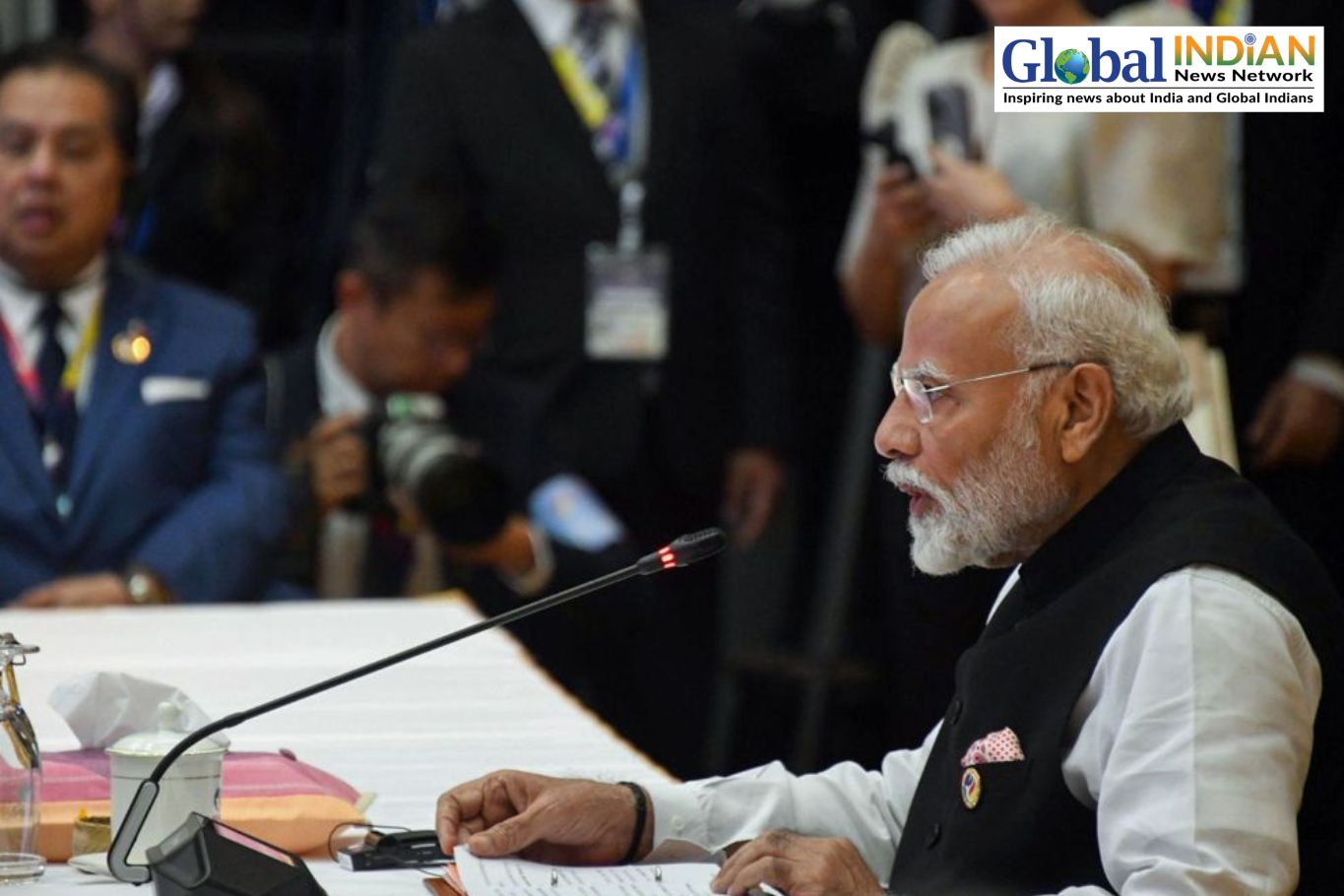
Prime Minister Narendra Modi will visit Manila, the capital of the Philippines, to participate in the 23rd ASEAN-India Summit and the 21st East Asia Summit (EAS), as India looks to strengthen its strategic, economic and diplomatic engagement with Southeast Asia and the wider Indo-Pacific region.
According to an official announcement by the Prime Minister’s Office, Modi will visit the Philippines from November 16 to 17 at the invitation of Philippine President Ferdinand R. Marcos Jr. The two summits are scheduled for November 17 as part of the 49th Association of Southeast Asian Nations (ASEAN) Summit and Related Summits.
The Ministry of External Affairs (MEA), during a special briefing, outlined the significance of Modi’s participation in the regional meetings. Secretary (East) Rudrendra Tandon said India’s engagement with ASEAN remains an important pillar of its Act East Policy and its broader vision for the Indo-Pacific.
The ASEAN-India Summit will review progress in implementing the Comprehensive Strategic Partnership, including the ASEAN-India Plan of Action for 2026-2030. Leaders will also discuss future areas of cooperation and ways to strengthen economic and strategic relations.
The year 2026 is being observed as the ASEAN-India Year of Maritime Cooperation, reflecting the importance both sides attach to maritime connectivity, regional stability and cooperation across the Indo-Pacific. India and ASEAN will also mark 35 years of dialogue relations and five years of their Comprehensive Strategic Partnership in 2027.
Following the ASEAN-India Summit, Modi will participate in the 21st East Asia Summit, an ASEAN-led platform that brings together regional leaders and major international partners to discuss strategic, political, economic and security issues.
The East Asia Summit provides an opportunity for participating countries to exchange views on regional and global developments, including maritime security, geopolitical tensions, economic resilience and regional stability.
The Philippines, under President Ferdinand Marcos Jr., is hosting the summit under the theme “Navigating Our Future, Together”. The agenda reflects ASEAN’s focus on strengthening collective resilience and enhancing cooperation in response to changing regional and international circumstances.
According to the Philippine Department of Foreign Affairs, at least 19 world and international institution leaders are expected to participate in the summit and related meetings. The gathering will begin with an opening ceremony at the Philippine International Convention Center, followed by plenary and retreat sessions.
The discussions are expected to cover several pressing regional challenges, including the situation in Myanmar, food and energy security, economic uncertainties, regional stability and cooperation against transnational crime.
The summit will also provide opportunities for engagement with representatives of the business community, youth organisations and ASEAN parliamentary institutions.
Several major global leaders are expected to participate in the wider summit process, reflecting ASEAN’s growing importance as a platform for international dialogue. China, Japan, South Korea, Australia, India, New Zealand, Russia and the United States are among the external partners involved in the related meetings.
Chinese Premier Li Qiang is also expected to attend the China-ASEAN leaders’ engagement, while US President Donald Trump and United Nations Secretary-General Antonio Guterres have been reported among the high-profile international participants.
The Philippine government has highlighted the participation of global leaders as an indication of ASEAN’s continuing role in facilitating dialogue and cooperation beyond Southeast Asia.
For India, Modi’s participation carries particular significance as New Delhi seeks to deepen its strategic partnerships, expand trade and investment opportunities and strengthen connectivity with ASEAN member countries.
India’s engagement with ASEAN has become an important component of its regional foreign policy, particularly in the context of the Indo-Pacific. Cooperation in maritime security, digital technology, infrastructure, education, trade and people-to-people exchanges remains central to the partnership.
The MEA has also indicated that the Prime Minister’s programme may include an interaction with members of the Indian community in the Philippines. The Indian diaspora has expressed considerable interest in meeting Modi during his visit, and officials are working to accommodate the engagement in his schedule.
The visit is expected to reinforce India’s commitment to ASEAN centrality and its efforts to build stronger regional partnerships through diplomatic dialogue, economic cooperation and strategic engagement.
As Manila prepares to welcome leaders from across the world, the 49th ASEAN Summit will offer India another important opportunity to advance its Act East Policy and strengthen its role in shaping the future of regional cooperation.