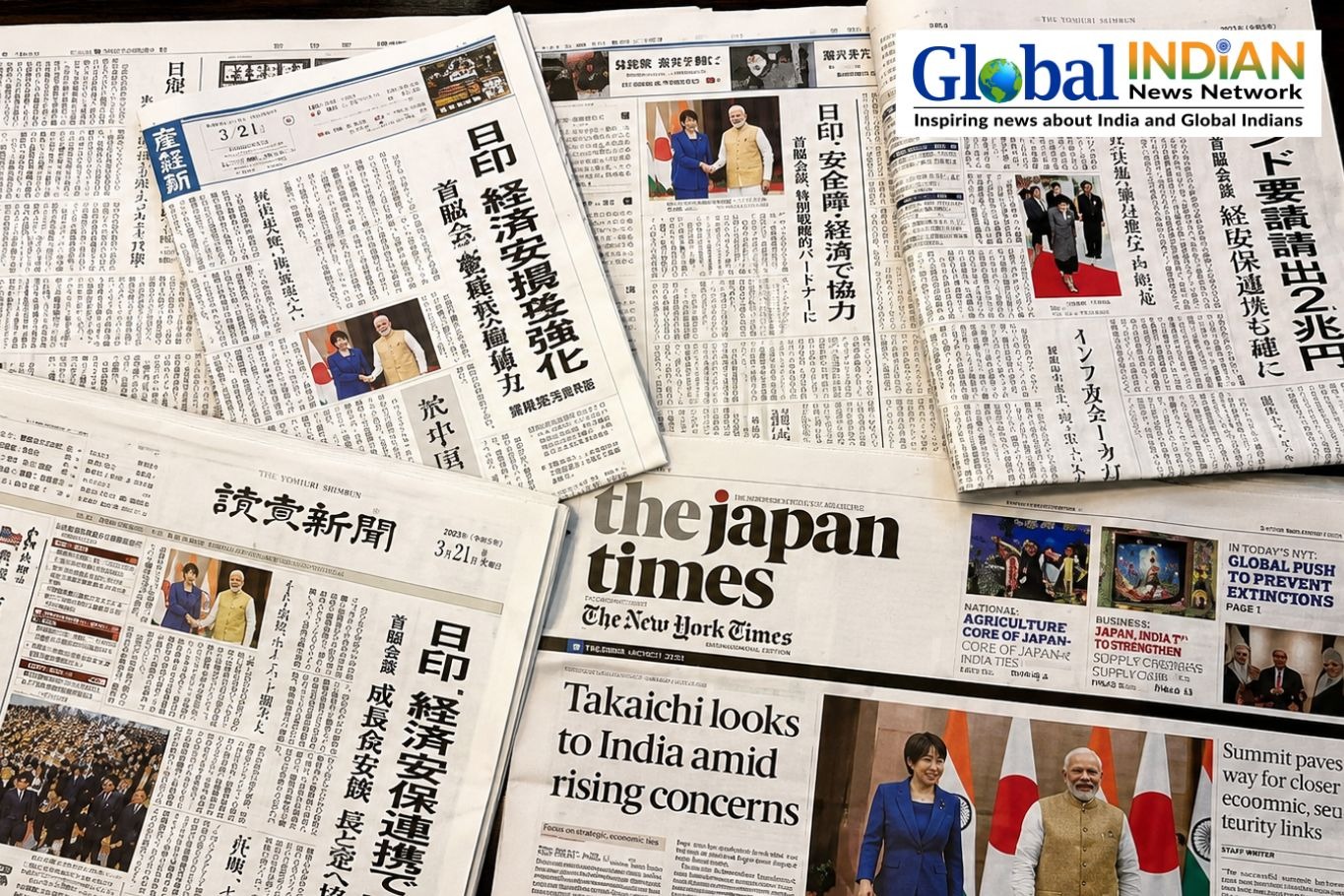
 Japanese media outlets have praised the outcome of the 16th India-Japan Annual Summit, emphasizing the growing strategic partnership between the two countries. Reports across leading publications described the meeting in New Delhi as a significant step toward expanding cooperation in security, economic resilience, defense technology, and regional stability across the Indo-Pacific.
Prime Minister Narendra Modi and Japanese Prime Minister Sanae Takaichi held extensive discussions covering a broad range of bilateral issues. Their talks focused on strengthening collaboration in key sectors, including supply chain resilience, critical minerals, maritime security, clean energy, and advanced defense capabilities. The summit reflected both countries’ commitment to building a stronger partnership amid evolving geopolitical and economic challenges.
According to The Japan Times, Japan views India as an increasingly important partner as it seeks to diversify supply chains and reduce vulnerabilities created by regional tensions. The report noted that concerns over China’s growing influence, export restrictions on dual-use goods, and pressure on Japanese companies have encouraged Tokyo to deepen economic and strategic engagement with India, whose expanding manufacturing sector and skilled workforce make it an attractive long-term partner.
Kyodo News also highlighted India’s central role in Japan’s vision for a free and open Indo-Pacific. The publication noted that Tokyo continues to strengthen ties with New Delhi as relations between Japan and China remain strained, particularly over trade restrictions and broader regional security concerns.
The two leaders agreed to expand cooperation on economic security by ensuring more reliable access to energy resources and critical minerals. During their approximately 90-minute meeting, they also reached a broad understanding on Japan’s transfer of Unicorn communication antenna technology to India, a move expected to enhance defense collaboration and support India’s domestic manufacturing initiatives.
Japan’s Ministry of Foreign Affairs stated that both governments reaffirmed their commitment to the revised Joint Declaration on Security Cooperation. The agreement includes expanding joint military training in the Indian Ocean, enhancing naval maintenance collaboration, and increasing cooperation on defense equipment and technology under India’s “Make in India” program. Officials were also instructed to organize the next India-Japan “2+2” ministerial dialogue later this year.
Following the formal summit, Prime Minister Modi hosted an informal dinner for Prime Minister Takaichi, where the leaders discussed bilateral relations, global developments, and cultural exchanges in a relaxed setting. Japan’s Prime Minister’s Office described the discussions as warm and constructive, saying they further strengthened the personal trust between the two leaders while reinforcing the long-term strategic partnership between India and Japan.