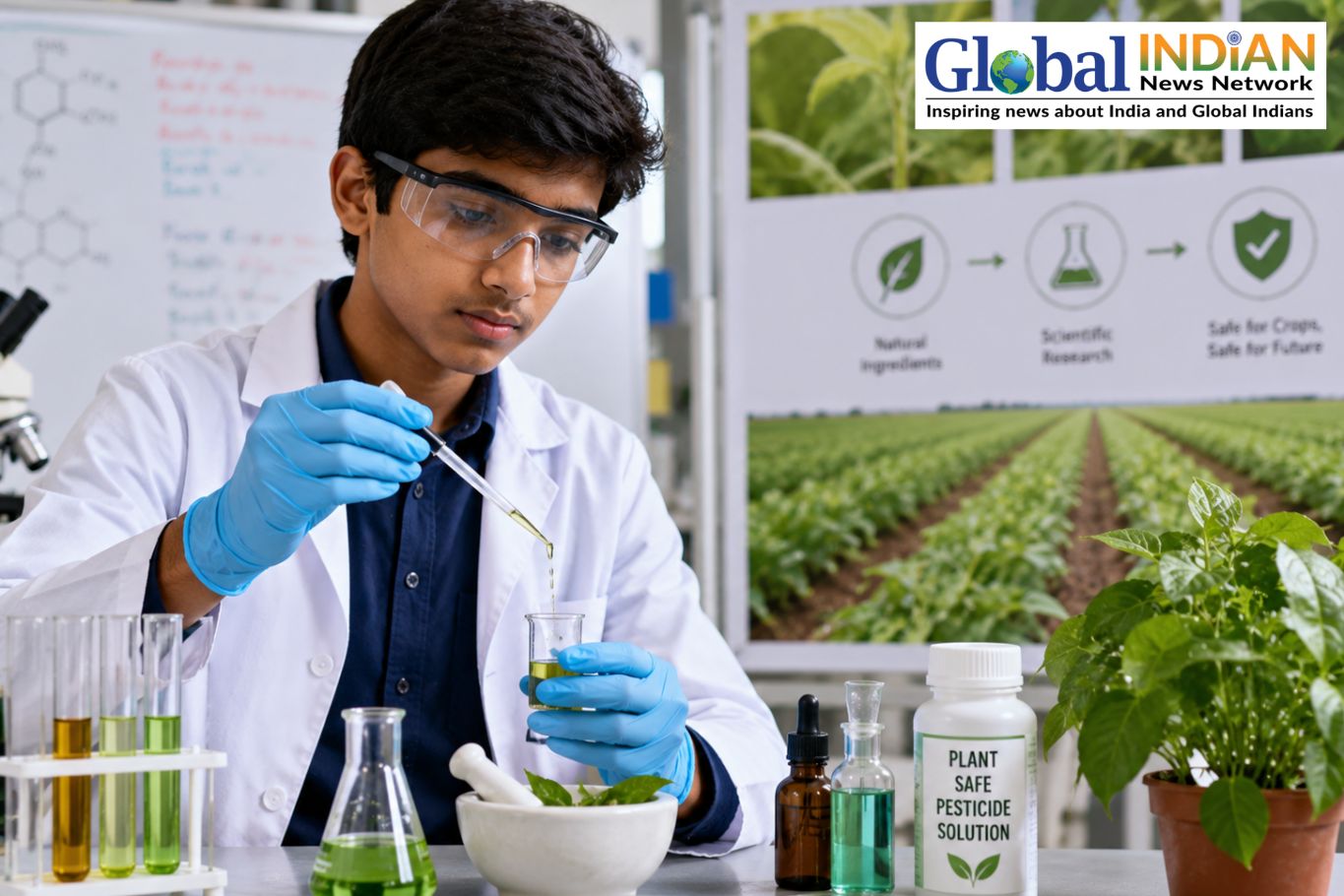
 A 13-year-old Indian-American student has developed an innovative approach to reducing pesticide residues on fruits and vegetables by transforming discarded peanut shells into a natural cleaning material. Arika Kundu, a seventh-grade student at Minnetonka Middle School East in Shorewood, Minnesota, created the project called “LIGNEX,” which uses agricultural waste to address a common food safety concern.
Kundu’s invention has earned her a place among the 10 finalists in the 2026 3M Young Scientist Challenge, a national competition that recognizes middle school students between the ages of 11 and 14 for developing science-based solutions to real-world problems. As a finalist, she will work with a 3M scientist before competing in the final round, where she will have the opportunity to win a $25,000 grand prize and the title of America’s Top Young Scientist.
The idea behind LIGNEX came from Kundu’s interest in finding a sustainable way to reduce chemical residues on fresh produce. While washing fruits and vegetables can remove dirt and some surface contaminants, it may not completely eliminate pesticide traces. To address this challenge, Kundu explored the potential of peanut shells, which are often discarded after agricultural processing.
Using a process known as biosorption, Kundu developed a material from peanut shells that can attract and capture pesticide residues from the surface of produce. The natural material works similarly to a filter, binding unwanted chemicals and potentially lowering the amount of pesticide residue remaining on fruits and vegetables.
Beyond improving food safety, the project also promotes environmental sustainability by giving new value to agricultural waste. By repurposing peanut shells that would otherwise be thrown away, Kundu’s innovation supports waste reduction and encourages the use of natural materials for practical solutions.
Kundu said she joined the 3M Young Scientist Challenge to further improve her invention and transform it into a product that could benefit people globally. She hopes that guidance from scientists and experts during the competition will help her refine the technology.
The young innovator, who previously received the Minnesota State Merit Award, has expressed interest in becoming an astrobiologist specializing in computational biology in the future. Her achievement highlights the growing impact of young Indian-American innovators in STEM fields and demonstrates how students are using creativity and scientific thinking to solve important challenges.
The 2026 competition features several talented young finalists from across the United States, showcasing the next generation of scientists working on solutions related to sustainability, technology, and everyday life improvements.