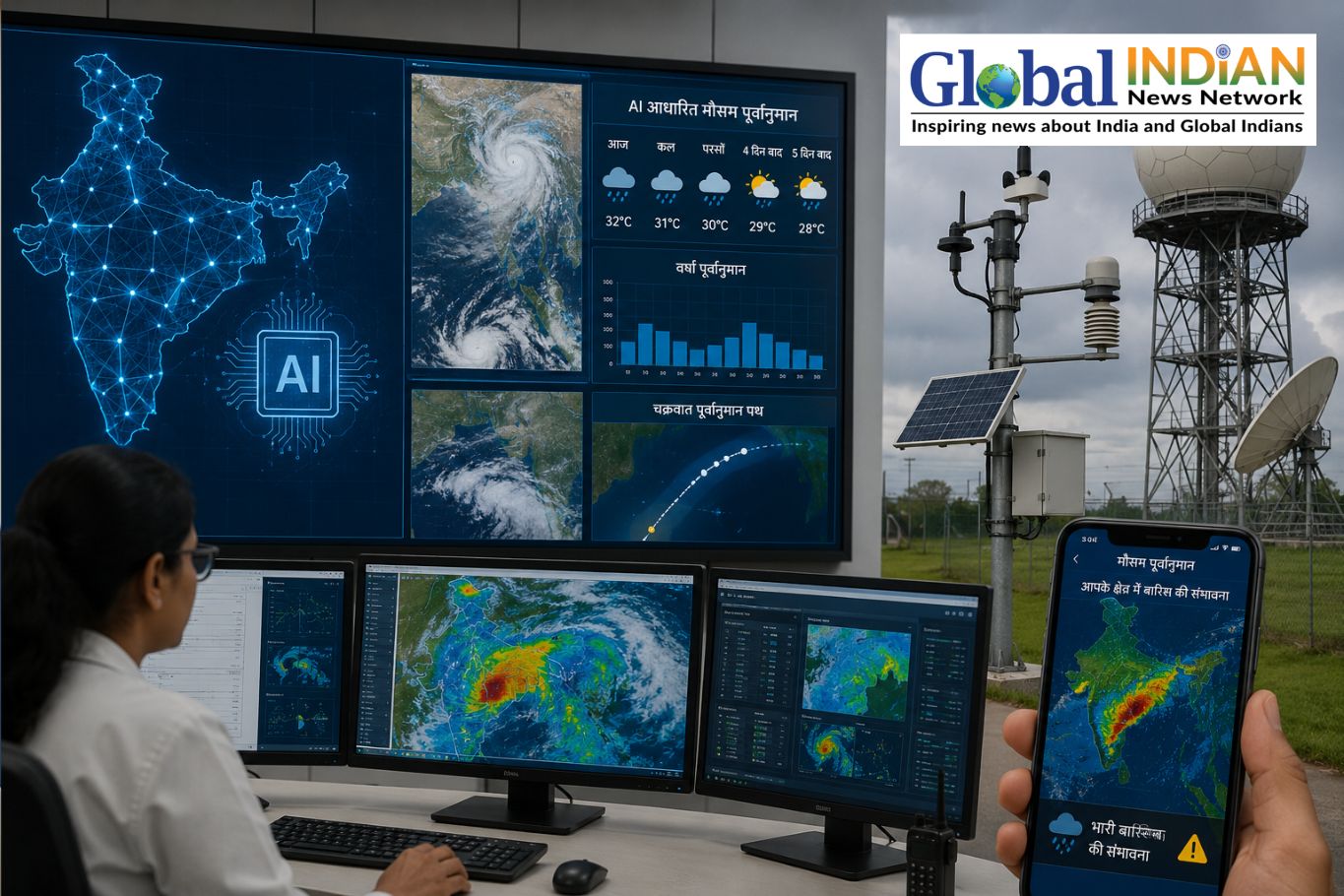
 India has significantly advanced its meteorological capabilities by introducing two artificial intelligence-based weather forecasting systems aimed at improving accuracy and delivering localized climate insights. The initiative, launched by the Ministry of Earth Sciences, was unveiled by Union Minister Dr. Jitendra Singh and focuses on enhancing monsoon prediction and high-resolution rainfall forecasting.
The first system, titled “Forecast of Monsoon Advance over Different Parts of the Country,” is designed to provide data-driven predictions on the movement of the monsoon across India. It will generate updated forecasts every Wednesday, extending up to four weeks in advance. The system will cover 16 states and more than 3,000 sub-districts, offering detailed insights intended to support agricultural planning and policy decisions.
The second initiative is a pilot project focused on Uttar Pradesh, which will deliver rainfall forecasts at an extremely detailed 1-kilometer spatial resolution. These predictions can extend up to 10 days ahead and use advanced artificial intelligence-based downscaling methods. The system integrates multiple data sources, including Doppler Weather Radars, Automatic Rain Gauges, Automatic Weather Stations, and satellite observations to improve precision.
Both forecasting systems have been jointly developed by the India Meteorological Department, the Indian Institute of Tropical Meteorology in Pune, and the National Centre for Medium Range Weather Forecasting. Together, these institutions aim to transition India’s weather services from traditional forecasting methods to impact-based decision-support systems.
According to Dr. Jitendra Singh, India has already achieved nearly a 40 percent improvement in the accuracy of severe weather forecasts over the past decade. The government is continuing to strengthen its meteorological infrastructure through initiatives such as Mission Mausam, expanded radar networks, and upgraded high-performance computing systems.
The new AI-powered tools are expected to play a crucial role in multiple sectors, including agriculture, water resource management, renewable energy planning, disaster response, and infrastructure development. By providing more localized and timely weather insights, the initiative aims to improve climate resilience and support better decision-making at both local and national levels.