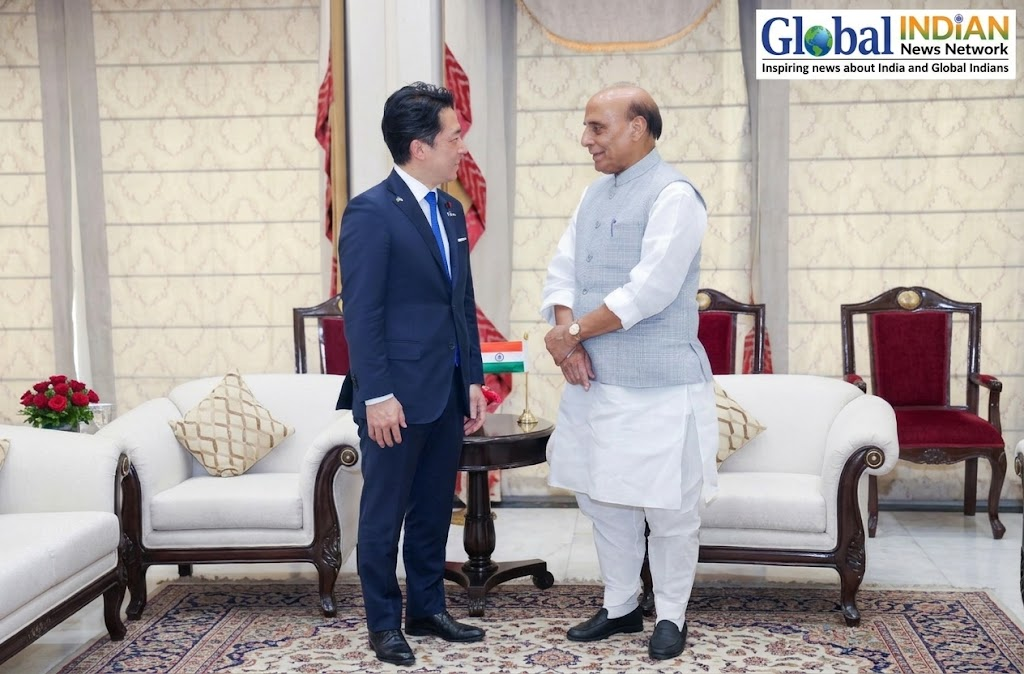
India and Japan have taken another step toward strengthening their strategic and defense partnership, signing a new agreement focused on maritime security and expanding cooperation between their armed forces. The development came during talks in New Delhi between Indian Defence Minister Rajnath Singh and Japanese Defence Minister Shinjiro Koizumi on August 20.
The two countries signed a Memorandum of Arrangement covering maritime security cooperation and agreed to expand practical coordination in several areas. These include information sharing, naval exercises, logistics assistance, ship maintenance and repair, and closer operational engagement between the Indian Navy and the Japan Maritime Self-Defense Force.
During their meeting, the ministers reaffirmed their commitment to the India-Japan Special Strategic and Global Partnership. They also emphasized their shared interest in maintaining a free and open Indo-Pacific at a time of growing geopolitical tensions.
Both sides voiced opposition to unilateral measures that could threaten freedom of navigation and overflight. They also rejected efforts to alter existing conditions through force or coercion, underscoring their common interest in maintaining stability and security across the region.
The new maritime arrangement will provide a framework for cooperation in Maritime Domain Awareness, search-and-rescue operations, and humanitarian assistance and disaster relief. India and Japan also plan to improve coordination aimed at protecting important Sea Lines of Communications through reciprocal port visits, joint exercises and exchanges involving military personnel and specialists.
Logistical cooperation will receive greater attention, including access to ports as well as maintenance and repair facilities. The countries also plan to explore collaboration on mine countermeasures and potential joint work in naval ship design and construction. Japan’s technological expertise could complement India’s manufacturing capabilities under the Make in India initiative.
Military exercises between the two countries are also set to become more sophisticated. The ministers welcomed continued cooperation through exercises such as Dharma Guardian and JAIMEX, along with the planned Veer Guardian 26 air exercise. Japanese fighter aircraft are expected to participate in an exercise in India for the first time. Both nations also intend to incorporate unmanned systems and consider exercises that can be organized at short notice.
India and Japan further agreed to expand cooperation between their Special Operations Forces and explore collaboration with India’s integrated theater commands once they are established.
Defense technology cooperation is another major component of the partnership. Singh welcomed Japan’s recent review of its framework for defense equipment and technology transfers. The two sides highlighted the shipborne UNICORN integrated communications antenna system as an important example of their growing technological relationship.
India’s Defence Research and Development Organisation and Japan’s Acquisition, Technology & Logistics Agency are expected to deepen work on advanced defense technologies. A new Defence Industry Forum will also provide a platform for closer industrial engagement.
To coordinate these initiatives, both countries agreed to establish a working group covering operational, intelligence, equipment, technology and industrial cooperation. They also agreed to speed up preparations for the fourth India-Japan “2+2” Foreign and Defence Ministerial Dialogue, scheduled to take place in Tokyo later this year.