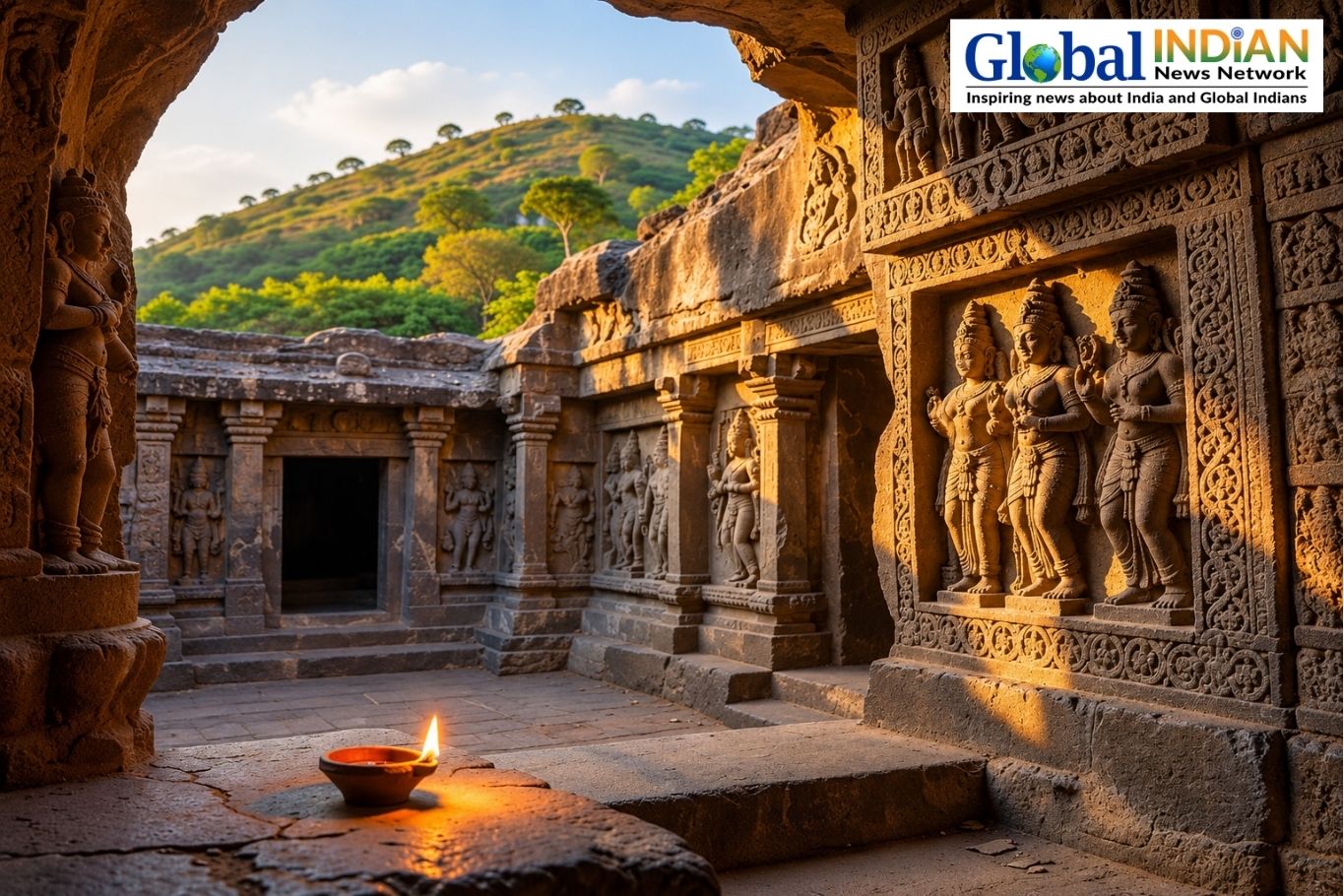
India has added five new heritage nominations to its UNESCO Tentative List, expanding the country’s portfolio of sites being considered for potential World Heritage recognition. The additions include four cultural sites in Madhya Pradesh and a joint India-South Africa proposal documenting the historical development of Mahatma Gandhi’s Satyagraha movement. According to the Press Information Bureau’s Culture division, the latest inclusions bring India’s Tentative List to 78 sites.
The newly nominated locations in Madhya Pradesh are the Bagh Cave Paintings, the Group of Temples of the Chambal Valley, Udaigiri Caves, and Ginnorgarh Fort. Each represents a different aspect of the region’s architectural, religious, artistic, and political history.
Located in Madhya Pradesh, the Udaigiri Caves feature a collection of rock-cut religious structures developed primarily under Gupta patronage between the late fourth and early fifth centuries. The complex comprises 20 excavated caves, sculptural panels, inscriptions, ancient markings, pathways, and associated natural features. Together, these elements illustrate the site’s historical significance as an integrated religious landscape.
The Bagh Caves, situated along the Baghni River on the southern slopes of the Vindhyan range, consist of nine rock-cut Buddhist caves. Their location in a predominantly basaltic region, where sandstone is unusually exposed, influenced their architectural design and helped shape the preservation of their mural paintings.
The other two nominations highlight the region’s historical and architectural heritage. Ginnorgarh Fort served as the principal fortified capital of the former Raj Gond rulers in central India. Meanwhile, the Chambal Valley temple nomination encompasses the Bateshwar, Padavali, and Kakarmath temple complexes.
The fifth addition is a proposed transnational heritage property tracing Satyagraha’s evolution from its origins in South Africa to its development and institutionalization in India. The nomination comprises nine sites: two in South Africa and seven in India. The South African locations are Pietermaritzburg Station and Phoenix Settlement. The Indian sites include Mahatma Gandhi Satyagraha Smarak, Sabarmati Ashram, Mani Bhavan, Harijan Sevak Sangh, Sevagram Ashram, Aga Khan Palace, and Gandhi Smriti.
Collectively, these locations document Satyagraha’s progression from resistance to racial discrimination to community-based nonviolence and large-scale civil disobedience. They also reflect how Gandhi’s philosophy became embedded in organized movements and institutions.
Placement on UNESCO’s Tentative List is an important preliminary step toward World Heritage consideration. The new nominations recognize the historical, cultural, and international dimensions of India’s heritage, while the Satyagraha proposal highlights the shared legacy connecting India and South Africa.