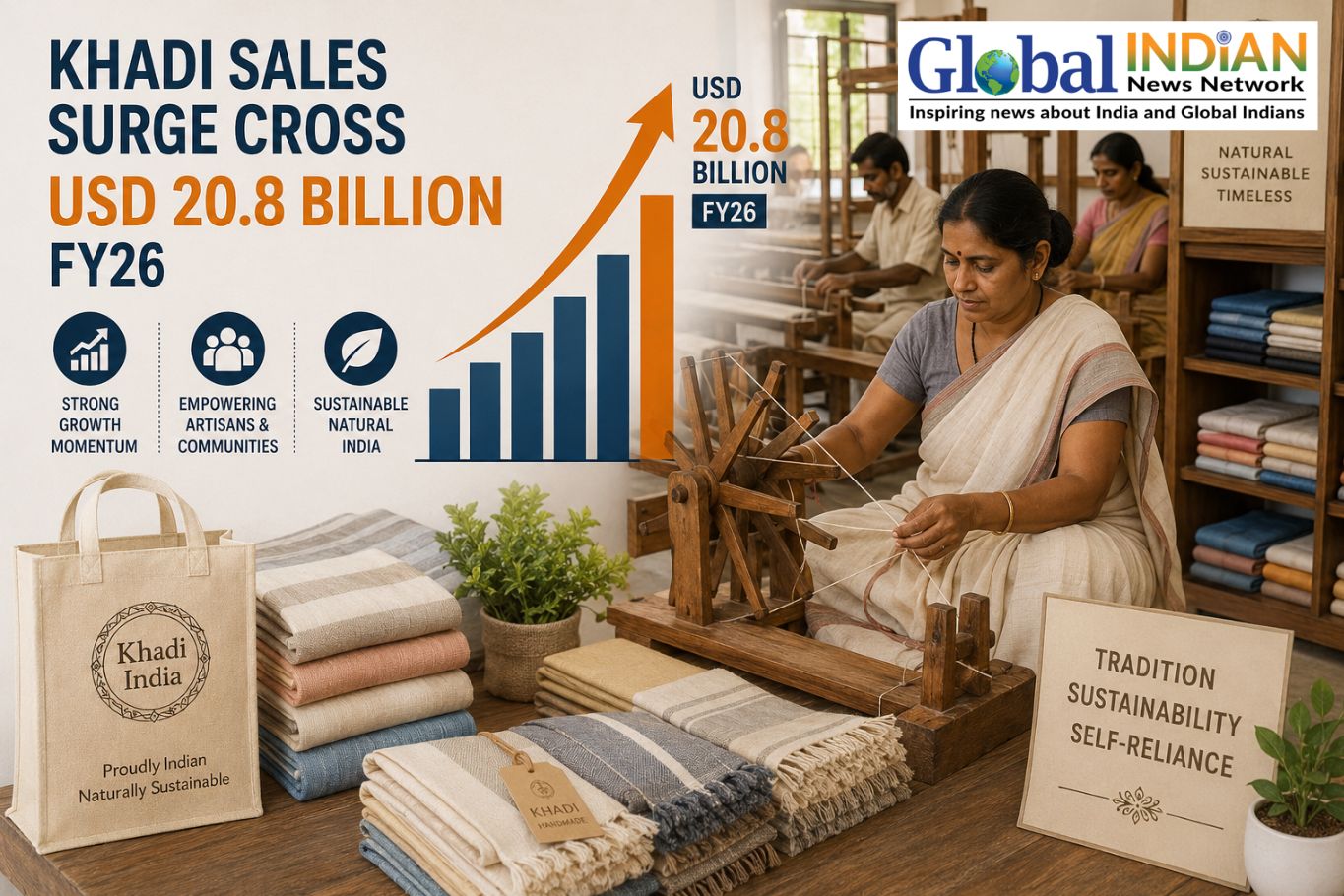
 India’s Khadi and Village Industries sector has delivered record-breaking performance in the financial year 2025-26, reflecting strong expansion in rural manufacturing, employment generation, and domestic demand. The sector’s total sales reached approximately USD 20.80 billion, marking an all-time high and highlighting the growing economic impact of India’s traditional and village-based industries.
Production also saw a significant rise, reaching about USD 13.96 billion during the same period. Compared to 2013-14, overall sales have increased by more than 500%, while production has grown by nearly 380%. This rapid growth has been supported by government-led initiatives such as Aatmanirbhar Bharat, Vocal for Local, and Local to Global, which aim to strengthen domestic production and promote Indian-made products in wider markets.
Within the segment, Khadi textiles recorded strong expansion, with sales rising from around USD 177.2 million in 2013-14 to approximately USD 876 million in 2025-26. Village industries, which form the backbone of rural manufacturing, contributed the largest share, with sales reaching nearly USD 19.96 billion. This reflects increasing market access and improved demand for rural products across the country.
Employment generation has also shown steady growth. Total jobs in the Khadi and Village Industries sector increased from about 13 million in 2013-14 to more than 20.4 million in 2025-26. This rise indicates the sector’s growing role in supporting livelihoods, especially in rural and semi-urban regions.
Under the Prime Minister’s Employment Generation Programme (PMEGP), nearly 66,494 new enterprises were established in 2025-26. These units were supported through subsidies amounting to roughly USD 274 million, backed by loans worth about USD 820 million. Collectively, these initiatives generated employment opportunities for over 731,000 people during the year, reinforcing entrepreneurship at the grassroots level.
The Khadi and Village Industries Commission (KVIC) also expanded its support for artisans through the distribution of modern tools and machinery under various development schemes. Skill development programs saw strong participation, with women making up nearly 59% of trainees, reflecting increasing female participation in rural entrepreneurship and economic activities.
Overall, the sector’s performance in FY26 highlights a strong push toward self-reliance, rural industrialization, and inclusive economic growth across India.