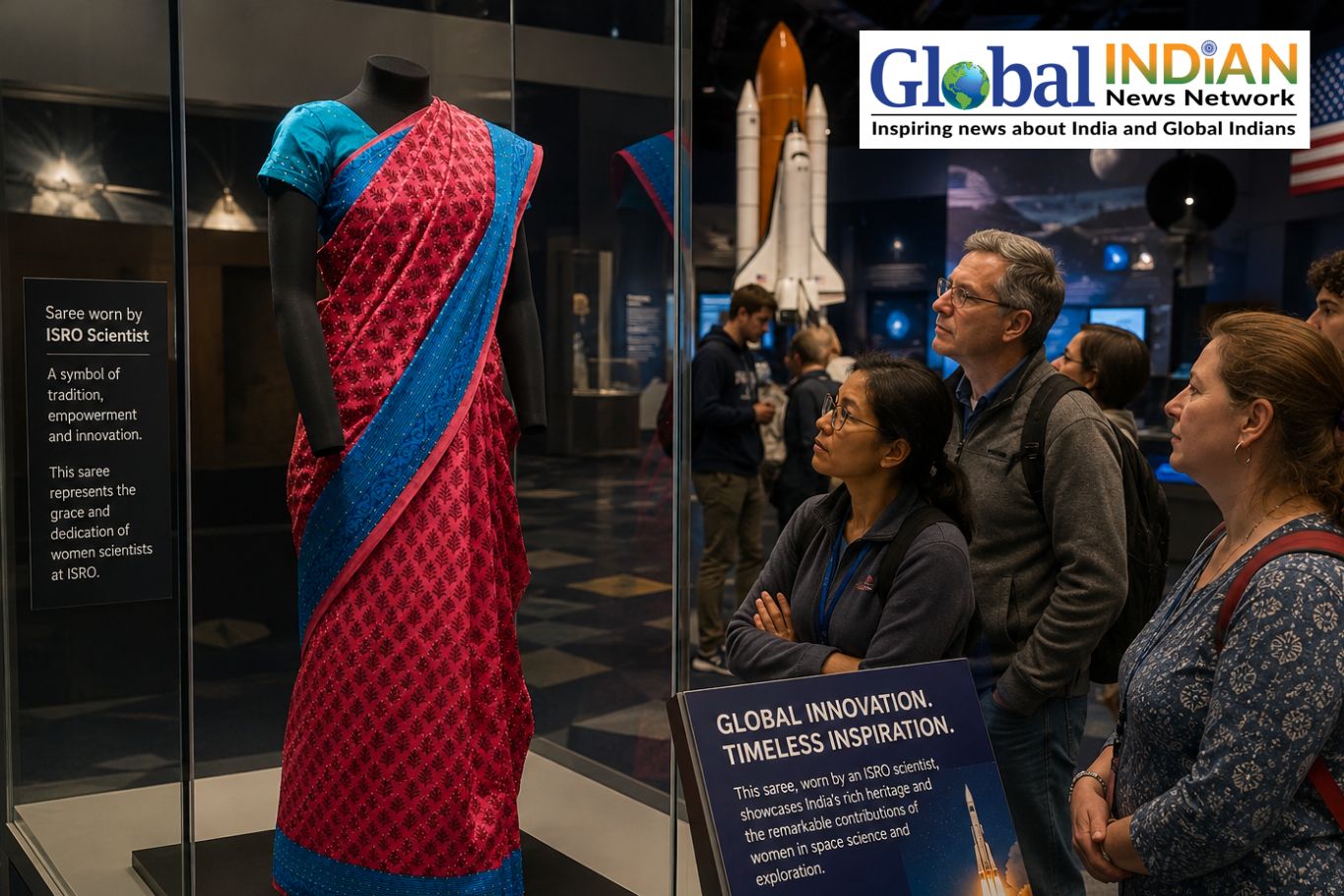
 A saree worn by Indian Space Research Organisation (ISRO) scientist Nandini Harinath during a landmark moment of India’s Mars Orbiter Mission has been showcased at the Smithsonian National Air and Space Museum in Washington, D.C. The exhibit highlights India’s growing achievements in space exploration while also recognizing the contributions of women scientists in the field.
The museum has included the garment as part of its space exploration collection, describing it as a vibrant red and blue saree with intricate patterns. The display features a mannequin dressed in the outfit along with details explaining its significance during India’s historic Mars mission.
Nandini Harinath, widely known as one of ISRO’s “rocket women,” wore the saree on the day the Mars Orbiter Mission successfully departed Earth’s orbit in 2013, beginning its journey toward Mars. At the time, she served as the deputy operations director for the mission and played a key role in planning and execution.
The Smithsonian highlighted her contribution by noting that she was instrumental in mission operations during India’s first interplanetary endeavor. The Mars Orbiter Mission, also known as Mangalyaan, went on to become a major milestone in India’s space history, making the country the first Asian nation to reach Mars orbit and the fourth globally to achieve the feat.
Originally designed for a short duration of six to ten months, the spacecraft far exceeded expectations by operating for nearly eight years, continuously sending valuable data and images of Mars’ surface and atmosphere. This success brought global recognition to India’s space program and established ISRO as a significant player in planetary exploration.
The inclusion of Harinath’s saree in the Smithsonian exhibit has been widely appreciated online, with many users praising it as a powerful representation of India’s scientific progress and the visibility of women in science, technology, engineering, and mathematics fields.
Harinath, who comes from an academically oriented family, has contributed to more than 14 space missions during her career at ISRO. Her work continues to inspire young scientists, particularly women pursuing careers in space research and engineering.
The exhibit not only celebrates a historic space mission but also symbolizes the blend of cultural identity and scientific achievement, reflecting India’s growing presence in global space exploration narratives.