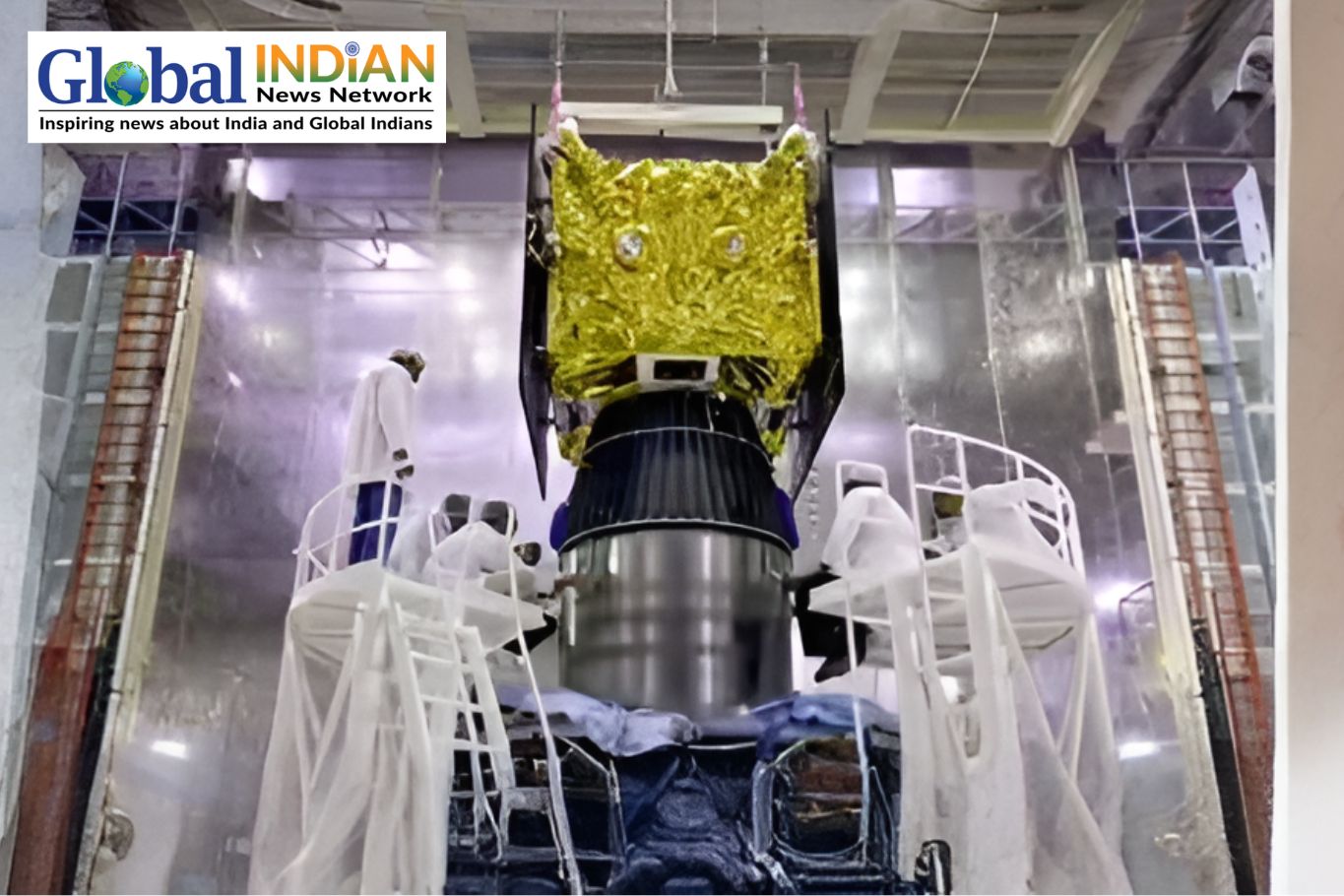
 India celebrated a major space milestone as IRNSS-1F, one of the country’s regional navigation satellites, completed its 10-year design mission life on March 10, 2026. Launched by the Indian Space Research Organisation (ISRO) in March 2016 aboard PSLV-C32 from Sriharikota, IRNSS-1F was the sixth satellite in the Indian Regional Navigation Satellite System (NavIC) constellation. Designed to operate in geostationary orbit at 32.5° East with a 5° inclination, the 1,425-kg satellite has been a silent yet pivotal contributor to India’s self-reliant navigation capabilities.
Equipped with dual payloads—a navigation transmitter operating in L5 and S-bands and a C-band transponder for precise ranging—the satellite also included corner cube retroreflectors for laser tracking. Managed from ISRO’s Master Control Facility in Hassan, IRNSS-1F demonstrated remarkable operational success, with its solar panels deployed efficiently within 19 minutes post-launch. The satellite extends India’s regional coverage 1,500 km beyond its borders, providing independence from global systems like GPS.
On March 13, 2026, ISRO reported that the onboard Rubidium atomic clock, critical for precise timing, ceased functioning. Despite this, IRNSS-1F continues to support essential societal applications, such as one-way messaging, navigation assistance, fleet management, fishing advisories, highway safety, and disaster response. Remarkably, of the three atomic clocks onboard, only one remained functional pre-end-of-life, demonstrating the satellite’s robust design and ISRO’s engineering excellence.
The satellite’s decade-long performance underscores the maturity of India’s clock technology and provides lessons for follow-on NavIC satellites, ensuring future resilience and enhanced capabilities. Beyond practical applications, IRNSS-1F has strengthened India’s strategic autonomy, particularly through dual-frequency functionality, which improves reliability in India’s challenging terrain.
Looking ahead, the NavIC constellation will continue to expand with the NVS series, aligning with global navigation standards and supporting ambitious programs such as Gaganyaan. IRNSS-1F’s successful mission stands as a testament to India’s cost-effective, indigenous space technology, cementing its place in the annals of regional navigation history. Its legacy demonstrates that with sustained innovation, Indian satellites can deliver dependable services decade after decade, enhancing both civilian and strategic applications.