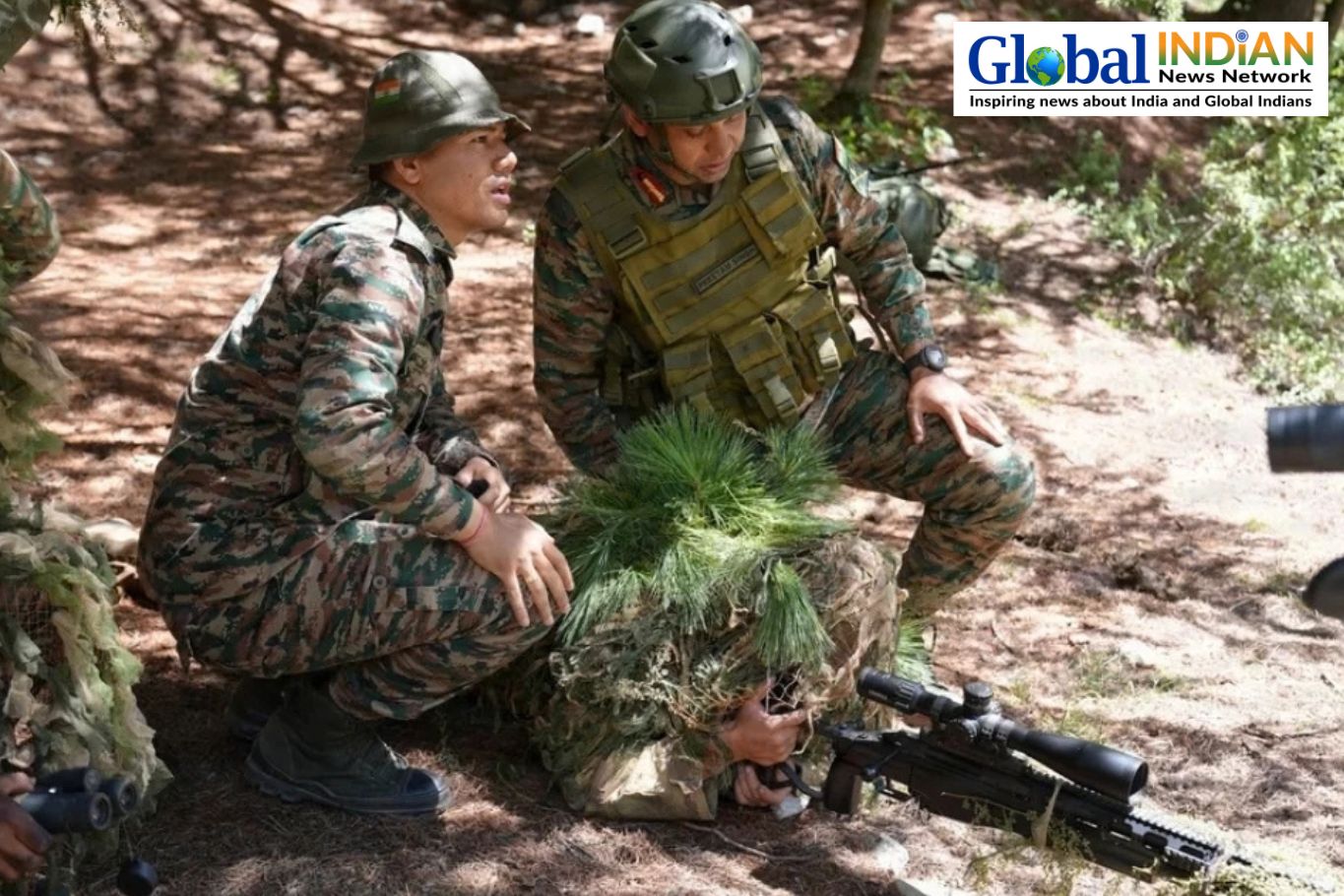
The US and Indian armies conducted joint long-range marksmanship training in the Himalayan region of Uttarakhand as part of Exercise Yudh Abhyas 2026, giving troops from both countries an opportunity to practice working together in challenging terrain. The training near Auli on September 22 focused on improving coordination between sniper and spotter teams while familiarizing American soldiers with equipment used by their Indian counterparts.
During the exercise, US and Indian troops formed mixed teams and trained with the Indian Army’s Sako TRG rifle, which uses the .338 Lapua Magnum cartridge. The teams began by zeroing their rifles before progressing to longer-range engagements. In wooded areas, soldiers practiced against targets positioned between 500 and 580 meters away. They later continued the exercise on more open terrain, engaging targets at distances of roughly 520 meters.
The marksmanship drills were part of a larger set of combined activities involving scouts, snipers and drone operators. Troops moved through dense vegetation while integrating small unmanned aircraft into tactical scenarios. The training also included exercises designed to help personnel identify concealed marksmen, adding a reconnaissance and surveillance component to the field drills.
Drone operations provided another area for the two armies to exchange techniques. The Indian Army’s Ashni drone platoon worked alongside American scouts to compare methods for operating unmanned systems in mountainous environments. The Indian unit brought a broader range of 3D-printed drone platforms, while the US team worked primarily with smaller intelligence, surveillance and reconnaissance systems, along with some one-way attack platforms.
The exercise also included an equipment familiarization program. American soldiers were able to examine Indian small arms, military vehicles and drone and counter-drone systems. Personnel from both sides operated drones together, while US troops also received an opportunity to fire an Indian Army rifle under the joint training program.
Col. Ben Jackman, commander of the US Army’s 1st Mobile Brigade Combat Team, 11th Airborne Division, said direct interaction with each other’s equipment and procedures helps build greater understanding between the forces. He described the practical exposure as contributing to interoperability and the broader military partnership between the United States and India.
Yudh Abhyas 2026 marks the 22nd edition of the annual bilateral Army exercise. The training is designed to enhance operational coordination, readiness and interoperability through combined field activities.