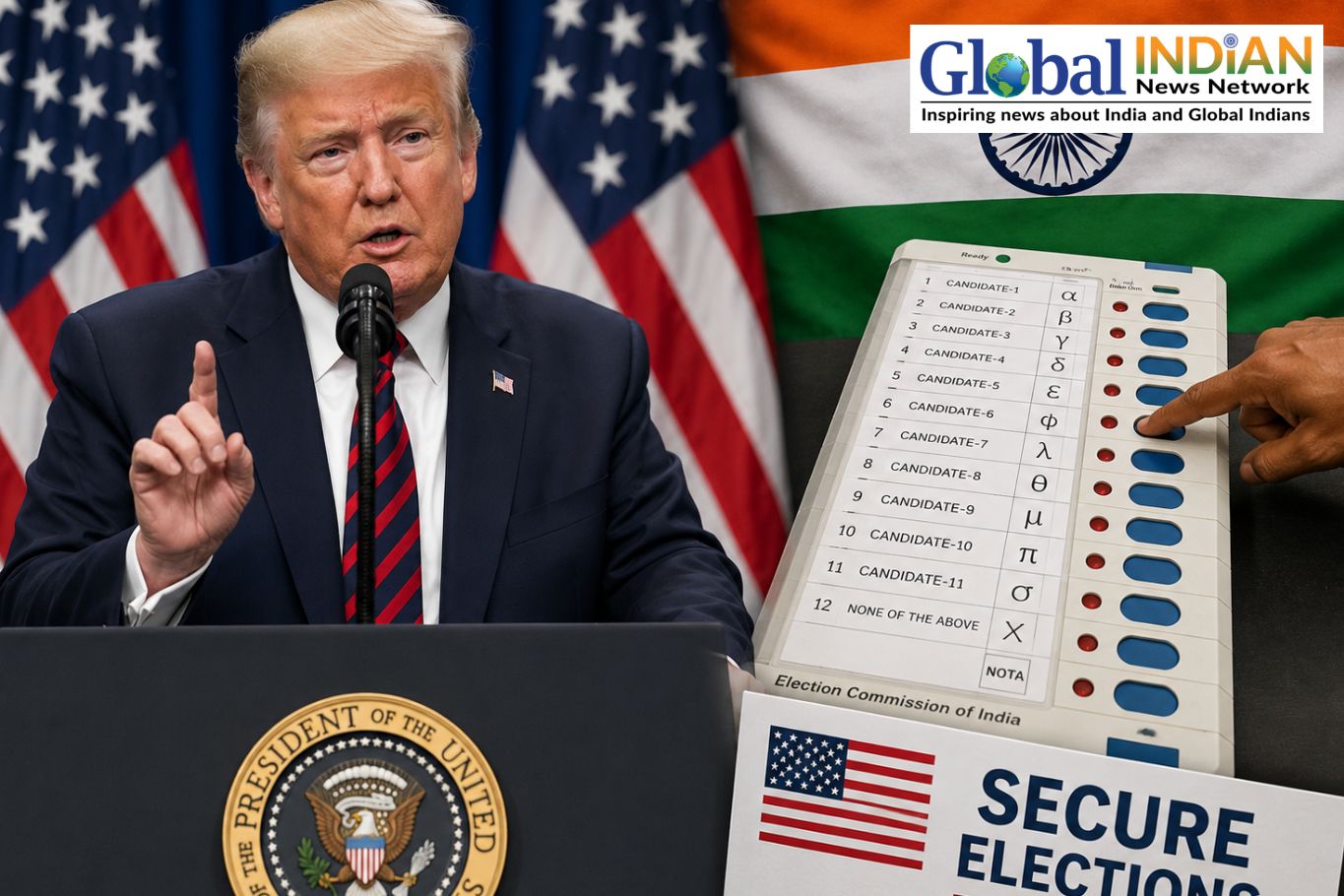
President Donald Trump has highlighted India’s electoral system while renewing his push for stricter voting requirements in the United States, pointing specifically to voter identification and the limited use of mail-in ballots.
In a Truth Social post on August 17, Trump referred to India’s most recent general election and said approximately 646 million people participated. He emphasized that fewer than 1% of those voters cast their ballots by mail, presenting the figures as an example of how elections could be conducted with stronger identification requirements.
Trump also recalled an interaction involving India’s Chief Election Commissioner Gyanesh Kumar and US administration officials earlier this month. According to Trump, Kumar questioned how American elections could be conducted without requiring voters to present valid photo identification.
The president used the remarks to reinforce his support for the Safeguard American Voter Eligibility, or SAVE America Act. The legislation would require individuals to provide proof of US citizenship when registering to vote and establish a nationwide voter identification requirement. It would also place substantial restrictions on voting by mail.
Trump has argued that the proposed legislation is necessary to protect election integrity and prevent voter fraud. However, the measure has encountered political resistance, with lawmakers in both major parties divided over several of its provisions.
The US Senate entered a five-week recess earlier this month without taking definitive action on the bill, leaving its legislative future uncertain. Trump nevertheless continues to call for Congress to approve the measure.
A White House fact sheet supporting the legislation also compares US voting procedures with systems used in countries such as India and Brazil. It states that both nations have connected voter identification systems with biometric databases, while the US system relies on voters attesting to their eligibility.
The proposed legislation extends beyond voter registration and identification. It also contains provisions addressing participation in women’s sports and medical procedures involving transgender minors, making the bill broader than a measure focused solely on election administration.
Trump’s latest comments place India’s election practices at the center of his argument for changing US voting rules. By citing the scale of India’s electorate, the use of identification documents and the relatively small share of postal voting, he is seeking to demonstrate that stricter election procedures can operate even in a large democracy.
The comparison is likely to remain part of the wider political debate surrounding election administration in the United States as lawmakers consider the future of the SAVE America Act.