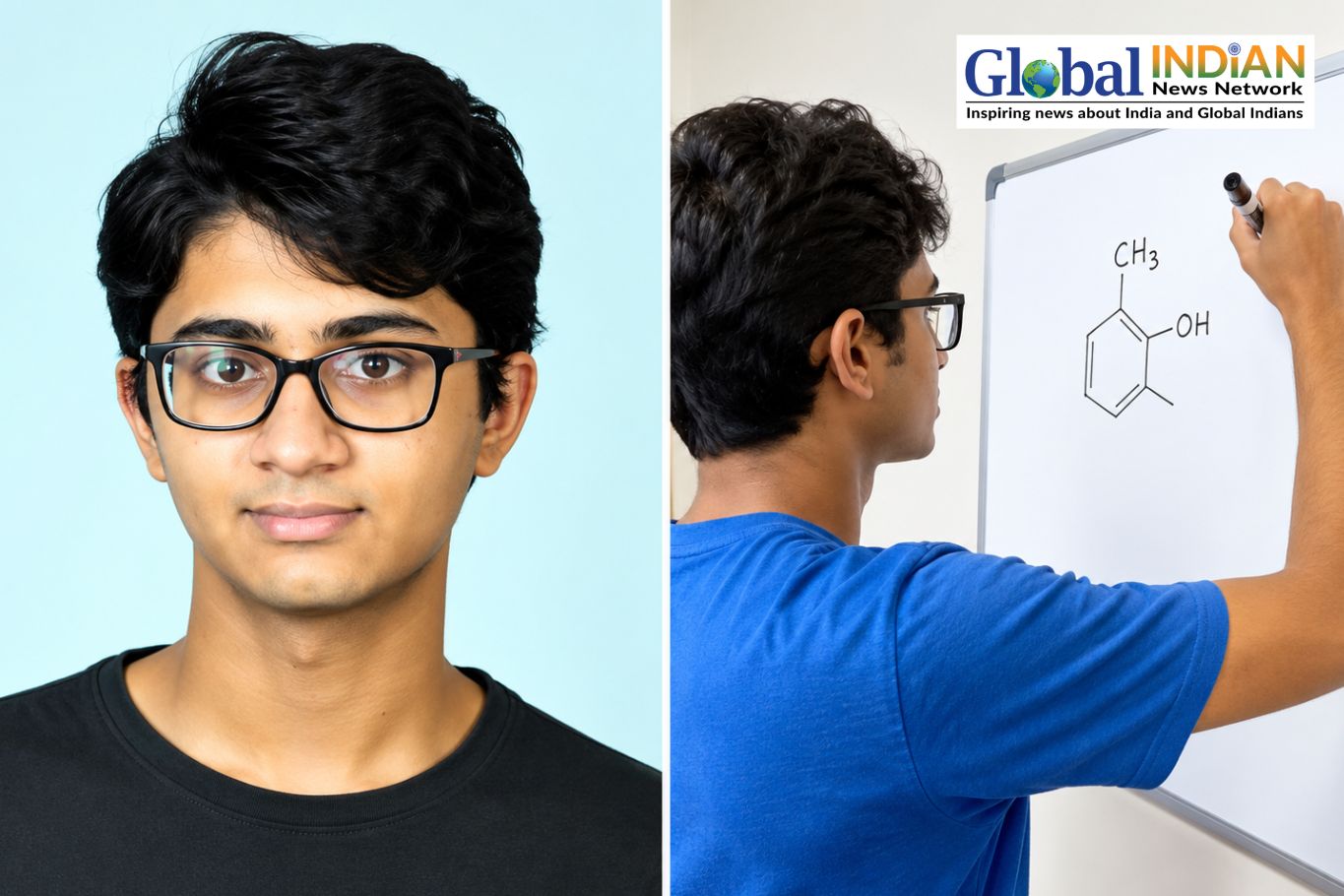
Pavan Subramani, a 17-year-old Indian-American student from Morgantown, West Virginia, has earned recognition for developing an artificial intelligence-based method designed to accelerate molecular simulations used in drug discovery. A senior at Morgantown High School, Subramani has been named a 2026 Davidson Fellow and awarded a $25,000 scholarship for his research into improving the efficiency of computational techniques used to study proteins and potential medicines.
His research combines generative diffusion models with molecular dynamics simulations, offering a potential way to investigate molecular behaviour more efficiently. According to his research results, the method improved sampling efficiency by 68 times for a specific molecular motion compared with conventional molecular dynamics, while a related technique reached equilibrium ligand-binding populations more than four times faster than an existing method.
Subramani’s research project, titled The Hybridization of Generative Diffusion Models with Molecular Dynamics Simulations: A Novel Method to Accelerate Drug Discovery, addresses a major computational challenge in pharmaceutical research.
Molecular dynamics simulations allow scientists to examine how proteins move, change shape and interact with potential drug molecules. These insights can help researchers understand how candidate medicines bind to biological targets and support the early stages of drug development.
However, conventional simulations can require substantial computing power and time, particularly when researchers need to capture rare molecular events or transitions between different structural states.
Subramani became interested in this problem while working on a separate drug discovery project involving potential inhibitors of the Receptor for Advanced Glycation End Products, a protein associated with several disease processes. After designing candidate molecules, he sought to investigate their interactions with the target protein using molecular dynamics simulations. The computational demands exceeded what his laptop could comfortably handle, prompting him to explore enhanced sampling methods.
That experience led him to develop a framework that uses generative AI to propose molecular changes while retaining the statistical safeguards required for reliable simulations.
Subramani developed a technique called diffusion hybridized molecular dynamics, or dhMD. The approach uses a diffusion model to propose changes to a protein’s molecular structure and incorporates a Metropolis-Hastings acceptance criterion to preserve the correct equilibrium distribution.
In tests involving alanine dipeptide, the method achieved a 68-fold improvement in effective sample size per GPU hour for the slow phi dihedral compared with classical molecular dynamics.
Effective sample size measures how efficiently a simulation generates statistically useful, independent information. Improving this measure can allow researchers to obtain more meaningful results from a given amount of computing time.
Subramani subsequently extended the approach to ligand-binding simulations through diffusion hybridized BLUES, known as dhBLUES. The technique combines diffusion-based proposals with BLUES, an existing enhanced-sampling method designed to explore ligand-binding behaviour.
In tests involving T4 lysozyme and toluene, dhBLUES reached equilibrium ligand-binding populations more than four times faster than BLUES. These results suggest that integrating generative models into established simulation frameworks could improve the efficiency of studying molecular interactions.
The significance of the work lies not simply in using AI to generate molecular structures, but in incorporating AI-generated proposals into simulations while preserving the statistical principles that make the results scientifically meaningful.
Maintaining accuracy was a central challenge in developing the method. AI-generated molecular changes can introduce bias if they are incorporated into a simulation without appropriate statistical controls.
Subramani addressed this issue by having the model predict the parameters of an explicit proposal distribution rather than directly generating the final molecular move. This approach made it possible to calculate the forward and reverse proposal probabilities required by the acceptance criterion.
He also encountered difficulties when large structural changes produced molecular overlaps and extremely high energies, leading to frequent rejection of proposed moves. These challenges contributed to the development of dhBLUES, which uses Nonequilibrium Candidate Monte Carlo to move a ligand through smaller steps while allowing its molecular surroundings to adjust.
Together, these developments demonstrate an approach to combining generative AI with established computational techniques without abandoning the mathematical safeguards needed for dependable simulation results.
More efficient molecular simulations could help scientists investigate a larger number of potential drug candidates and explore molecular interactions that conventional methods may take longer to capture.
Understanding protein conformations and ligand-binding modes provides important information about how molecules interact with biological targets. Improved sampling efficiency could help researchers examine these interactions with fewer computational resources and potentially shorten parts of the early-stage drug discovery process.
The approach may also offer benefits to academic laboratories and research groups with limited access to high-performance computing infrastructure. However, the reported results demonstrate improvements in specific computational tests rather than an established reduction in the time required to develop medicines. Further research will be needed to evaluate the methods across a broader range of proteins, drug candidates and pharmaceutical applications.
Subramani’s work highlights the growing role of AI in scientific research, where machine learning can be used not only to generate new structures but also to improve the computational tools scientists rely on to understand complex biological systems.
The Davidson Fellows programme recognises students who have completed significant work in fields including science, technology, engineering, mathematics, literature and music. Subramani’s $25,000 scholarship acknowledges his research contributions and supports his plans for further education.
His achievements also include a third-place Grand Award in Chemistry at the International Science and Engineering Fair and participation as a mentee in the Massachusetts Institute of Technology’s Research Science Institute.
Subramani plans to major in chemistry or applied physics and continue research in computational chemistry and biophysics, with a particular interest in advancing human health through drug discovery.
Reflecting on the scholarship, he said that being selected as a Davidson Fellow recognised the value of his research and encouraged him to continue pursuing scientific work. He added that the financial support would help him pursue the higher education needed to advance his goals.
Alongside his work in computational science, Subramani founded The Substance Safety Project, a nonprofit organisation focused on substance abuse advocacy and education.
According to his Davidson Fellows profile, the organisation has raised more than $10,000, distributed 750 drug disposal packets and conducted educational workshops that have reached more than 1,500 people.
His scientific research and community initiative reflect two areas of focus: advancing knowledge through computational innovation and promoting public awareness of substance safety.
As artificial intelligence becomes increasingly integrated into scientific research, Subramani’s work offers an example of how young researchers are exploring ways to make complex computational methods more efficient. While further validation will be necessary to determine the technique’s broader applications, the reported improvements provide a promising direction for research into molecular simulations and computational drug discovery.