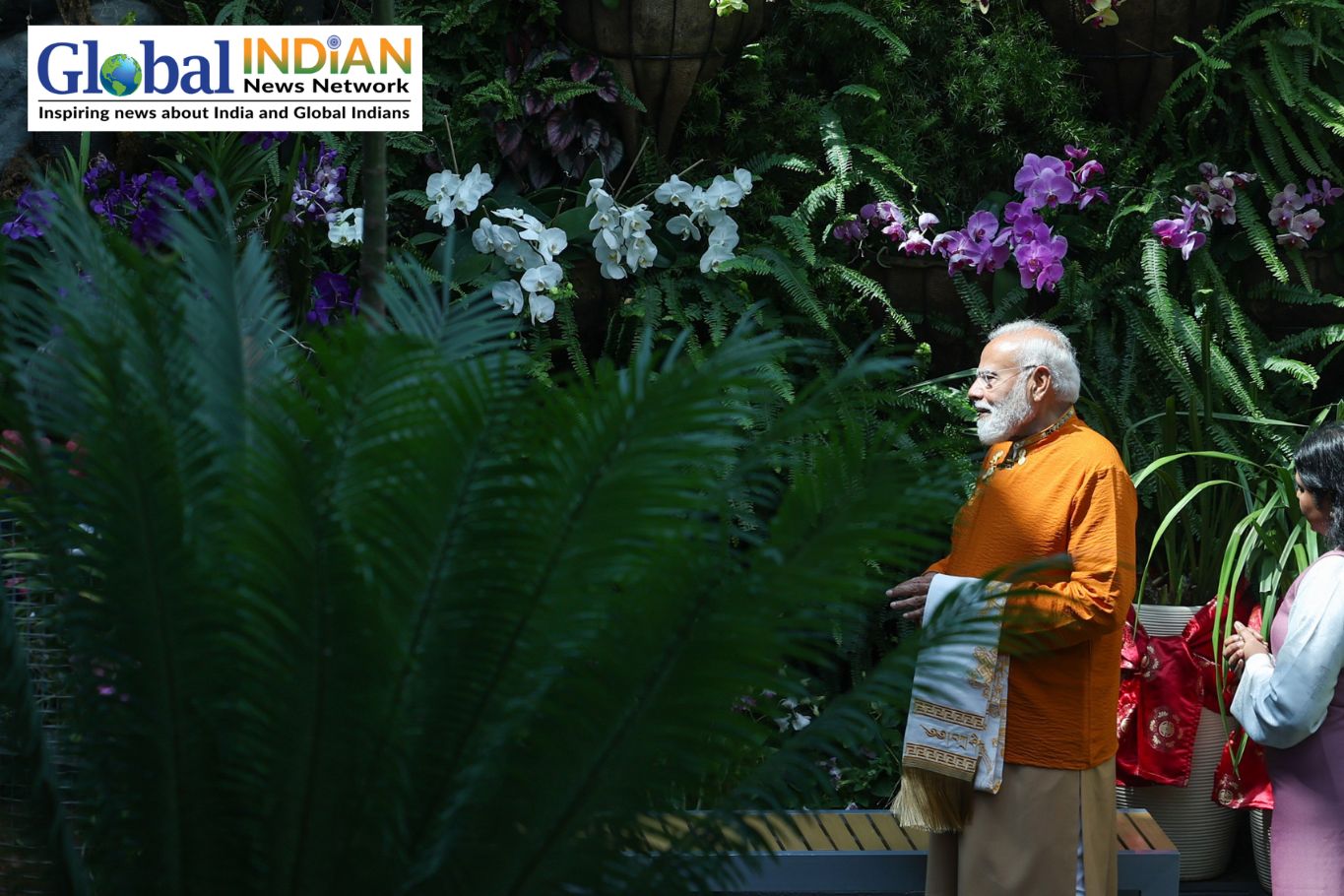
 Prime Minister Narendra Modi, during his visit to Sikkim, praised the state’s exceptional biodiversity and emphasized its importance as a model for sustainable and eco-friendly development. He visited the Orchidarium in Gangtok, where he expressed admiration for its natural beauty and the state’s rich floral diversity. In a message shared on social media, he noted that Sikkim’s environmental wealth reflects a deep harmony between nature and human development, inspiring efforts toward conservation and sustainable living.
The Orchidarium, located within the Swarnajayanti Maitri Manjari Park, has been developed as a world-class centre showcasing the region’s unique orchid species and floral heritage. It stands as a symbol of Sikkim’s commitment to preserving its ecological richness while promoting tourism.
During the closing ceremony of Sikkim’s 50th year of statehood celebrations at Paljor Stadium, the Prime Minister highlighted the state’s journey as a balance of cultural preservation and modern progress. He described the celebrations, set against the Himalayan landscape, as an embodiment of national unity under the spirit of “Ek Bharat, Shreshtha Bharat.” He also appreciated the participation of 21 ethnic communities in a grand roadshow in Gangtok, calling it a reflection of India’s unity in diversity.
PM Modi praised the people of Sikkim for their strong environmental awareness and commitment to cleanliness, describing them as dedicated protectors of nature. He also highlighted that although Sikkim accounts for less than 1% of India’s geographical area, it contributes more than 25% of the country’s floral diversity and is home to hundreds of species of birds and butterflies.
On development, the Prime Minister announced multiple projects across infrastructure, healthcare, tourism, education, and connectivity sectors. He emphasized that strong infrastructure is essential to boosting tourism, which he described as one of Sikkim’s key economic drivers. Major connectivity projects such as the Bagdogra–Gangtok expressway and the Sevok–Rangpo rail line were highlighted, with the railway project set to connect Sikkim to India’s national rail network for the first time.
He also spoke about expanding road connectivity to remote areas and building urban ring roads to improve accessibility. In tourism, he encouraged innovative projects like ropeways, skywalks, and border tourism initiatives, along with plans to develop 1,000 homestays to directly benefit local communities.
In healthcare, he noted significant improvements through Ayushman Arogya Mandirs, district hospitals, and wellness centres, along with upcoming facilities like the Drejong Namgyal Sowa Rigpa Hospital. He further praised Sikkim’s achievement as India’s first fully organic state, achieved in 2016, and highlighted the success of organic farming in crops such as cardamom, ginger, and turmeric, which has boosted farmer incomes.
Concluding his address, PM Modi reaffirmed the central government’s commitment to accelerating Sikkim’s development, describing the Northeast as India’s “Asht Lakshmi” and a vital contributor to the vision of a developed nation.