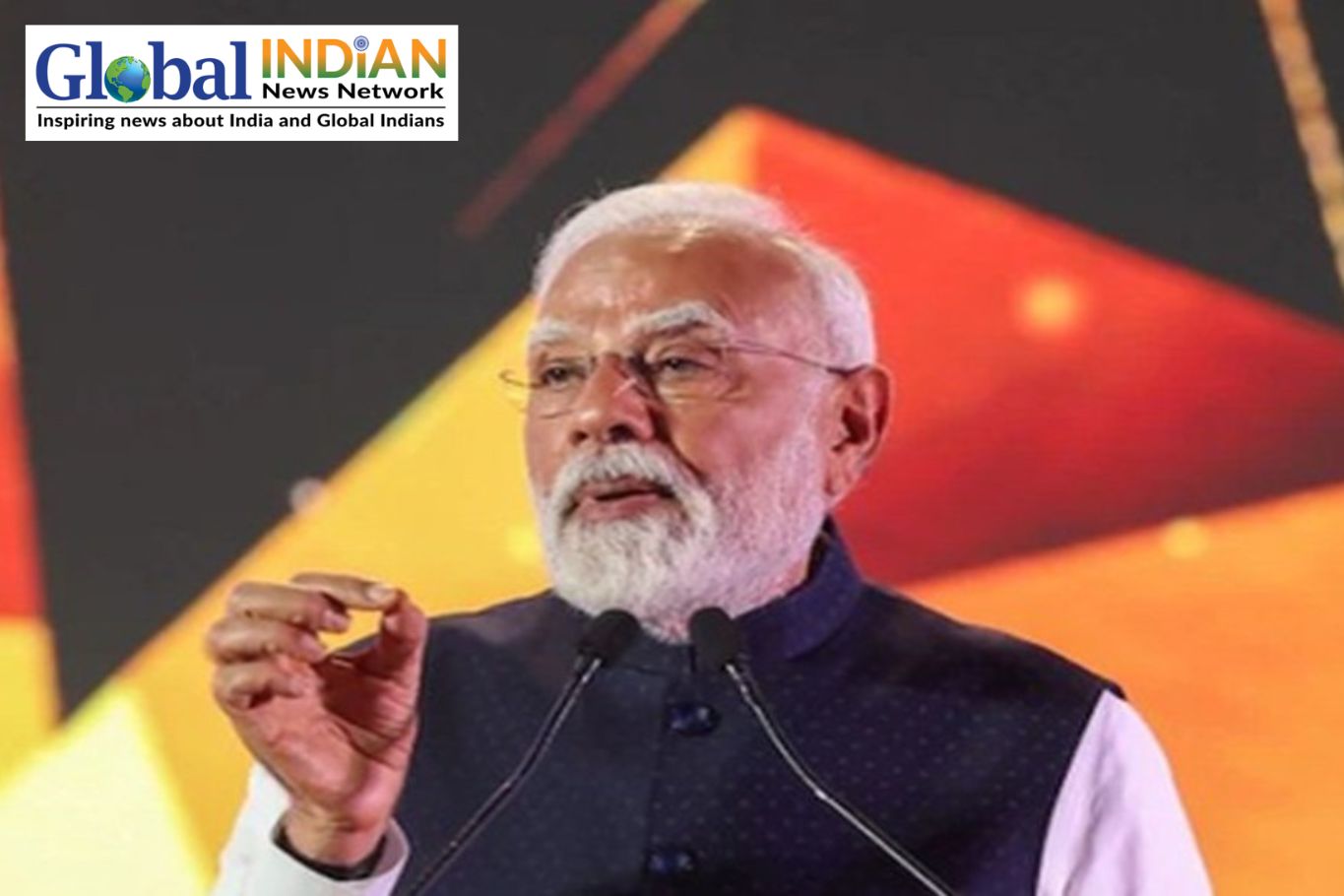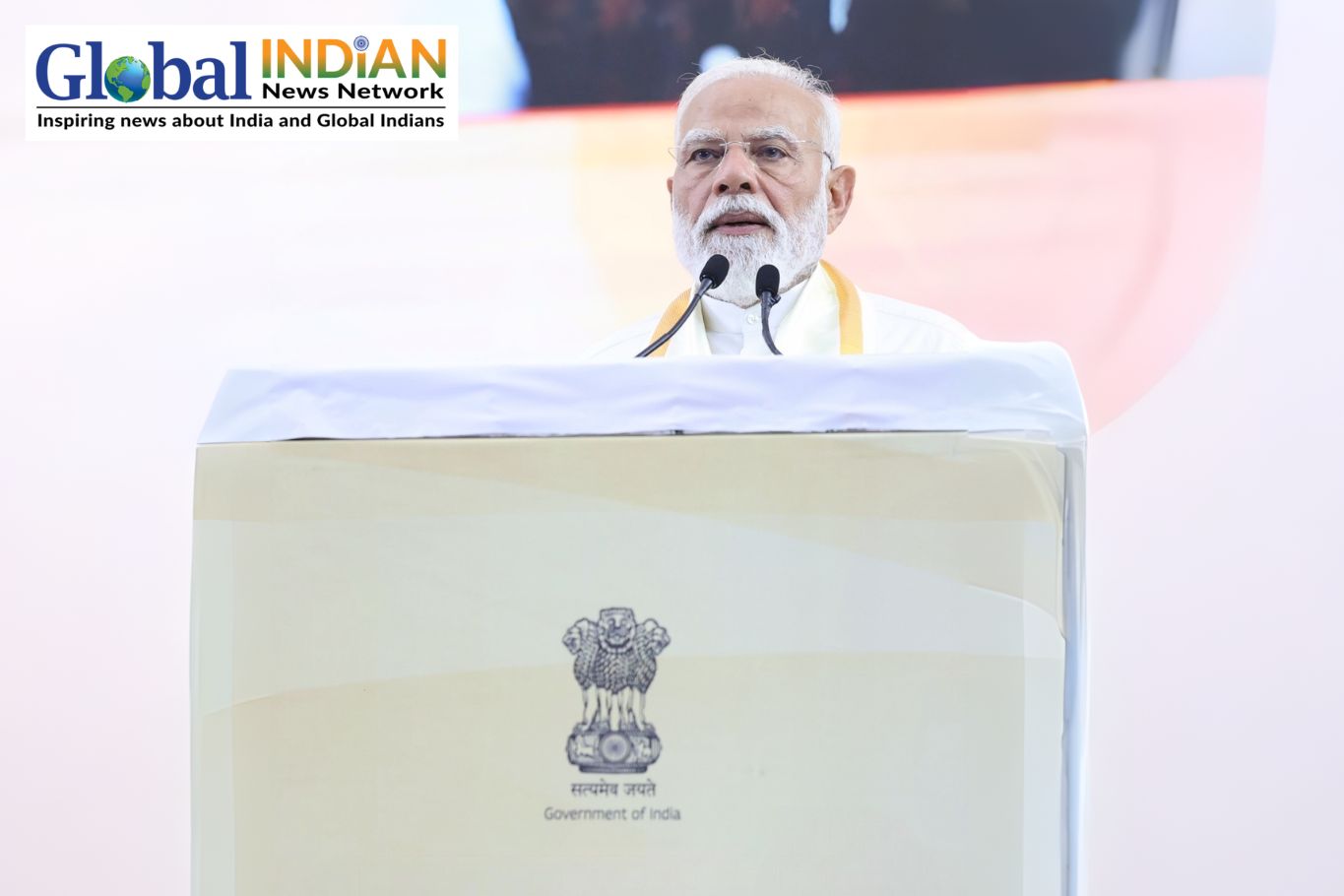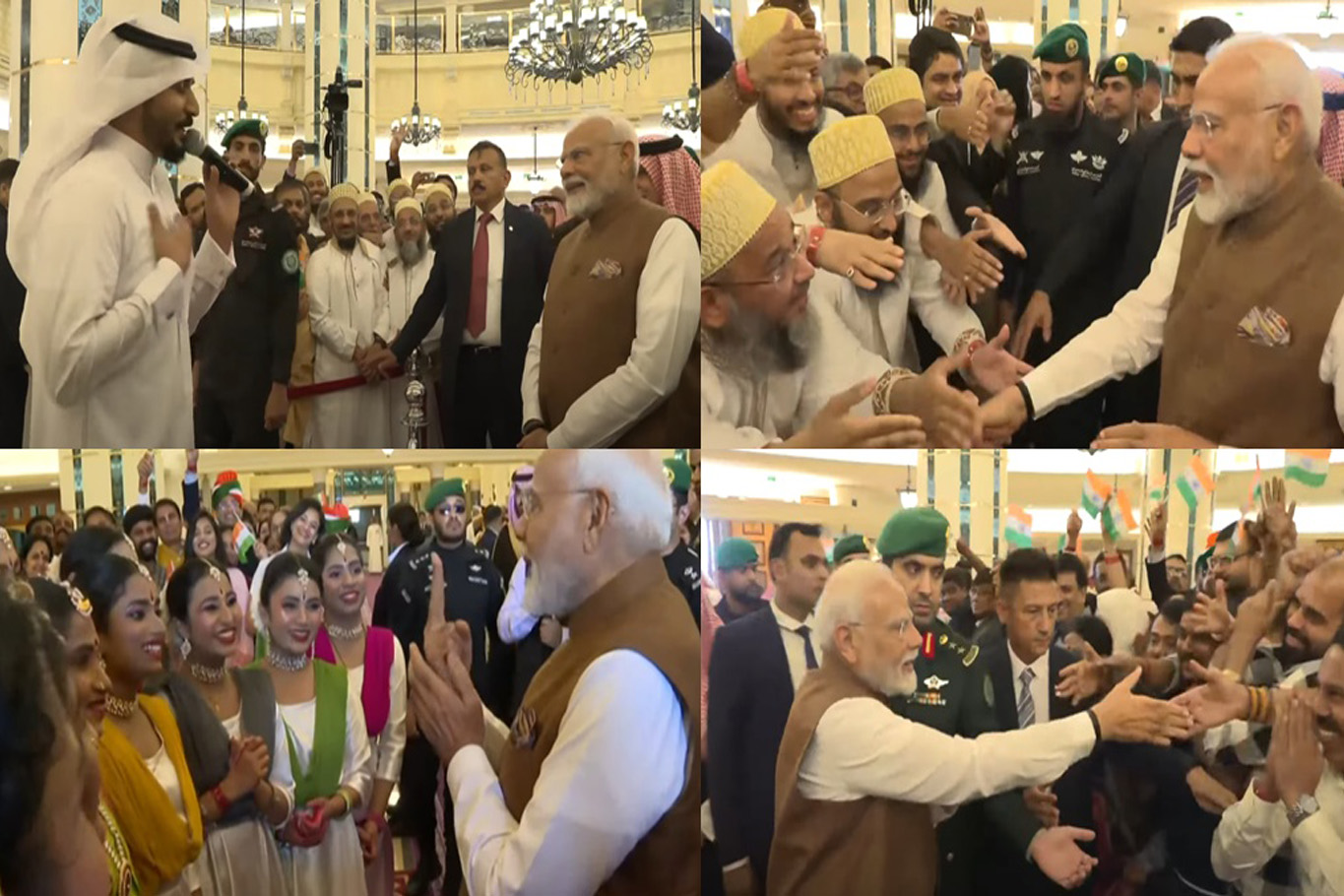
A large gathering of locals and members of the Indian diaspora gave a rousing and heartfelt welcome to Prime Minister Narendra Modi as he arrived at his hotel in Jeddah on Tuesday afternoon.
The Prime Minister was greeted with vibrant cultural performances and chants of “Modi-Modi” and “Bharat Mata Ki Jai,” as the atmosphere reverberated with energy and pride.
Adding to the celebratory fervor, Saudi singer Hashim Abbas performed the iconic patriotic song “Ae Watan…”, drawing cheers and applause from the audience, including Prime Minister Modi himself.
“I have a deep love for India, and people often told me that one day something like this would happen. With help from my friend, I got this incredible opportunity to sing in front of Prime Minister Modi. It felt unreal—like a dream. I can’t put into words what it means to meet the number one man in India,” Abbas shared with IANS after the performance.
Earlier in the day, Prime Minister Modi arrived in the historic port city to a grand reception that included a 21-gun salute and a ceremonial welcome.
Underscoring the deep-rooted and long-standing relationship between India and Saudi Arabia, PM Modi was warmly received at the airport by key Saudi dignitaries, including Deputy Governor of Makkah Prince Saud bin Mishaal bin Abdulaziz Al Saud, Commerce Minister Majid bin Abdullah Al Kassabi, and Jeddah Mayor Saleh Ali Al-Turki. This marks PM Modi’s third visit to the Kingdom, following earlier trips in 2016 and 2019. The visit comes at the invitation of Saudi Crown Prince and Prime Minister Mohammed bin Salman.
In a special gesture to honor the visit, the Royal Saudi Air Force escorted PM Modi’s aircraft as it entered Saudi airspace.
“Landed in Jeddah, Saudi Arabia. This visit will strengthen the friendship between India and Saudi Arabia. Eager to take part in the various programmes today and tomorrow,” PM Modi posted on X after his arrival.
The two-day visit from April 22–23 follows the State Visit of Crown Prince Mohammed bin Salman to New Delhi in September 2023 for the G20 Summit, where he also co-chaired the inaugural meeting of the India-Saudi Arabia Strategic Partnership Council (SPC).
Earlier in the day, in his departure statement, PM Modi highlighted India’s strong and historic relationship with Saudi Arabia, noting how the partnership has evolved in recent years to include strategic dimensions.
“Together, we have developed a mutually beneficial and substantive partnership across areas like defence, trade, investment, energy, and people-to-people ties. We share a commitment to promote peace, prosperity, security, and stability in the region,” he stated.
This visit marks PM Modi’s first time in the historic city of Jeddah, where the second meeting of the Strategic Partnership Council will take place. The SPC was initially formed during his State visit to Saudi Arabia in October 2019, with a mission to elevate bilateral relations across multiple domains.
Later in the evening (IST), the Prime Minister is scheduled to interact with members of the Indian community in Saudi Arabia, reiterating the importance he places on the welfare and contributions of Indians living abroad.
“I am also eager to connect with the vibrant Indian community in Saudi Arabia that continues to serve as the living bridge between our nations and makes immense contributions to strengthening our cultural and human ties,” he remarked in his departure statement.
The Indian community in Saudi Arabia numbers 2.7 million and plays a vital role in cementing ties between the two nations. Their economic contributions are widely acknowledged, and the number of Indians traveling to Saudi Arabia for employment has been steadily increasing. In the past year alone, approximately one lakh Indians have arrived in the Kingdom for work.
The bilateral relationship has seen remarkable progress over the past decade, especially after PM Modi’s historic 2016 visit to Riyadh, which ushered in a new era of cooperation in political, economic, security, and defense areas. During that visit, King Salman honored PM Modi with the Kingdom’s highest civilian award, the ‘King Abdulaziz Sash.’
Established in 2019, the SPC consists of two primary pillars—the Political-Security-Socio-Cultural (PSSC) and Economic and Investment components. The PSSC is co-chaired by India’s External Affairs Minister and Saudi Arabia’s Foreign Minister, while the Economic pillar is overseen by India’s Commerce and Industry Minister and the Saudi Energy Minister.
Eight Joint Working Groups and subcommittees operate under these pillars, meeting regularly to ensure progress and cooperation in key areas.
The first SPC summit was held in New Delhi in September 2023, co-chaired by PM Modi and Crown Prince Mohammed bin Salman.
In just the early part of 2024, there have already been 11 ministerial-level exchanges between India and Saudi Arabia. Notably, the Saudi Foreign Minister and the Minister of Industry and Mineral Resources visited India in November 2024 and February 2025, respectively.
As the headquarters of the Gulf Cooperation Council (GCC), Riyadh plays a pivotal role in regional affairs. India and the GCC Secretariat have enjoyed positive relations and sustained dialogue. In September 2024, External Affairs Minister S. Jaishankar traveled to Riyadh to co-chair the first-ever India-GCC Ministerial Meeting.
Economically, Saudi Arabia remains India’s fifth-largest trade partner, while India stands as Saudi Arabia’s second-largest. In FY 2023-24, India’s imports from Saudi Arabia totaled US $31.42 billion, while exports reached US $11.56 billion.
Saudi Arabia is also India’s third-largest source of crude oil and petroleum products. In FY 2023-24, India imported 33.35 million metric tons (MMT) of crude oil from the Kingdom, accounting for 14.3% of India’s total imports. Additionally, Saudi Arabia was India’s third-largest supplier of LPG, providing 18.2% of the country’s LPG imports in the same period. It also serves as a key supplier of fertilizers, ranking as the second-largest source of DAP (Di-Ammonium Phosphate) for India.
Religious ties also play a significant role in bilateral relations. The annual Haj and Umrah pilgrimages are a major component of the connection, with India’s Haj quota currently set at 175,025 pilgrims.