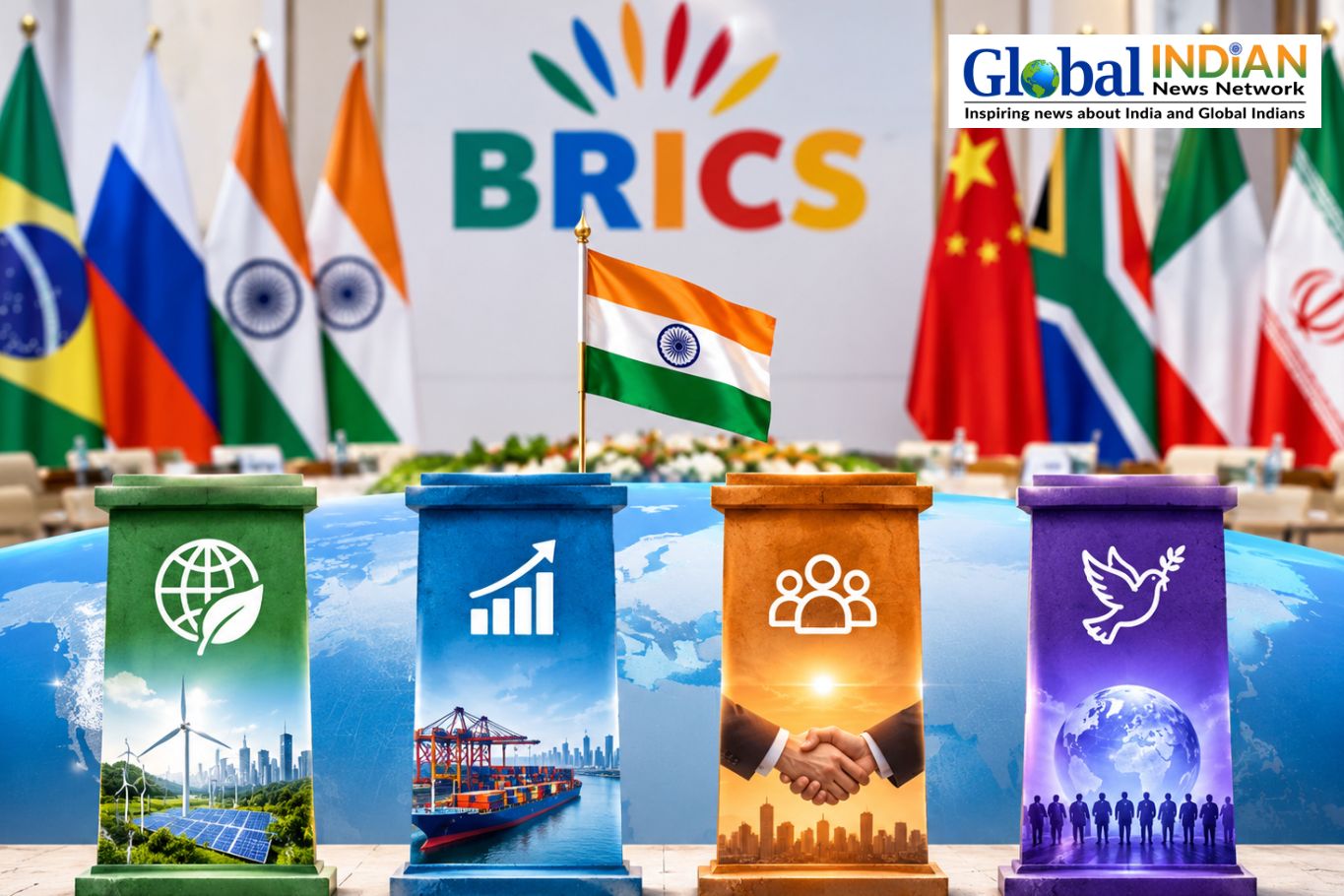
India is preparing to wrap up its 2026 chairship of BRICS with the 18th BRICS Leaders’ Summit, scheduled to take place in New Delhi on September 12-13. India assumed the leadership of the grouping on January 1 and has centered its year-long agenda on the theme “Building for Resilience, Innovation, Cooperation and Sustainability.”
The four priorities reflect India’s approach to making BRICS cooperation more practical and focused on the needs of people across emerging and developing economies. Resilience emphasizes stronger economic, social and institutional systems that can withstand global disruptions, including supply-chain shocks, public health challenges and climate-related risks.
Innovation forms another major part of the agenda, with India highlighting technologies that could support economic development and improve public services. Artificial intelligence, Digital Public Infrastructure and financial technology are among the areas being promoted as tools for building more adaptable and technology-driven economies.
The cooperation pillar focuses on closer coordination between member countries in areas such as policymaking, development finance and trade. India is also seeking greater discussion around reforms to international governance institutions, reflecting the broader BRICS objective of giving developing nations a stronger voice in global decision-making.
Sustainability is the fourth focus area, bringing climate action, green finance, clean energy transitions and sustainable development into the group’s wider agenda. Together, the four pillars are intended to strengthen collaboration while addressing challenges that extend beyond national borders.
BRICS currently has 11 full members: Brazil, Russia, India, China, South Africa, Egypt, Ethiopia, Indonesia, Iran, Saudi Arabia and the United Arab Emirates. The expanded group accounts for approximately 49.5% of the world’s population, 40% of global GDP and 26% of global trade.
The 2026 chairship is India’s fourth time leading BRICS, following its previous presidencies in 2012, 2016 and 2021. The grouping traditionally works across three major areas: political and security affairs, economic and financial cooperation, and cultural and people-to-people exchanges. Its agenda has since expanded to include food and energy security, agriculture, telecommunications, climate change, trade and emerging technologies.
India’s leadership builds on Brazil’s 2025 chairship and places particular emphasis on stronger cooperation among countries of the Global South. BRICS has also developed a partner-country framework involving Belarus, Bolivia, Cuba, Kazakhstan, Malaysia, Nigeria, Thailand, Uganda, Uzbekistan and Vietnam.
The New Delhi summit is expected to give leaders an opportunity to review the group’s expanding role and establish priorities for its next phase, with India’s four pillars providing the central framework for deeper cooperation.