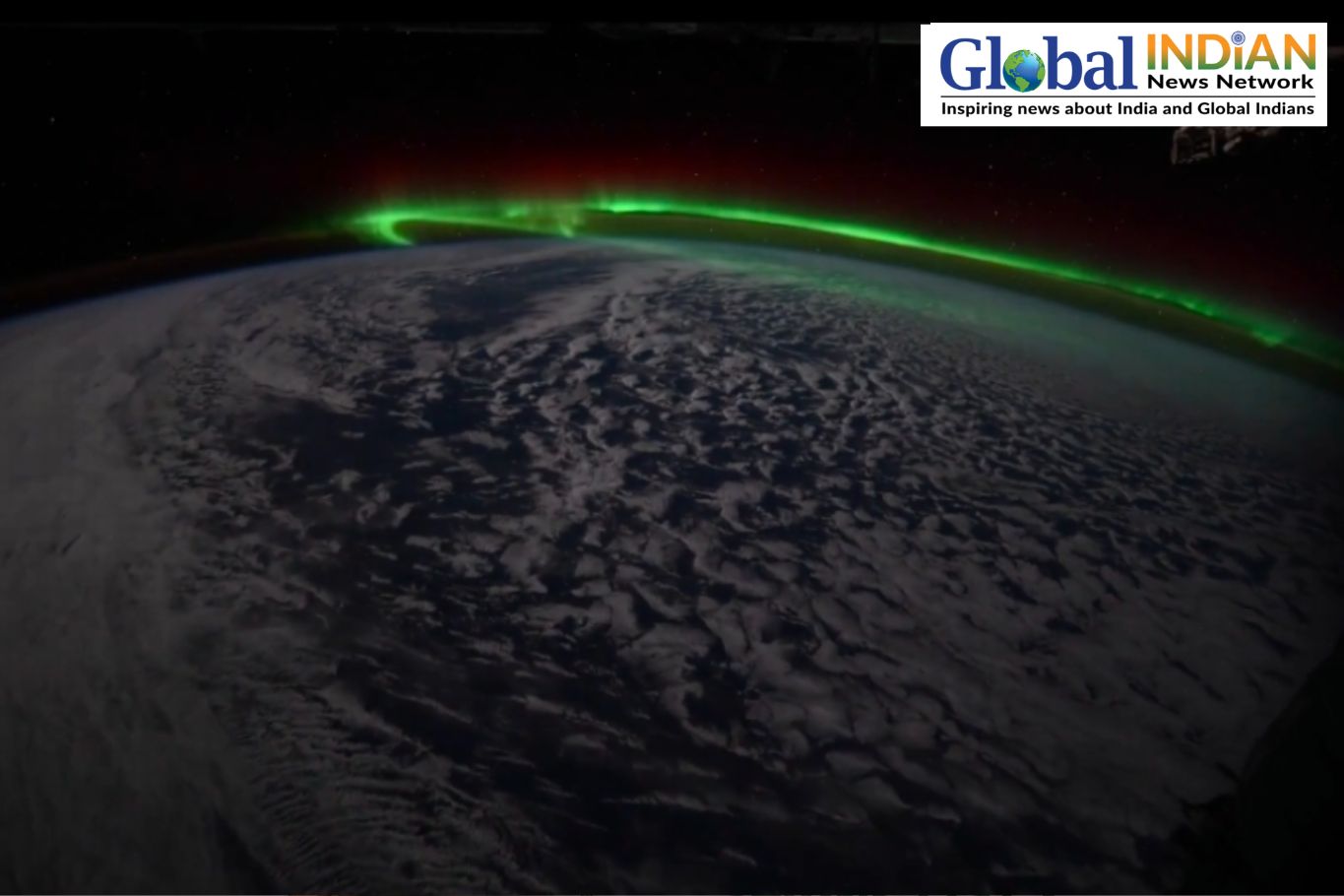
A powerful solar event produced dazzling auroras across parts of the Northern Hemisphere, while astronauts aboard the International Space Station enjoyed an extraordinary view from orbit. Among those witnessing the colorful display was Indian-American NASA astronaut Anil Menon, who experienced the phenomenon from space for the first time.
The auroras appeared after a coronal mass ejection (CME) struck Earth’s magnetosphere around midday on August 2, generating a moderate G2 geomagnetic storm. Scientists believe the solar material originated either from a slower-moving CME released on July 27 or from a weaker eruption that occurred on July 30. The interaction between the charged particles and Earth’s magnetic field produced vibrant displays across high-latitude regions, including northern Scotland and Scandinavia.
NASA astronaut Jessica Meir shared a time-lapse video from the International Space Station showcasing brilliant green and red auroras sweeping across the planet. She described the experience as especially memorable because it was shared with Anil Menon during his first opportunity to witness such an intense auroral event from orbit.
Meir expressed her excitement on social media, saying she never grows tired of watching the northern lights from space. She also noted that the red bands visible above the green auroras were particularly striking during the observation, making the event even more remarkable for the crew aboard the station.
Astronomers reported relatively low solar flare activity during the same period, with several weak C-class and B-class flares detected. According to space weather monitoring agencies, the strongest flare observed was classified as C6.3 on August 2, while additional weaker flares were produced by active sunspot regions over the following days.
Experts believe solar activity will continue through the first week of August, increasing the likelihood of additional auroral displays. If conditions remain favorable, the northern lights could become visible farther south than usual, offering residents in cities such as Edinburgh, Seattle, Toronto, Chicago, London, and New York an opportunity to witness the phenomenon.
Scientists also cautioned that continued solar activity may temporarily affect satellites, radio communications, and power infrastructure. While moderate M-class solar flares remain possible in the coming days, the probability of more powerful X-class eruptions is currently considered low. Researchers continue to closely monitor active sunspot regions responsible for the ongoing space weather activity.