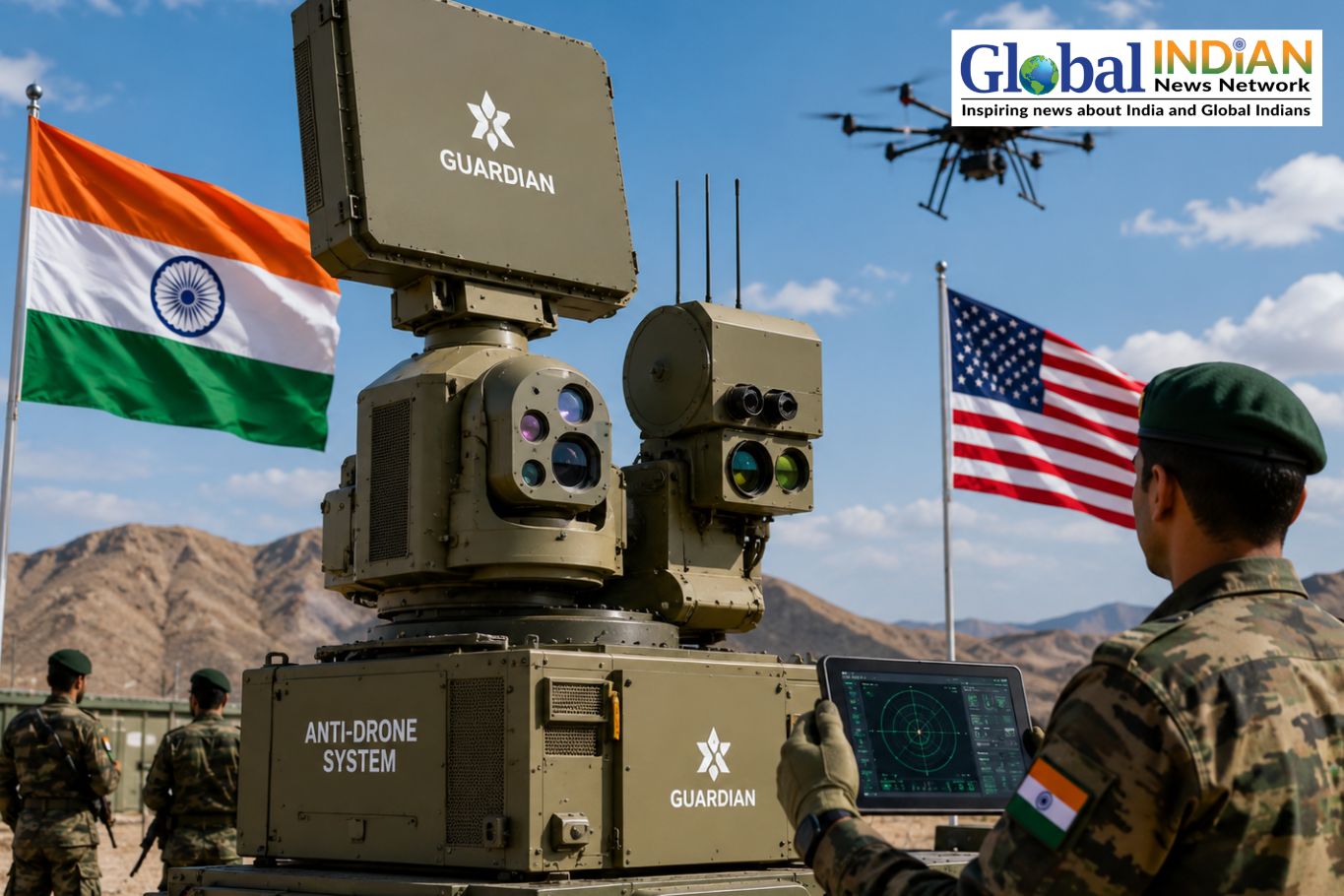
India’s defense manufacturing sector is set to gain access to US-origin counter-drone technology as Paras Defense & Space Technologies moves toward locally manufacturing and commercializing the Guardian family of interceptor systems.
The development comes as India’s armed forces increasingly focus on finding effective solutions to detect, track and physically neutralize hostile unmanned aerial vehicles, commonly known as UAVs. The growing use of drones in modern conflicts has increased the need for specialized systems capable of stopping aerial threats before they can reach sensitive military or civilian targets.
According to an analysis cited by The Sunday Guardian, US-based Powerus has granted Paras Defense exclusive rights to manufacture and market its Guardian interceptor products within India. The arrangement was executed through Powerus subsidiary Tandem Defense LLC and was disclosed in filings submitted to the US Securities and Exchange Commission.
Under the agreement, Paras Defense will receive exclusive manufacturing and commercialization rights for the Guardian interceptor family in India. In return, the Indian company will pay a licensing fee and share a portion of net profits generated from domestic sales.
The agreement, however, does not mean that the Guardian interceptor has already been chosen for use by India’s armed forces. Any future procurement or induction would need to go through the Indian government’s established testing, evaluation and acquisition procedures.
The Indian Army has already begun outlining its requirements for new counter-drone capabilities. Earlier this year, it reportedly issued a request for information covering as many as 45 drone interception systems and 50 drone-catching systems. These platforms could potentially be deployed across different operational environments, including plains, deserts and high-altitude regions.
The Army’s requirements reportedly emphasize kinetic methods for neutralizing drones with a low radar signature. Such systems could destroy or disable hostile UAVs through direct impact or controlled proximity detonation.
India’s broader counter-drone effort is also moving toward greater use of artificial intelligence. The Army recently issued a GeM tender seeking the development of an AI-enabled, high-speed interceptor UAV designed for counter-drone operations. Meanwhile, the Indian Air Force has also been exploring domestically developed technologies capable of identifying, following and eliminating hostile drones.
Powerus describes its Guardian-1 and upgraded Guardian-2 systems as affordable, high-speed interceptor platforms designed to counter unmanned aerial threats on a larger scale. The technology reportedly emerged from efforts to commercialize autonomous defense systems developed in Ukraine and owned by G1 Exploration.
The partnership gives India a potential route to locally produce foreign-origin counter-drone technology while strengthening its domestic defense manufacturing ecosystem and responding to rapidly evolving UAV threats.