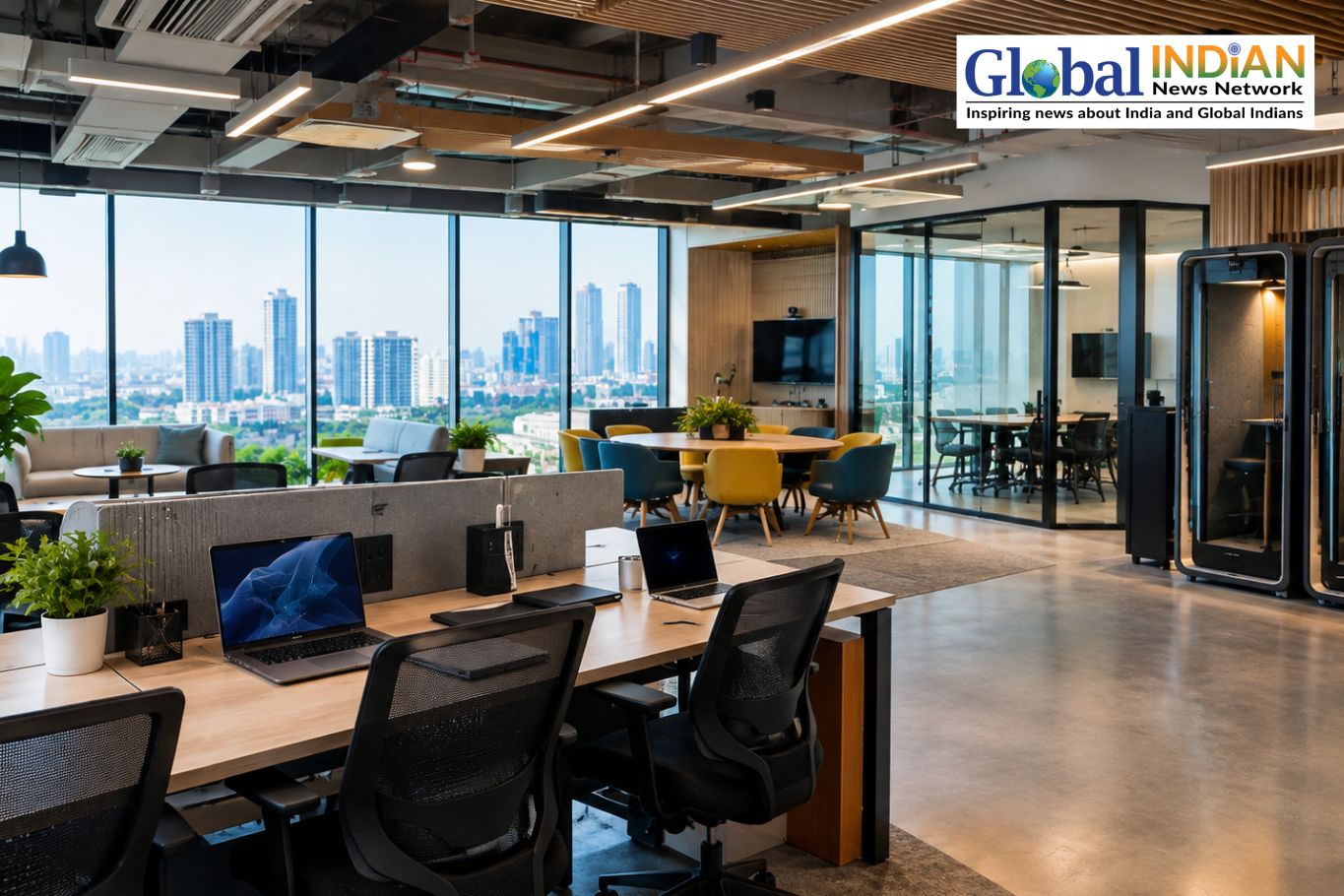
India has reinforced its position as a global leader in flexible office spaces, achieving a perfect score of 100% on Cushman & Wakefield’s Flexible Office Market Maturity Index. The sector’s rapid expansion reflects growing demand from businesses seeking adaptable workplaces, professionally managed offices, and cost-effective alternatives to conventional commercial leases.
Data from Upflex, based on nearly 23,000 on-demand bookings, shows that India’s share of worldwide flexible workspace bookings climbed from 2.2% in the first half of 2025 to 10.2% during the same period in 2026. This placed the country second globally for booking activity, behind the United States.
India’s flexible office inventory reached 88.70 million square feet in the first half of 2026, equivalent to 10.5% of its total office stock. Industry projections suggest that capacity could surpass 100 million square feet by the end of 2026 and approach 160 million square feet by 2030. Increasing enterprise requirements, institutional investment, and demand for premium workplace facilities are expected to support this growth.
Leasing activity has also reached new heights. Flexible workspace providers leased 8.50 million square feet across India’s eight largest cities during the first six months of 2026, marking their strongest first-half performance on record. These operators accounted for approximately 20% of the country’s overall office leasing activity.
The industry has evolved considerably beyond shared desks and traditional coworking facilities. Providers now offer managed offices, customized fit-out services, and comprehensive workplace solutions. Between 2023 and 2025, operators leased 44.10 million square feet, creating capacity for more than 720,000 flexible workspace seats. Seat demand has also surged, increasing from approximately 38,000 in 2020 to an estimated 300,000 in 2026.
Several cities are emerging as important growth centers. Flexible office providers represented 35% of total office leasing in Pune, 33% in Ahmedabad, and 26% in Hyderabad during the first half of 2026. Meanwhile, Tier II cities are attracting attention as businesses explore opportunities beyond established metropolitan markets.
Indian operators are also pursuing international expansion. Smartworks has entered Singapore, while Table Space has proposed expanding into the Philippines through a strategic investment in KMC Solutions. Growing requirements from Global Capability Centres, multinational corporations, and businesses developing artificial intelligence solutions are creating additional opportunities.
Investor interest is strengthening alongside market growth. Four flexible office operators have gone public, with another initial public offering in the pipeline. Together, expanding enterprise demand, broader geographic reach, and greater access to capital are positioning India’s flexible workspace industry for further growth through the end of the decade.