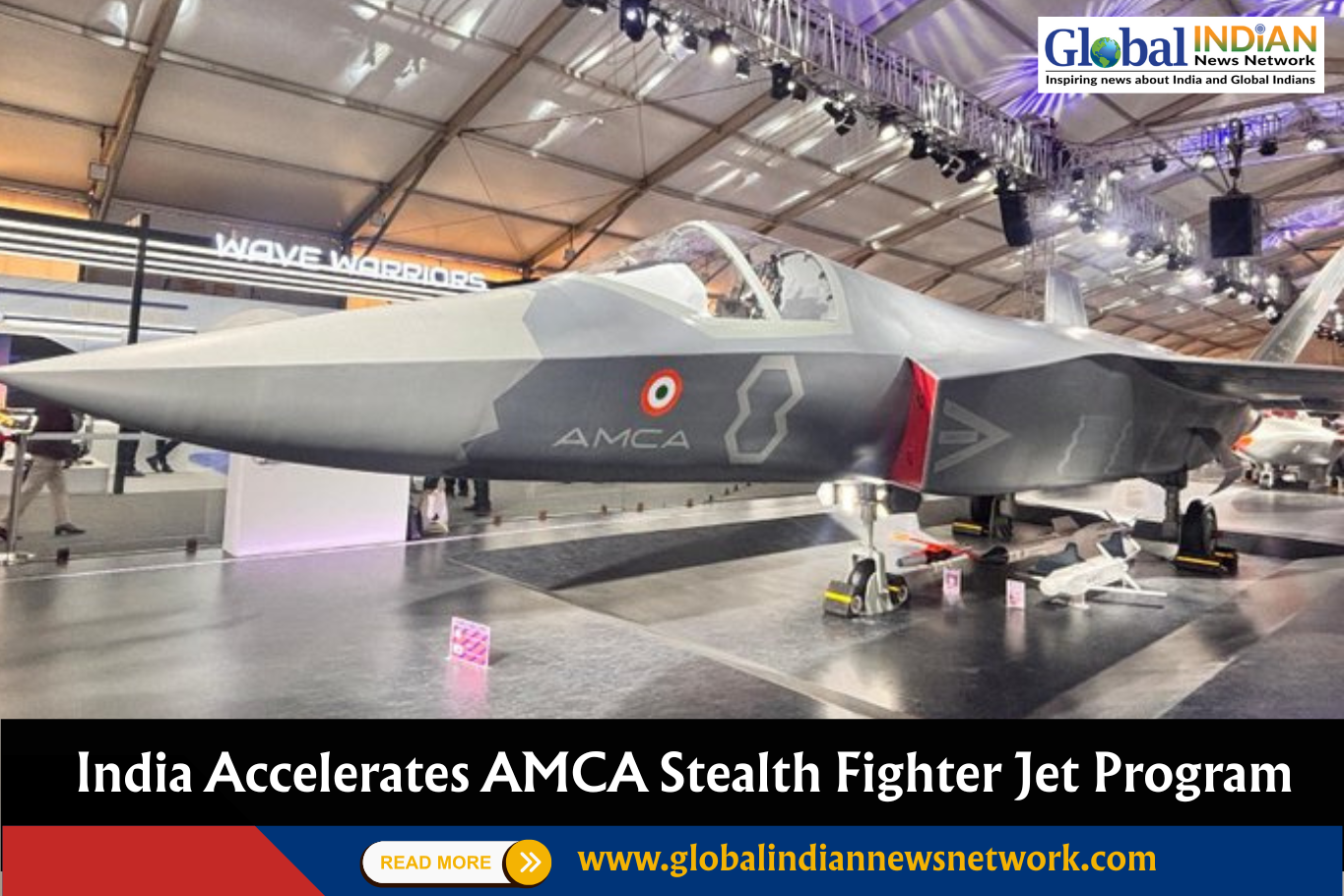
 India has officially launched its long-anticipated Advanced Medium Combat Aircraft (AMCA) program, a fifth-generation stealth fighter jet initiative. After years of delay, the government has now finalized the execution framework and timeline, positioning the project as a cornerstone of India’s future airpower and defense self-reliance strategy.
In light of recent geopolitical developments—including aerial tensions with Pakistan and China’s growing military assertiveness—this move comes at a critical juncture. The AMCA will play a crucial role in reducing the widening capability gap with China, whose air force already operates around 195 J-20 stealth jets and has a fleet exceeding 1,600 fourth- and fifth-generation fighters. At the same time, Pakistan is procuring J-10CE fighter jets and is expected to induct 40 J-35A stealth aircraft from China, further bolstering the China-Pakistan airpower partnership.
India’s Air Force, currently operating just 30 squadrons—well below the sanctioned 42.5—faces further pressure as older jets like the MiG-21, Mirage 2000, and Jaguar are phased out. Against this backdrop, the AMCA project, under the Aeronautical Development Agency, introduces a public-private model that opens doors to Indian private sector aerospace companies. While Hindustan Aeronautics Limited (HAL) is expected to lead, this marks the first time such an ambitious combat aircraft project isn’t exclusively state-run.
The AMCA is designed as a 25-ton, twin-engine stealth fighter with AI-driven avionics, internal weapons bays, and supercruise capability. The Indian Air Force plans to induct 126 fighters across seven squadrons. It will complement indigenous platforms like the LCA Tejas Mk1A and Mk2, gradually reducing India’s dependence on imports such as the Su-30MKI fleet.
An essential component of this push for indigenization is the development of a homegrown 120kN turbofan engine. The first two squadrons will use GE-F414 engines, but subsequent versions aim to run on a domestically built engine, possibly co-developed with firms like GE, Safran, or Rolls-Royce.
Success in this program could reshape India’s defense manufacturing landscape and enhance its strategic resilience. However, its impact will depend on timely execution. Continued delays could further deepen India’s airpower disadvantage, particularly against an evolving and well-equipped China-Pakistan axis.