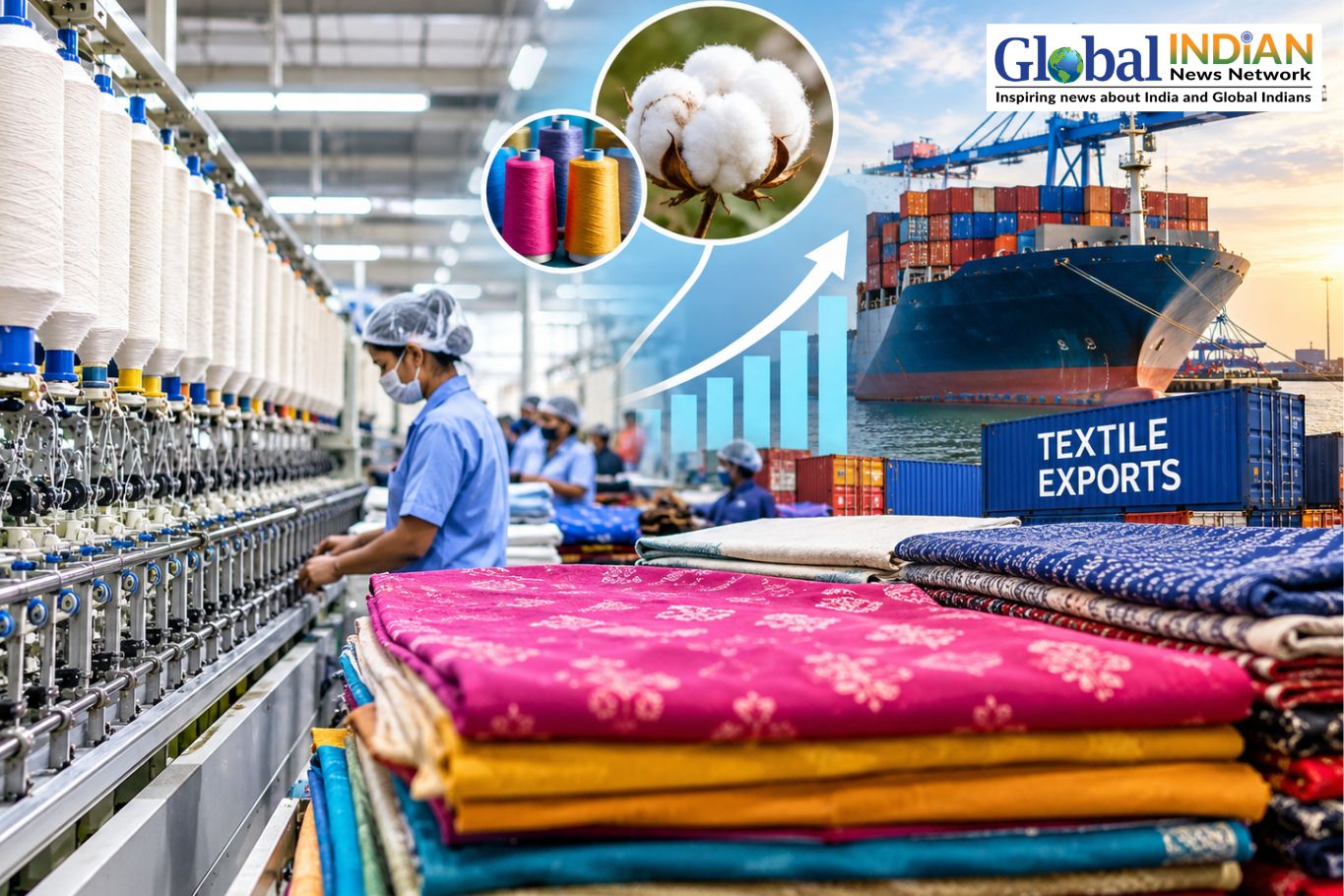
India’s textile industry is targeting a market value of US$350 billion by 2030, supported by domestic demand, manufacturing investments and renewed export growth, according to a report by Rubix Data Sciences cited by the India Brand Equity Foundation (IBEF).
The sector reached nearly ₹16.79 lakh crore (US$190 billion) in FY26, reflecting its continued importance to India’s manufacturing economy and employment landscape. The industry is expected to benefit from capacity expansion, technological modernisation and efforts to strengthen the country’s position in international textile markets.
The Central Government is considering a five-year Textile Expansion and Employment (TEEM) Scheme with a proposed outlay of ₹40,000 crore (US$4.21 billion). The initiative is expected to focus on modernising machinery, adopting advanced technologies and upgrading traditional textile clusters, potentially supporting productivity improvements and employment generation across the sector.
India’s textile and apparel exports, including handicrafts, showed signs of recovery during the first five months of FY27. Exports rose 10.30% year-on-year between April and August 2026, following a 2.70% decline to ₹3.17 lakh crore (US$35.80 billion) during FY26.
Despite the recent improvement, the industry continues to navigate global trade uncertainty, elevated input costs and changing demand across major international markets. Textile imports increased 17.10% to ₹84,835.2 crore (US$9.60 billion) in FY26. However, exports remained approximately 3.7 times the value of imports, underlining India’s position as a substantial net exporter of textile products.
Readymade garments accounted for 44% of India’s textile exports, making them the largest product category, while man-made fibre textiles contributed 15%. These segments remain important to the industry’s efforts to expand its global market share and respond to changing consumer preferences.
Rising raw material costs have emerged as a major concern for manufacturers. Cotton yarn prices increased by approximately 60%, reaching ₹400 per kilogram in September 2026 compared with ₹250 per kilogram in early 2026. The increase came amid a decline in domestic cotton production to 290.91 lakh bales during the 2025-26 season.
To provide relief to the industry, the government extended the exemption from the 11% cotton import duty until October 31, 2026. The measure is intended to help mills manage raw material costs and maintain competitiveness amid supply constraints.
The United States remained India’s largest textile export destination in FY26, accounting for 31% of total shipments. The European Union ranked second, representing nearly 16% of exports. However, shipments to the US declined by around 7%, while exports to major European markets increased by 9%.
The changing export landscape has encouraged Indian manufacturers to diversify their international markets and reduce dependence on a limited number of destinations. Expanding market access across Europe and other regions could help businesses manage geopolitical uncertainties, trade barriers and fluctuations in demand.
Investment in integrated textile manufacturing infrastructure is also gathering momentum. Proposals under the seven approved PM Mega Integrated Textile Region and Apparel Parks reached ₹68,590 crore (US$7.21 billion) by August 2026. The investments are expected to support capacity expansion, modernisation and the development of integrated production ecosystems.
The parks form part of broader efforts to improve manufacturing efficiency by bringing different stages of textile production closer together, potentially reducing logistics costs and strengthening supply-chain coordination.
India’s ambition to build a US$350 billion textile industry by 2030 will depend on its ability to sustain export growth, improve productivity and manage rising input costs. Continued investment in modern machinery, advanced manufacturing technologies and diversified export markets will be important to maintaining competitiveness.
With strong domestic demand, an established textile manufacturing base and ongoing policy initiatives, the sector has opportunities to expand its contribution to economic growth and employment. However, the pace of progress will also depend on global trade conditions, raw material availability and the effective implementation of proposed and ongoing government programmes.