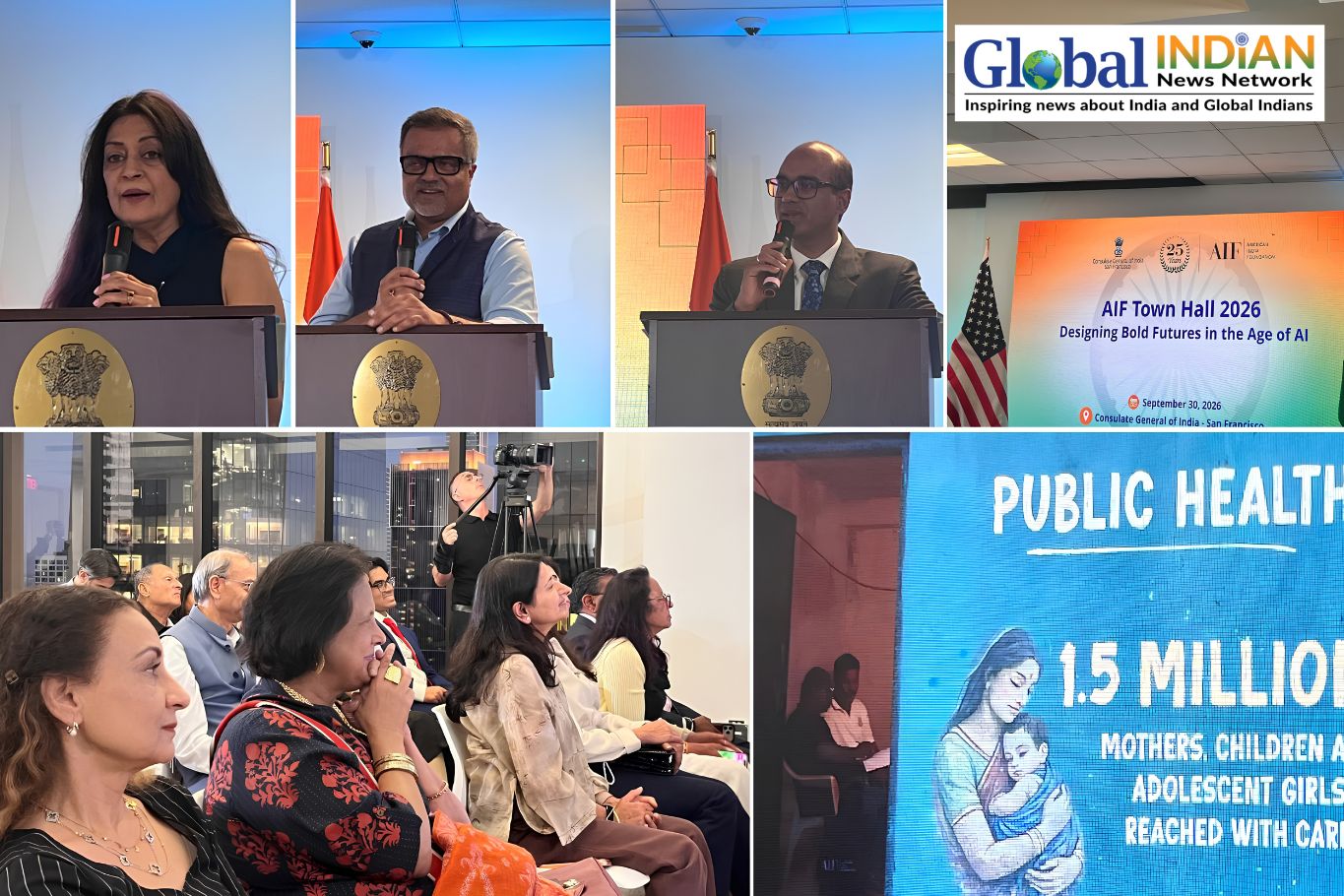
The American India Foundation (AIF) marked its 25th anniversary with an annual town hall meeting at the Consulate General of India in San Francisco, bringing together community leaders, philanthropists and technology experts to discuss how artificial intelligence can promote social impact without deepening existing inequalities.
The discussions focused on using AI to improve education, healthcare and livelihoods, particularly for underserved communities. Speakers emphasised the importance of accessible technology, reliable internet connectivity, language-inclusive tools and public trust to ensure that technological progress benefits people across socioeconomic backgrounds.
Consul Abhishek Sharma praised the foundation’s work in rural India, noting that its programmes had reached approximately 23 million people through initiatives supporting education, healthcare and skills development.
AIF Co-Founder and Board Co-Chair Lata Krishnan reflected on the organisation’s beginnings following the 2001 Gujarat earthquake, when members of the Indian diaspora united to support affected communities. Over the years, the foundation expanded its work to include education, public health, livelihood development and leadership opportunities.
AIF Chief Executive Officer Nishant Pandey outlined plans to integrate artificial intelligence and machine learning into the foundation’s programmes over the next 25 years, aligning its mission with India’s Viksit Bharat 2047 vision.
Pandey warned that India must address the emerging AI divide alongside the existing digital divide. He stressed that underserved communities continue to face challenges such as limited access to devices, connectivity and foundational education. While AI can help frontline workers identify needs and allocate resources, he emphasised that technology must complement human judgement and relationships.
Through its flagship Digital Equalizer programme, AIF is working with state governments in Delhi, Karnataka and Telangana to provide AI skills to approximately 375,000 children across 1,029 government schools. The initiative aims to prepare students from underserved backgrounds for an increasingly technology-driven economy.
The foundation is also applying AI to public health. Pandey highlighted a predictive health tool developed using programme data from 22,000 children in Madhya Pradesh and Odisha. The system helps frontline health workers identify children at risk of undernutrition over the following six to 24 months, allowing them to prioritise interventions.
The event also explored how AI could support classroom learning while strengthening foundational literacy and mathematics. Anchal Sayal, senior global partnerships manager at CodeAI and a former Teach For India educator, discussed the importance of introducing accessible, engaging technology tools for teachers and students.
CodeAI has partnered with state governments in Uttarakhand and Uttar Pradesh on initiatives such as Hour of AI events and AI for Farmers, a mobile-based curriculum that teaches machine learning through interactive activities. The organisation is also developing short courses to introduce students to computer science, software, hardware and AI concepts.
Experts at the town hall highlighted the need to develop technologies that reflect local languages, cultural contexts and community needs. They also emphasised that inadequate infrastructure, limited connectivity and a lack of trust can prevent underserved populations from benefiting from AI.
The event recognised the role of diaspora-led networks in supporting AIF’s work through fundraising, professional development and community engagement. Initiatives led by its Bay Area Young Professionals group have supported the foundation’s programmes, including efforts focused on maternal and newborn health.
As AIF enters its next quarter-century, its focus remains on ensuring that AI-driven progress creates meaningful opportunities for underserved communities. Speakers emphasised that the success of inclusive AI should be measured not simply by technology adoption, but by its ability to improve education, strengthen healthcare and support sustainable livelihoods.