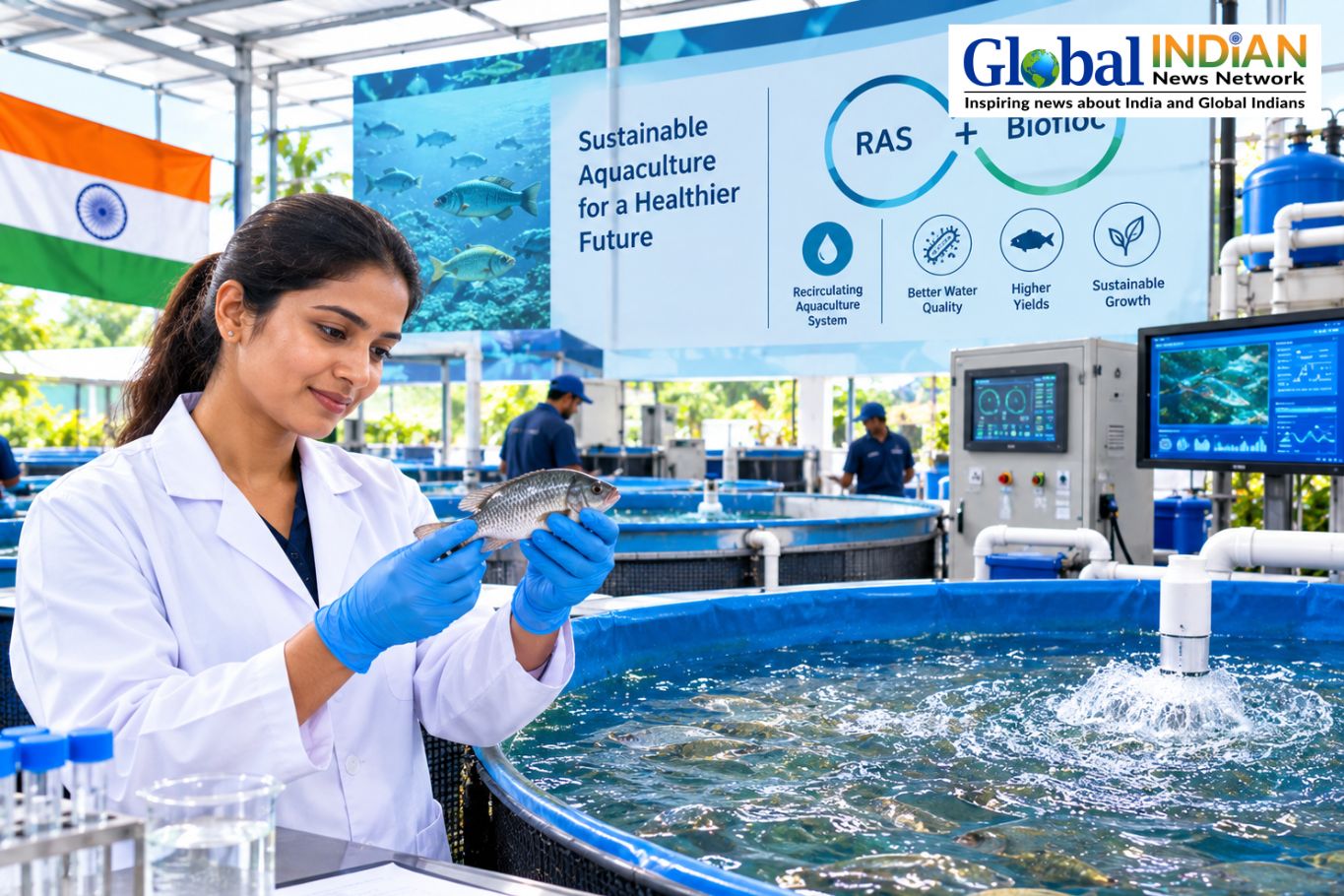
 India is increasingly turning to advanced aquaculture technologies to strengthen its fisheries sector, improve resource efficiency, and support the country’s growing Blue Economy. Recirculatory Aquaculture Systems, known as RAS, and Biofloc technology are emerging as important tools in this transformation, helping fish farmers increase production while using resources more efficiently.
The fisheries and aquaculture industry has become an important contributor to India’s economic development and supports the livelihoods of nearly 30 million fishers and fish farmers. India is now the world’s second-largest producer of fish, contributing around 8% of global production, while also holding a leading position in shrimp production and exports.
Government investment has played a major role in the sector’s rapid expansion. Since 2015, cumulative investments approved or announced through major fisheries and aquaculture programs have exceeded $5.21 billion. These initiatives have contributed to a substantial increase in fish production and strengthened India’s position in international seafood markets.
Annual fish production has more than doubled over the past decade, rising from approximately 9.6 million tonnes in 2013-14 to a record 19.8 million tonnes in 2024-25. Inland fisheries and aquaculture have also experienced significant growth, with production increasing by around 147% during the same period.
India’s seafood export industry has followed a similar upward trajectory. Export earnings increased from approximately $4.99 billion in 2013-14 to a record $8.36 billion in 2025-26, reflecting growing global demand and the expansion of India’s seafood production capabilities.
A major part of the sector’s technological transformation is being driven by RAS and Biofloc systems under the Pradhan Mantri Matsya Sampada Yojana. These methods allow farmers to operate more intensive fish-production systems while improving the use of water and other resources.
RAS technology is particularly important because it can recycle between 90% and 95% of the water used in fish farming. This makes it possible to establish production facilities in locations closer to cities and export centers while reducing dependence on large volumes of freshwater.
Biofloc technology also supports intensive aquaculture by improving water management and creating conditions that can help increase production within controlled farming systems.
Under government-supported programs, 9,467 RAS units and 4,573 Biofloc units have been approved, supported by investments totaling approximately $466.22 million.
These advanced technologies are also being introduced in cold-water fisheries regions, including Jammu and Kashmir, Ladakh, Uttarakhand, and Himachal Pradesh, where they are supporting trout farming. At the same time, technology-driven systems are strengthening export-oriented shrimp production.
The growing use of advanced aquaculture reflects India’s broader goal of building a more self-reliant and technologically capable economy. By combining investment, innovation, and resource-efficient farming, India is seeking to expand fish production, support millions of livelihoods, and strengthen its position as a major player in the global seafood industry.