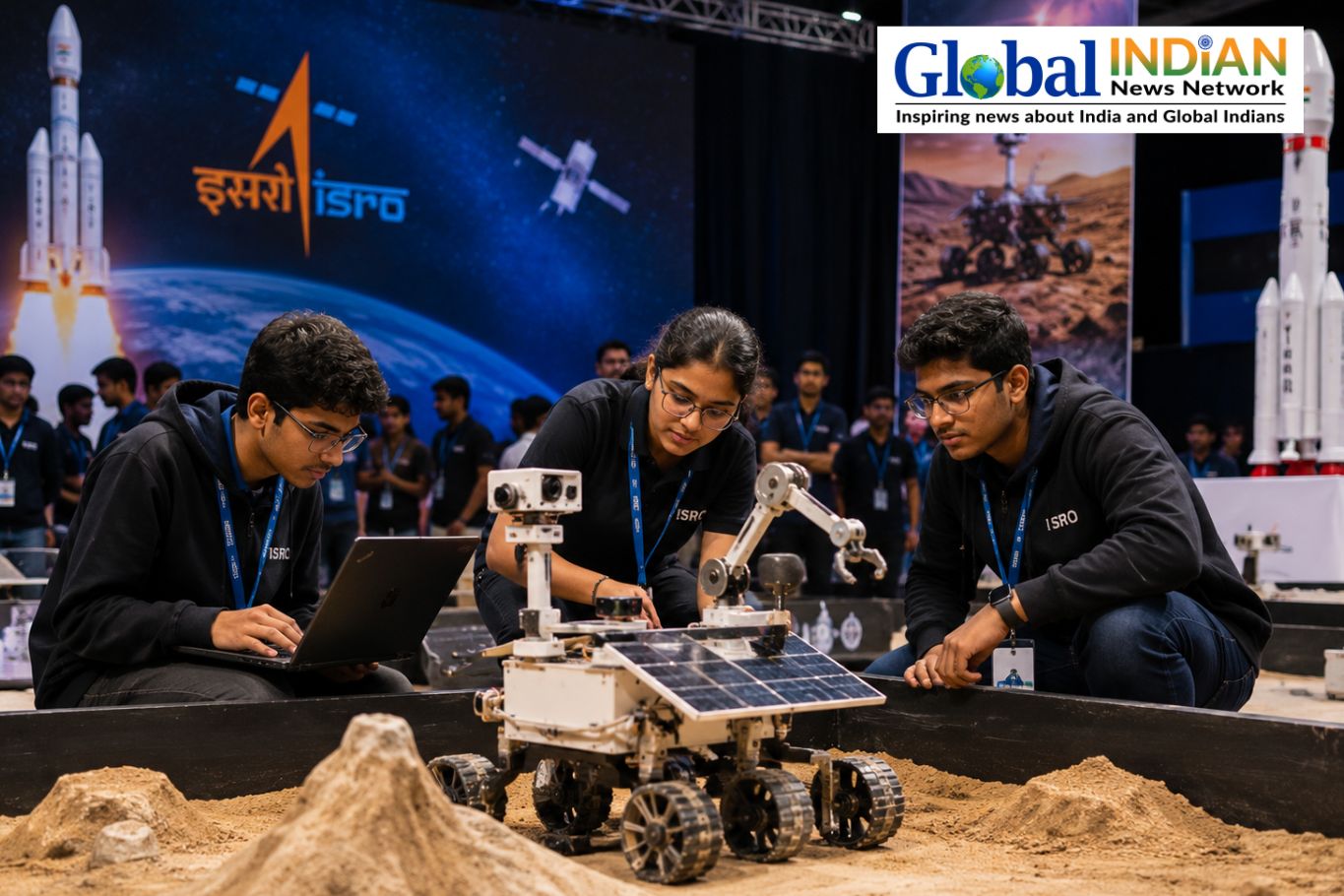
 The third edition of the ISRO Robotics Challenge–URSC (IRoC-U) 2026 has highlighted India’s growing talent in robotics, artificial intelligence, and space technology, with students developing advanced autonomous systems aimed at supporting future planetary exploration missions.
Organized by the UR Rao Satellite Centre (URSC), the national-level competition attracted nearly 590 student teams from across India. After multiple rounds of design improvements, testing, and experimentation, 20 shortlisted teams participated in the final field round held in Bengaluru from July 21 to July 23.
The 2026 challenge, titled “Towards Swarm Expedition: Autonomous Surveyor Challenge for Exploration, Navigation and Dynamics” (ASCEND), required participants to create fully autonomous unmanned aerial vehicles (UAVs) and supporting base stations. The systems were expected to perform complex tasks such as terrain mapping, navigation, feature identification, autonomous landing, data transmission, and self-recharging in environments without GPS support, similar to conditions that could exist during future space missions.
The finalist teams presented their solutions using advanced technologies, including artificial intelligence, computer vision, embedded systems, and autonomous navigation. Their innovations were evaluated by ISRO scientists and technical experts, reflecting the importance of student contributions to India’s future space ambitions.
Speaking at the closing ceremony, ISRO Chairman and Secretary of the Department of Space V. Narayanan praised the participants, describing them as an important part of India’s upcoming space journey. He highlighted India’s transformation from early challenges, including transporting rocket components through basic methods, to achieving major milestones such as the Mars Orbiter Mission, Chandrayaan-3, SpaDeX, and NISAR.
Narayanan encouraged students to focus on developing new technologies instead of only consuming existing innovations. He urged young engineers to take on challenging projects, experiment boldly, and view failures as opportunities for learning and improvement.
URSC Director M. Sankaran said the competition was created not only to recognize winners but also to strengthen technical skills, creativity, collaboration, and problem-solving abilities among future engineers. Chief evaluator V. Koteswara Rao called the event a “festival of innovation” and appreciated the high standard of autonomous systems created by participating teams.
Launched in 2024 to celebrate Chandrayaan-3’s successful landing near the Moon’s South Pole, IRoC-U has become a major platform connecting students with technologies relevant to India’s upcoming exploration programs. The winners of the 2026 edition will be announced on National Space Day on August 23.