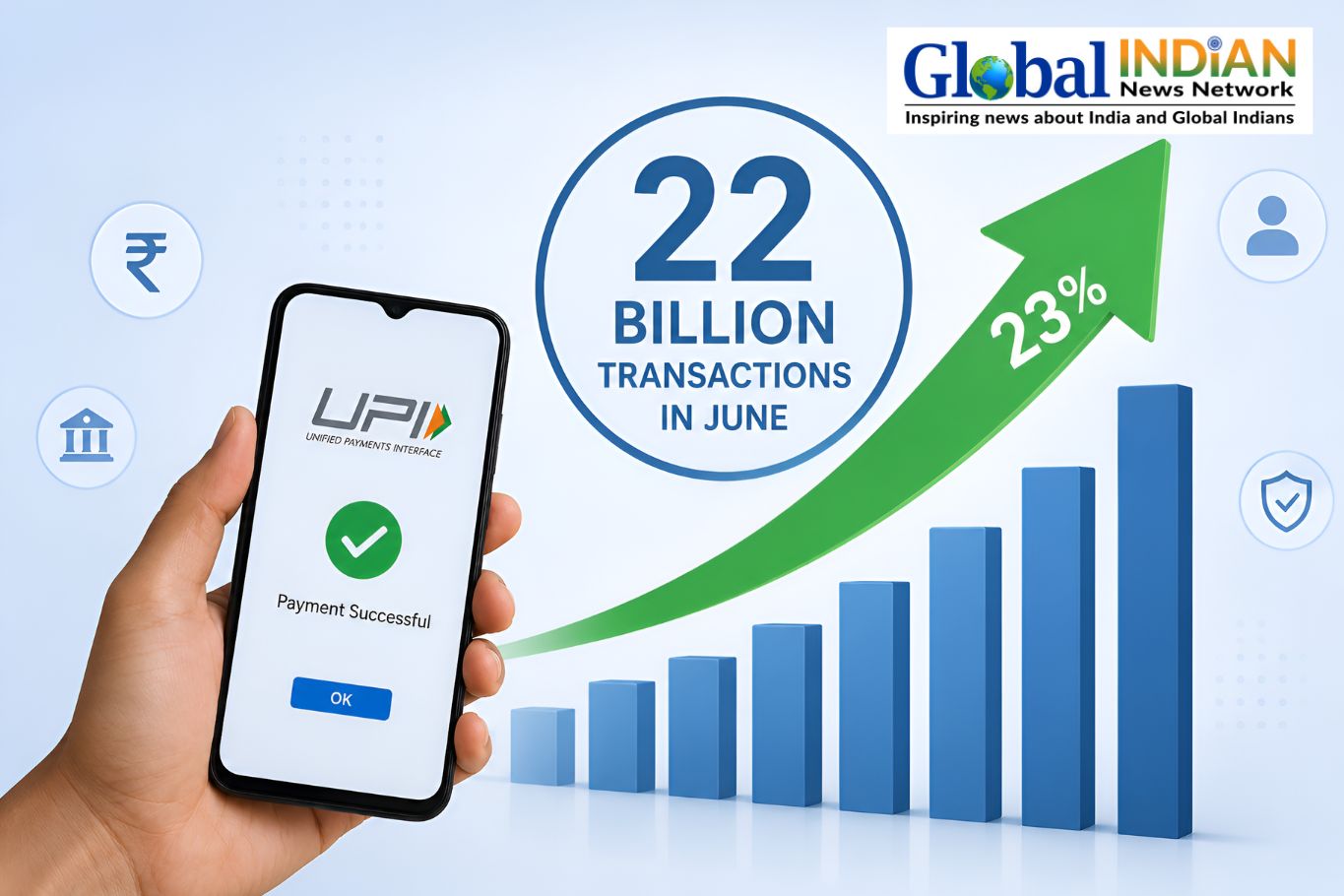
 India’s Unified Payments Interface (UPI) continued its strong upward momentum in June 2026, registering a sharp rise in both transaction volume and value, according to data released by the National Payments Corporation of India (NPCI). The platform processed more than 22 billion transactions during the month, reflecting a year-on-year increase of 23% and highlighting the continued acceleration of digital payments across the country.
In terms of value, UPI transactions climbed 20% compared to the previous year, crossing $296.92 billion. This growth underscores the increasing reliance of both consumers and businesses on instant, cashless payment systems. On an average day in June, UPI handled around 757 million transactions, demonstrating the scale, speed, and efficiency of India’s digital financial infrastructure.
Officials and industry experts attribute this sustained expansion to broader financial inclusion, improved merchant acceptance, and growing consumer trust in secure digital payment platforms. Small businesses, retail outlets, and service providers across urban and rural regions are increasingly adopting UPI as their preferred payment method, further strengthening the country’s shift toward a cashless economy.
Beyond domestic growth, UPI is also expanding its global reach, reinforcing India’s position as a leader in digital public infrastructure. The system is now operational in more than eight countries, including the United Arab Emirates, Singapore, France, Mauritius, Sri Lanka, and Greece, among others. This international expansion is helping facilitate faster, more seamless cross-border transactions for Indian users abroad.
A notable development during the period was the launch of a UPI-based remittance service by Eurobank in Greece, allowing direct transfers to India. This initiative is expected to simplify international money transfers while reducing costs and processing times for users.
The global adoption of UPI reflects India’s growing influence in financial technology and its efforts to build interoperable payment systems that can connect multiple economies. By enabling real-time, low-cost transactions across borders, UPI is emerging as a key tool in strengthening global financial connectivity.
Experts believe that continued expansion of UPI will further enhance digital inclusion, support innovation in fintech services, and reinforce India’s leadership in developing scalable and secure payment ecosystems. As adoption deepens both domestically and internationally, UPI is expected to play an increasingly central role in shaping the future of global digital payments.