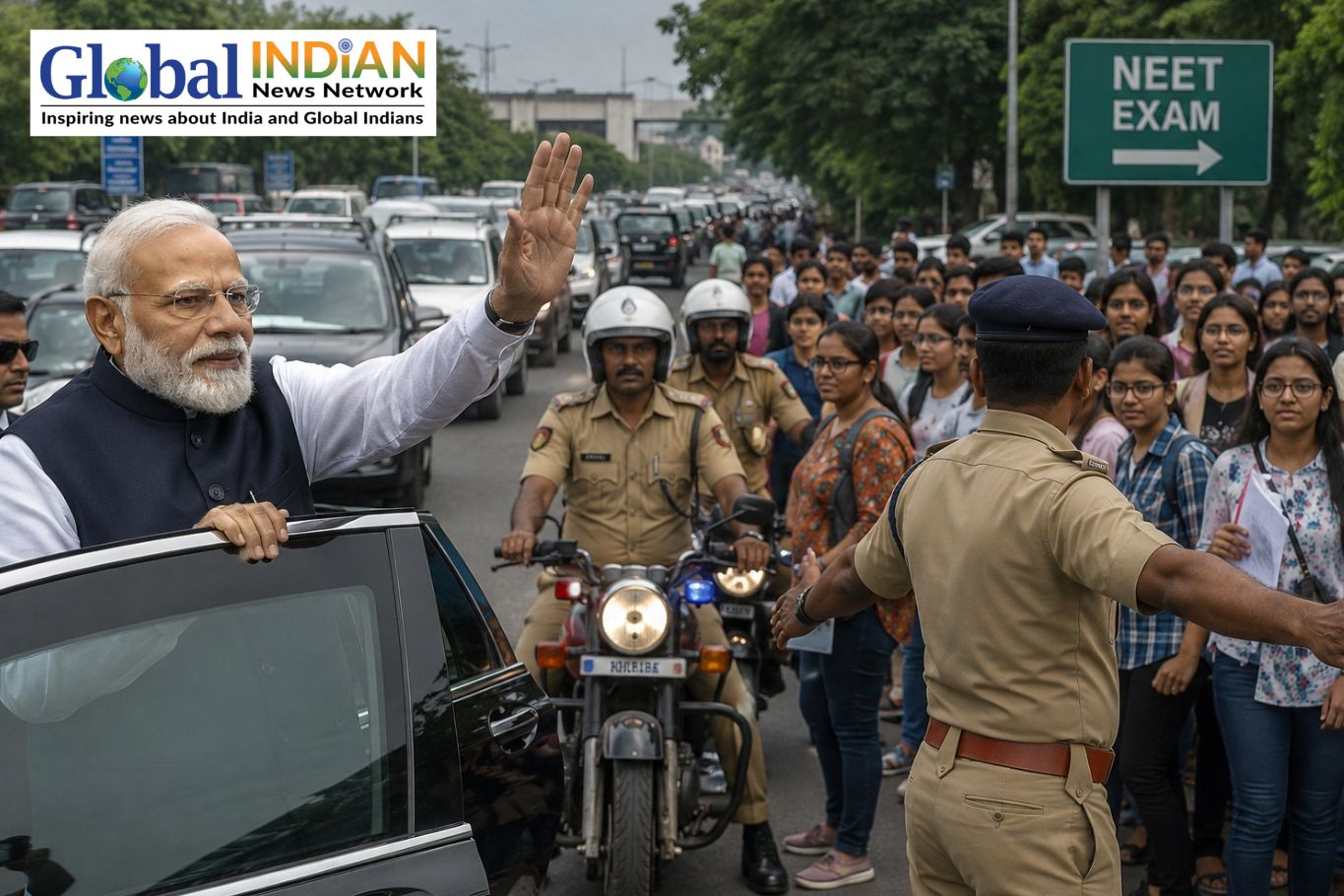
 Prime Minister Narendra Modi adjusted his departure from Delhi Airport on Sunday to ensure that students appearing for the NEET-UG re-examination did not face any travel inconvenience. The decision was taken to maintain smooth traffic flow in the national capital at a time when thousands of candidates were travelling to examination centres across the city.
According to official information, the Prime Minister arrived at Delhi Airport at around 1:15 pm. Instead of leaving immediately for his residence, he remained at the airport as the NEET-UG examination was scheduled to begin at 2 pm. Authorities noted that this was a crucial travel window for students heading to exam venues, making uninterrupted traffic movement essential.
Officials explained that movement of the Prime Minister’s convoy typically requires temporary road diversions and heightened traffic management. By delaying his departure, the need for such restrictions during peak student movement was avoided, helping ensure that candidates could reach their centres on time and without disruption.
After the examination commenced at 2 pm, the Prime Minister left the airport for his residence. The step was described as a measure taken to prioritise student convenience during one of India’s largest competitive examinations.
The NEET-UG 2026 re-test is being conducted across the country following the cancellation of a previous session due to reported irregularities. The examination remains one of the most significant entrance tests for admission to undergraduate medical courses in India.
This year, more than 2.2 million candidates are appearing across approximately 5,440 centres in India and abroad. The National Testing Agency has implemented extensive security arrangements to ensure fairness and transparency throughout the process.
More than 95,000 examination rooms are being monitored through around 1.38 lakh CCTV cameras across centres. In addition, over 51,000 signal jammers have been deployed to prevent electronic malpractice during the exam.
The arrangements also include about 39,000 frisking personnel, nearly 48,000 biometric verification staff, and thousands of observers and centre officials working together to maintain strict examination protocols.
Officials stated that these large-scale measures are designed to protect the integrity of the examination process and ensure a level playing field for all candidates appearing in the NEET-UG re-test.