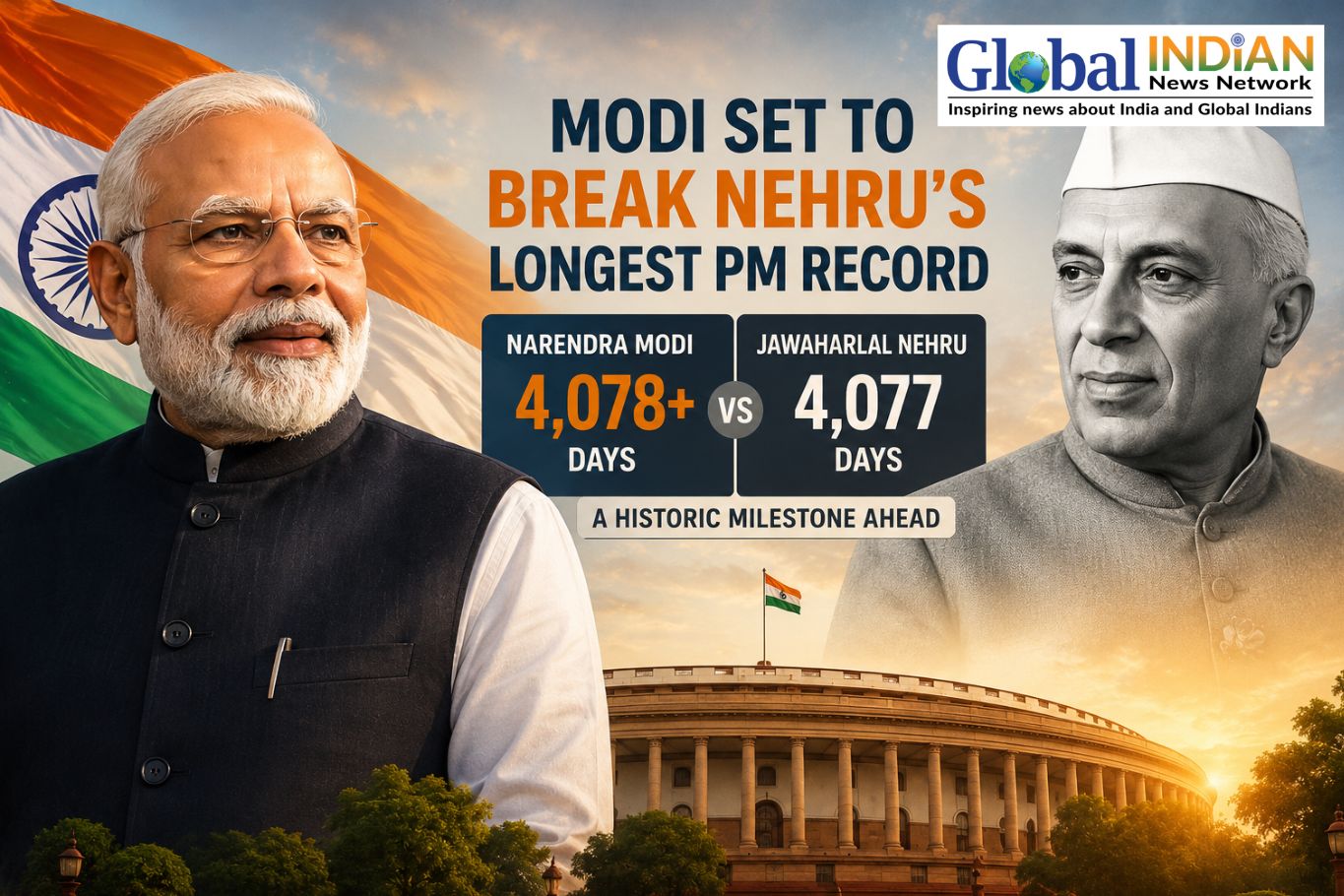
 Prime Minister Narendra Modi is on track to achieve a historic milestone in Indian political history by surpassing Jawaharlal Nehru’s record for the longest continuous tenure as an elected head of government. According to calculations based on his time in office, this landmark is expected to be reached on June 10, 2026.
Modi has served as Prime Minister since May 26, 2014, when he first took office after leading his party to a decisive majority in the Lok Sabha elections. By the time he completes his tenure on the stated date, his uninterrupted period in office will total approximately 4,399 days, narrowly exceeding Nehru’s record of 4,398 days.
Jawaharlal Nehru, India’s first Prime Minister, held office from the establishment of the Republic’s electoral system in the early 1950s until his death in 1964. His leadership spanned a foundational era in India’s post-independence development, and he remains one of the most influential figures in the country’s political history.
The comparison between the two leaders highlights contrasting political eras and leadership styles. Nehru governed during a period when the Indian National Congress dominated the political landscape with limited organized opposition, shaping the early framework of India’s democratic institutions. His legacy continued to influence Indian politics for decades after his passing.
In contrast, Modi’s rise came in a far more competitive and diverse political environment. Before becoming Prime Minister, he served multiple terms as Chief Minister of Gujarat, where he built a strong political base through consecutive electoral victories. His national leadership began with a decisive electoral mandate that brought his party to power with a clear majority in 2014, followed by renewed mandates in subsequent elections.
Supporters of the current administration point to major policy decisions and legislative actions taken during Modi’s tenure, including constitutional changes, judicially approved reforms, and large-scale infrastructure and governance initiatives. These developments are often cited as defining features of his time in office.
The milestone has also sparked broader comparisons between India’s early post-independence leadership and its current political trajectory. While Nehru is credited with laying the foundations of modern Indian democracy and governance institutions, Modi’s tenure is viewed by supporters as a period of assertive policy-making and structural transformation.
As the date approaches, the record is being closely watched as a symbolic moment in India’s democratic journey, marking a shift in the historical narrative of the country’s longest-serving elected leaders.