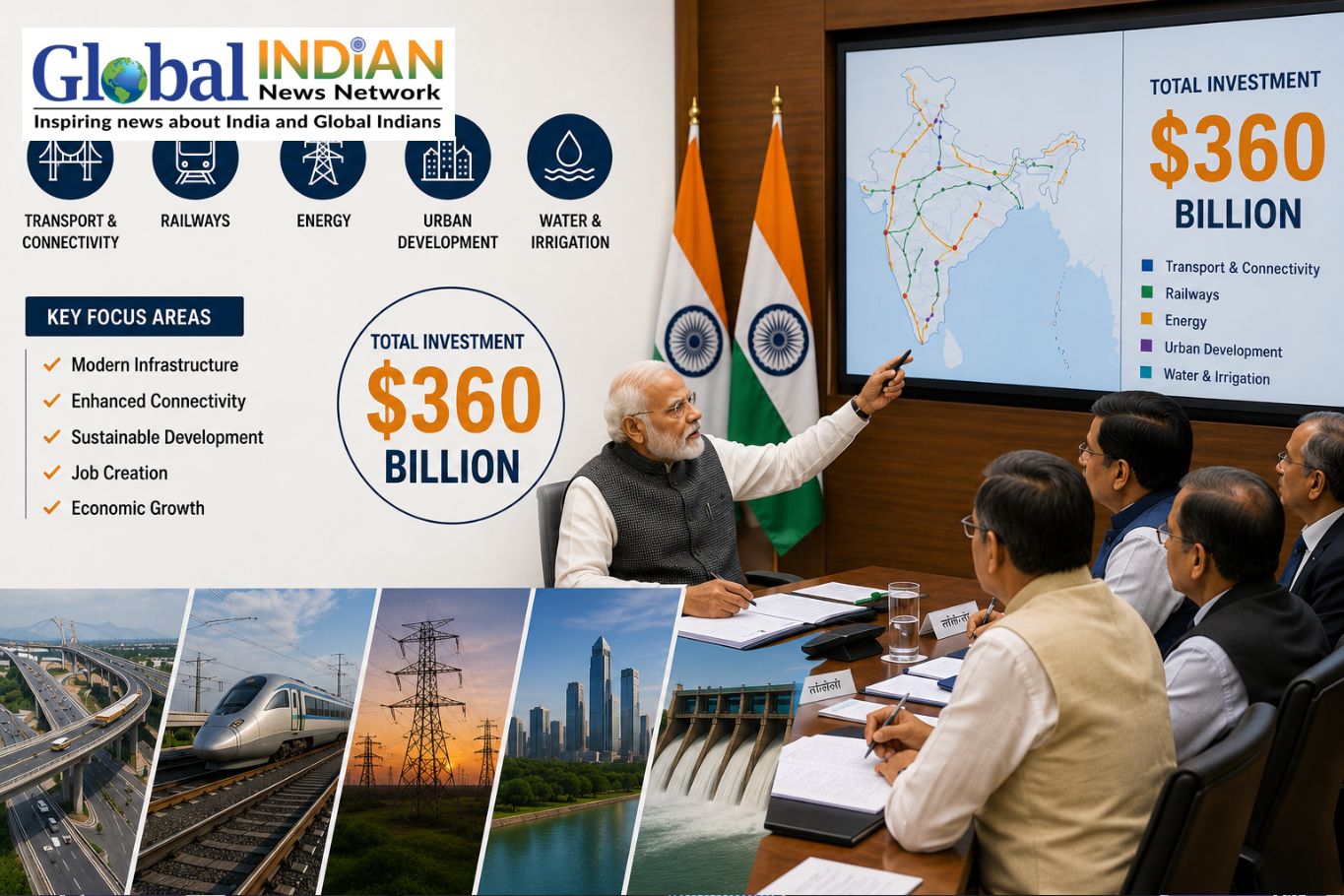
 Prime Minister Narendra Modi on Thursday said that infrastructure and development projects worth more than $360 billion were reviewed during the latest PRAGATI meeting held on Wednesday. The review covered multiple sectors, including railways, power, road connectivity, ports, sanitation, and social welfare initiatives across several Indian states.
In a post on X, the Prime Minister said the discussions included key projects in railways, energy, and road infrastructure, along with updates on port development, Swachh Bharat Mission 2.0, and other ongoing social sector schemes. The PRAGATI platform is designed to bring together central and state governments to ensure faster implementation of major public projects through coordinated monitoring.
The 51st PRAGATI meeting focused on seven major infrastructure projects spread across nine states. These included initiatives in railways, power generation, and road development, as well as the Ken-Betwa river interlinking project, which is considered a significant step in addressing water distribution challenges in central India.
During the review of power sector projects, PM Modi stressed the importance of accelerating rooftop solar adoption across urban regions. He highlighted the need for wider deployment in cities, housing societies, and public institutions, emphasizing that rooftop solar should be implemented on a mission basis. According to him, this would help reduce electricity costs, improve energy security, and promote clean energy usage at the household level.
While reviewing road and port infrastructure, the Prime Minister highlighted the importance of developing Vadhavan Port as a model for integrated logistics. He stated that the port should be connected seamlessly with multiple transport systems, including coastal shipping, inland waterways, freight corridors, highways, railways, and airports. This integrated approach is expected to create a modern and efficient logistics network to support India’s long-term economic growth.
The Prime Minister also emphasized the need for effective implementation of Swachh Bharat Mission 2.0. He said the focus should go beyond building infrastructure and shift toward achieving measurable outcomes through regular monitoring and public participation. He urged states to speed up the completion of waste management facilities, including processing plants and GOBARdhan units.
On the Ken-Betwa River Linking Project, PM Modi said it should serve as a model for resolving inter-state water disputes through cooperation and technology-based monitoring. He encouraged states to explore similar integrated approaches for water conservation, irrigation efficiency, and groundwater recharge to ensure long-term water security.
He further underlined that delays in public projects increase costs and deny citizens timely benefits. He called for faster decision-making, removal of bottlenecks, and strict timelines for execution. The Prime Minister also suggested innovative use of canal networks, including installing solar panels over canals to generate renewable energy while reducing water loss and optimizing land use.