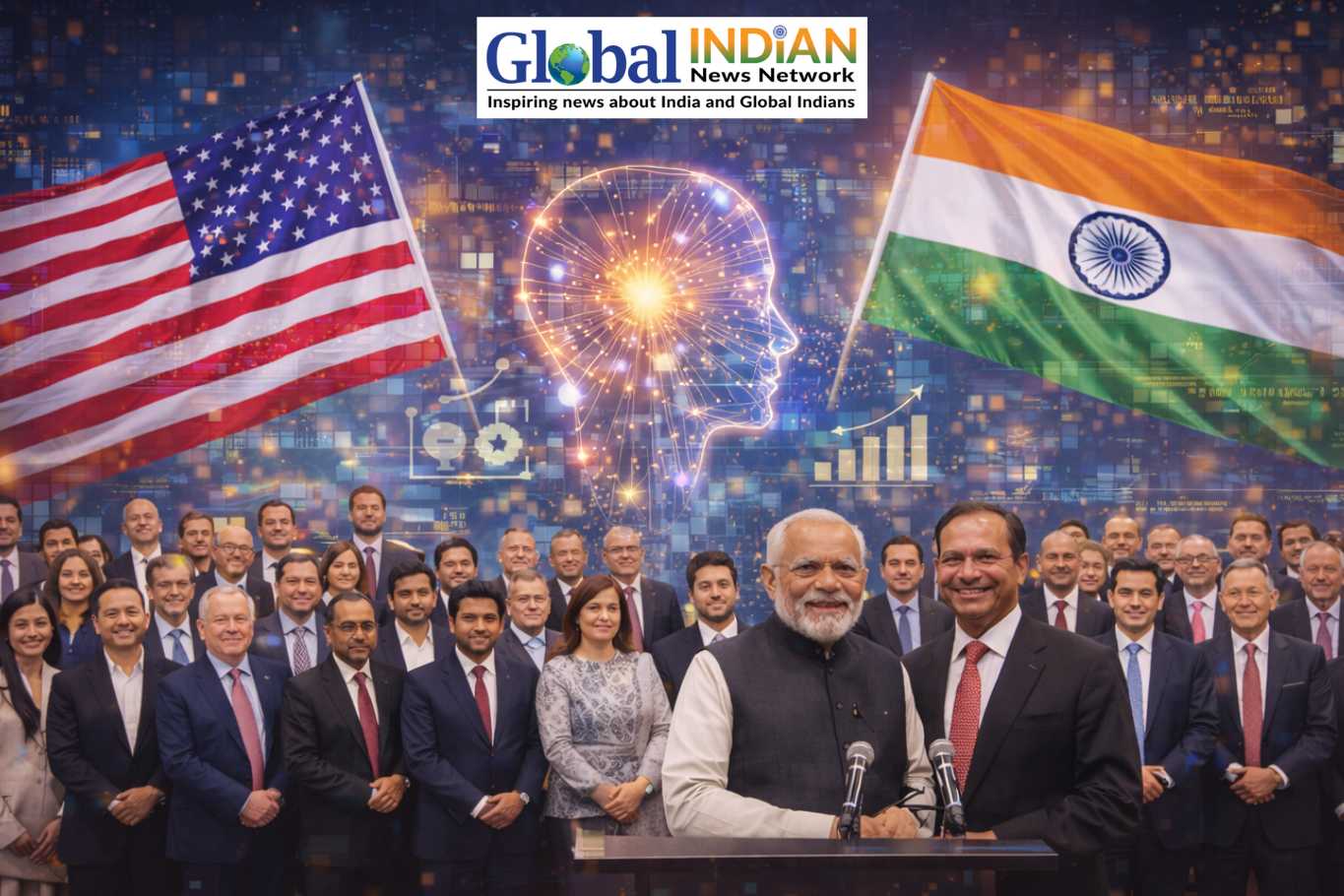
 The US–India Strategic Partnership Forum (USISPF) has unveiled plans to spearhead the most extensive American corporate delegation ever assembled for India, marking its role as an official partner of the India AI Impact Summit 2026. The high-profile gathering is scheduled to take place in New Delhi from February 16 to 20, in close coordination with the Ministry of Electronics and Information Technology, underscoring the growing centrality of artificial intelligence in bilateral engagement.
USISPF confirmed that more than 120 top executives and senior technology leaders from the United States will participate in the summit, describing the move as a pivotal moment in deepening collaboration on AI governance, secure digital ecosystems, and future-ready technological infrastructure. The organization views this initiative as a bridge between innovation, policy, and real-world deployment of advanced technologies.
Ahead of the summit, USISPF also introduced a newly formed Board AI Task Force, chaired by veteran technology leader John Chambers. This body will concentrate on reinforcing AI frameworks, promoting ethical and responsible adoption, and ensuring that AI-driven solutions generate meaningful impact at a large scale. Chambers emphasized the symbolic and practical significance of AI for both nations, remarking that artificial intelligence represents a shared future for America and India, benefiting nearly two billion people collectively.
The delegation will be jointly led by Shantanu Narayen, vice chair of USISPF and chief executive of Adobe, and Raj Subramaniam, vice chair of USISPF and head of FedEx Corporation. Their leadership reflects the blend of software innovation and logistics expertise shaping modern digital economies.
USISPF stated that the delegation will feature senior representatives from leading global firms such as Microsoft, General Catalyst, Ericsson, Chemours, Rubrik, Uniphore, and Kore.ai, alongside executives from manufacturing, transportation, and advanced service sectors. This diverse mix highlights the multi-industry relevance of AI and digital transformation.
A key objective of the visit is to advance the TRUST Initiative, which aims to stimulate investment in India’s computational infrastructure while supporting startups developing AI applications focused on social welfare. The delegation will also work toward strengthening supply chain security, including deeper integration with the Pax Silica framework, which seeks to build resilient technology networks among like-minded nations.
During the official program at Bharat Mandapam, USISPF will host a flagship session titled “Scaling Trusted AI for 8 Billion+,” exploring how AI can be deployed responsibly across global populations. Additionally, it will organize exclusive events at The Leela Palace in New Delhi on February 18, featuring closed-door dialogues on national security, supply chain stability, and strategic technology cooperation.
Mukesh Aghi, president and chief executive of USISPF, reaffirmed that the US–India relationship plays a crucial role in shaping a reliable global AI ecosystem. As India prioritizes artificial intelligence as a national mission and the United States advances trusted AI frameworks, emerging technologies are rapidly becoming a defining pillar of the broader strategic partnership between the two nations.