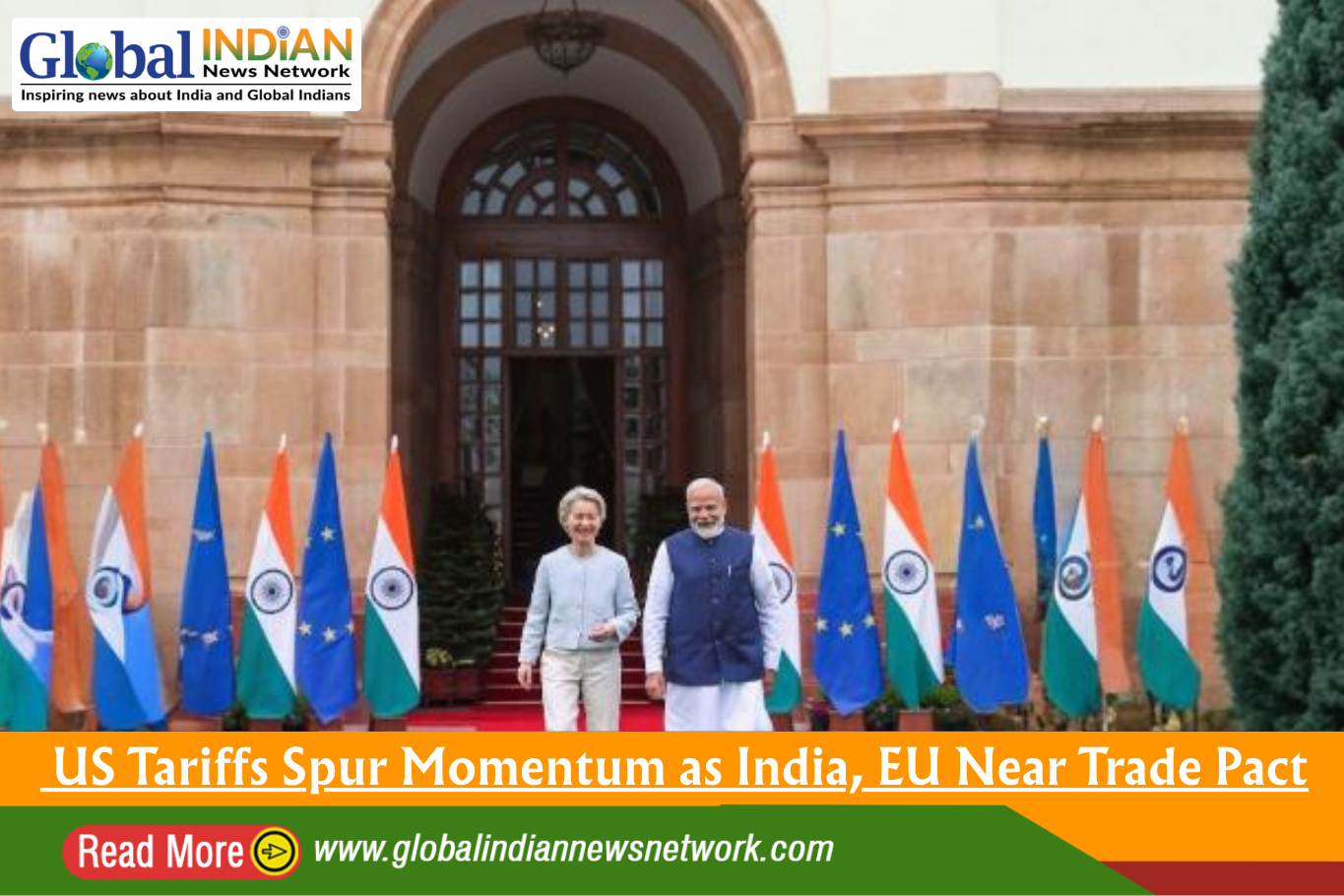
 India and the European Union are moving closer to finalizing a long-awaited trade pact within the next three months, according to a recent report. The agreement, currently under negotiation, is expected to address crucial areas such as agriculture, sustainability, and market access. If concluded, it has the potential to transform the landscape of global commerce.
Negotiators have reported a noticeable surge in momentum during the discussions. Much of this renewed energy has been attributed to U.S. President Donald Trump’s tariff offensive, which has pushed both parties to accelerate their dialogue, according to an analysis published by OneWorldOutlook.
The report emphasizes that for the European Union, the trade pact is largely a shield against increasing global volatility. By contrast, for India, it is more than just an economic safeguard—it is a powerful statement of strategic confidence after more than a decade of reforms and steady growth.
“Where the EU’s approach is driven by the need to shield its market from global volatility, India’s motivation is strategic. New Delhi sees this deal not as an act of desperation but as an assertion of its global economic confidence—a step toward shaping, rather than merely adapting to, the new trade order,” the report underlined.
India’s rapidly expanding manufacturing base, its flourishing digital economy, and the strength of its domestic demand position the country as an indispensable partner for European businesses. For many firms, India represents not only a vast consumer market but also a crucial production hub, particularly as companies seek reliable alternatives to China.
Europe’s urgent need to diversify away from its dependence on Russia and China has further elevated India’s importance in the bloc’s strategic calculations. This is true even as New Delhi continues to maintain its longstanding relationship with Moscow, a factor that the report notes is being carefully balanced within the negotiations.
A major point of contention has been sustainability-related provisions, especially those connected to the European Union’s Carbon Border Adjustment Mechanism (CBAM). India has consistently opposed binding clauses in this regard. Union Commerce Minister Piyush Goyal has described such requirements as “unfair,” arguing that they effectively penalize developing economies for historical carbon emissions they did not cause.
The report concludes that if the trade agreement is successfully finalized, it will not merely be another bilateral deal. Instead, it would represent India’s arrival as a decisive player capable of influencing and shaping the very rules of global trade. However, if the deal is delayed or postponed, it will serve as a reminder of the inherent complexity of negotiations conducted between two equal partners, each pursuing its own vision of economic resilience and strategic influence.