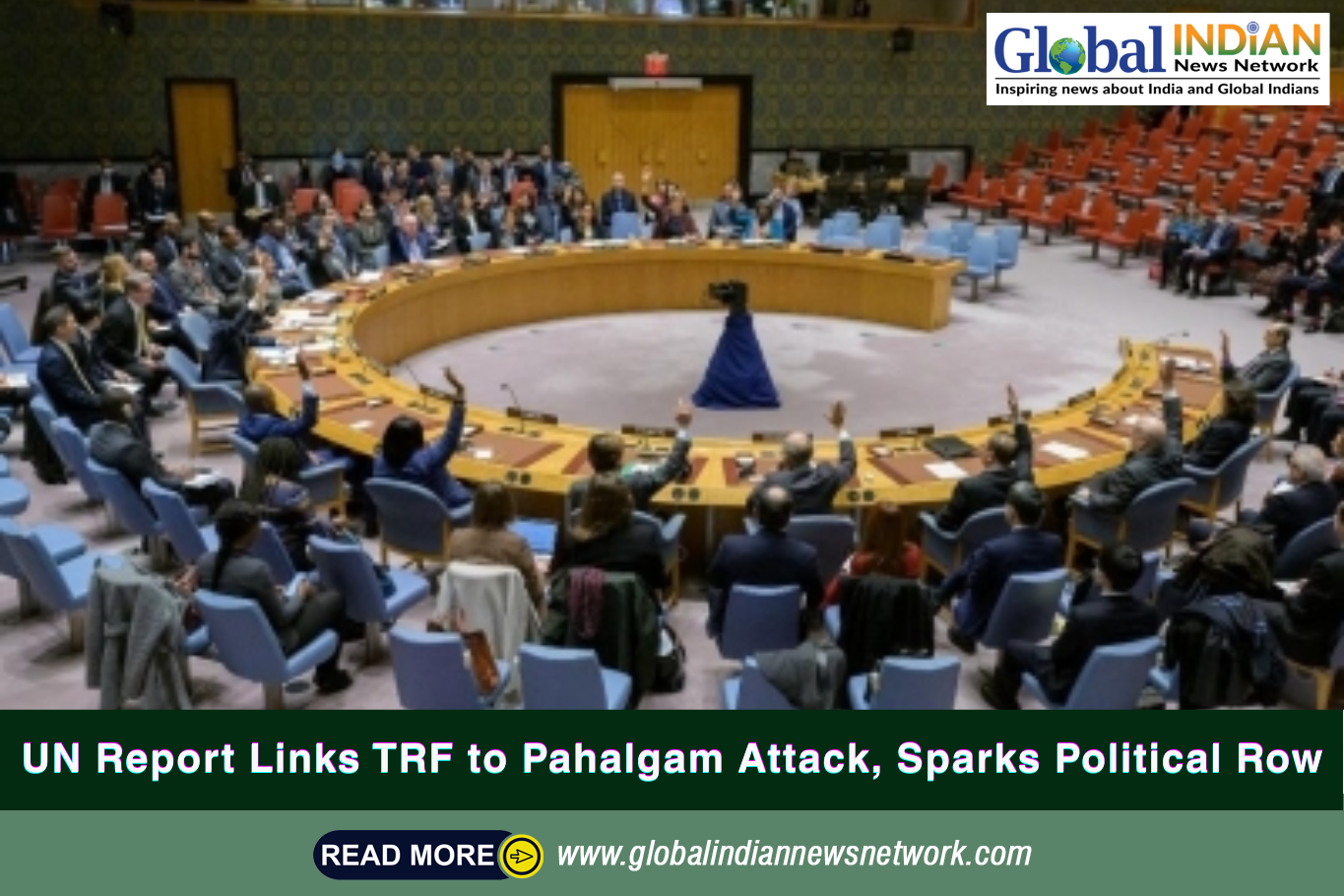
 In a major international development, the United Nations Security Council (UNSC) has officially named The Resistance Front (TRF), a known proxy of Lashkar-e-Taiba (LeT), as the perpetrator behind the deadly terror attack in Pahalgam. The attack, which occurred on April 22, claimed the lives of 26 civilians, most of them tourists, and marked one of the deadliest attacks on Indian soil since the 2008 Mumbai strikes.
The UNSC’s monitoring committee released its findings on July 24, linking TRF to the brutal incident. According to the report, five terrorists attacked a popular tourist location in Pahalgam, resulting in the mass killing of civilians. The group claimed responsibility immediately after the incident and even published a photo from the site. However, TRF curiously retracted the claim on April 26, and no other organization stepped forward to claim involvement, reinforcing TRF’s accountability.
The development was hailed as a diplomatic victory for India, coming just days after the United States formally designated TRF as a global terrorist entity. The U.S. had announced the designation under the Foreign Terrorist Organization (FTO) and Specially Designated Global Terrorist (SDGT) lists. U.S. Secretary of State Marco Rubio emphasized that the action underlined Washington’s commitment to supporting global counter-terrorism efforts and bringing justice to the victims of the Pahalgam massacre.
Back home, the political implications were swift. BJP IT cell chief Amit Malviya cited the UNSC report to target senior Congress leader P. Chidambaram, who had recently questioned whether the attackers had come from Pakistan. Malviya, in a scathing social media post, said the UN report leaves no ambiguity about Pakistan’s involvement and TRF’s role. He accused Chidambaram and others in the opposition of acting as apologists by continuing to deny clear evidence of cross-border terrorism.
Chidambaram, in an earlier interview, had cast doubt on the origin of the attackers, suggesting they might be “homegrown” and asserting that there was “no evidence” to prove a Pakistani link. His remarks sparked controversy, especially in light of international findings naming TRF—a known LeT proxy operating with the support of Pakistan’s military-intelligence complex.
The UNSC report also noted the fragile regional relations and cautioned that terrorist groups may exploit these tensions. Observers say the retraction of TRF’s initial claim may have been a tactical move under pressure from handlers in Pakistan to obfuscate state involvement.
The U.S. has stood firmly with India following the attack. The listing of TRF as a global terror outfit was described as part of a broader initiative to strengthen the international fight against terrorism and hold accountable those who finance and support such acts.
This global endorsement of India’s counter-terrorism narrative comes at a time when India has aggressively pursued terror infrastructure across the border under Operation Sindoor. The inclusion of TRF in both UN and U.S. terror listings further consolidates India’s long-standing claim that Pakistan continues to sponsor and shelter terrorist groups.
As the debate continues within India’s political circles, the international community appears to be increasingly aligned with New Delhi’s position on cross-border terrorism. The Pahalgam attack and its aftermath may prove to be a turning point in both diplomatic and domestic responses to the long-running threat of Pakistan-sponsored terrorism.