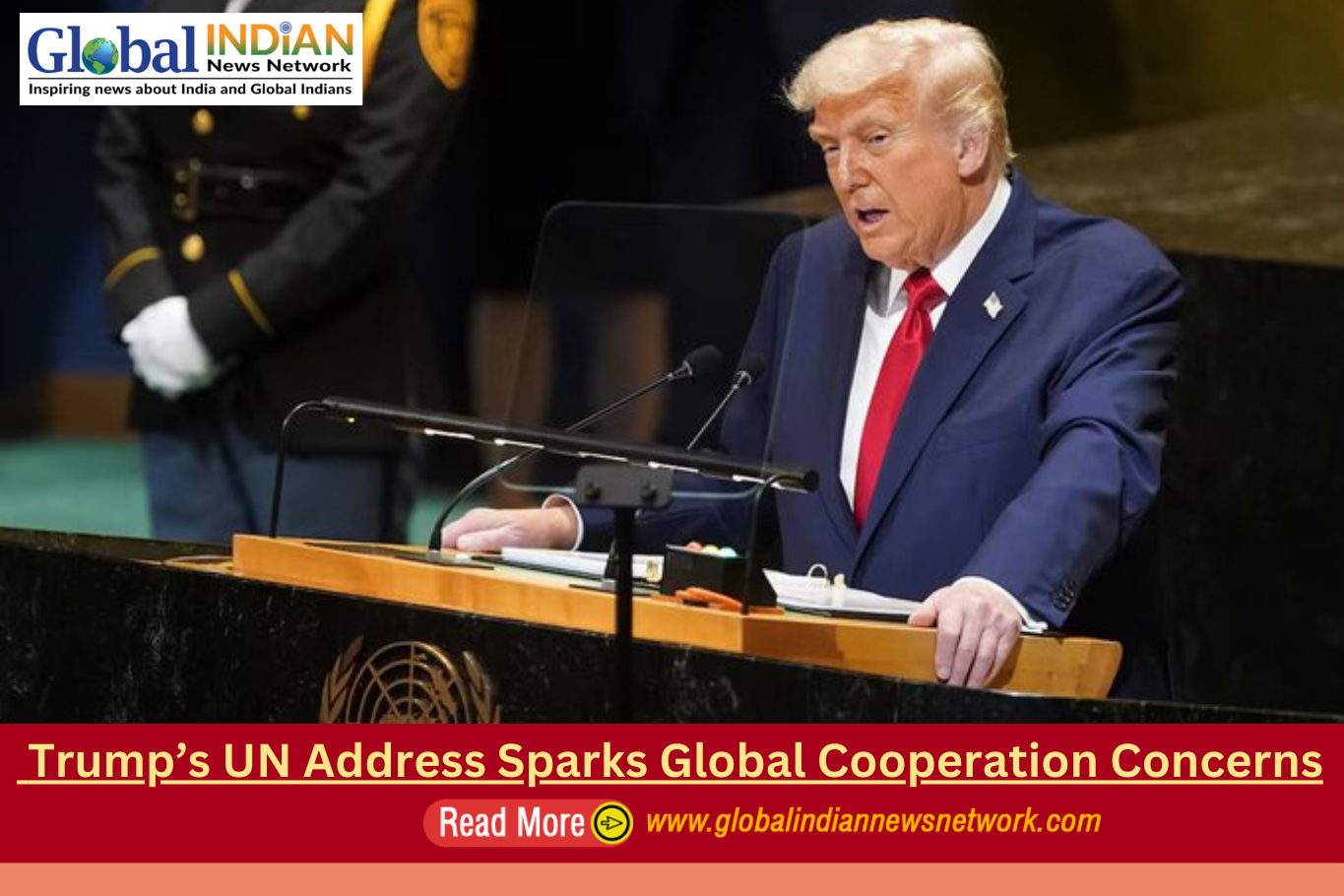
 U.S. President Donald Trump returned to the United Nations General Assembly (UNGA) on September 23, 2025, delivering a speech that highlighted his long-standing focus on national sovereignty, state independence, and cultural preservation. Speaking before a largely silent audience of world leaders, Trump criticized migration, climate initiatives, and the efficacy of international institutions, signaling a preference for transactional and bilateral diplomacy over multilateral cooperation.
Trump described migration as a “crisis” threatening Western countries, arguing that nations should address challenges domestically rather than rely on international frameworks. He criticized UN programs for providing financial support to refugees, framing these efforts as a burden on Western nations. Similarly, he dismissed climate science, calling carbon footprint concepts a “hoax” and labeling global green energy initiatives as harmful to countries abroad.
While positioning himself as a peacemaker, Trump claimed credit for ending multiple longstanding conflicts, overlooking the contributions of other nations and diplomatic efforts. He lamented that the UN’s potential has largely remained unrealized, describing the organization’s work as “empty words” in many cases.
Experts warn that such rhetoric undermines the foundation of international cooperation, rejecting shared responsibility for global challenges like human rights protection, environmental sustainability, and nuclear non-proliferation. Over recent months, Trump’s administration has taken concrete steps to reduce U.S. involvement in global institutions, including withdrawing from the World Health Organization, scaling back the U.S. Agency for International Development, and exiting the Paris Climate Accord.
Trump’s UNGA address echoes his March 2025 Congressional speech, using critical language to label multilateral programs and guide public perception without detailed justification. While he did not engage with ongoing UN reform proposals, his comments reinforce a vision of international relations centered on sovereignty and national interest rather than collaborative global governance.
By prioritizing domestic concerns and bilateral approaches, Trump challenges the traditional role of the UN and risks weakening multilateral frameworks designed to address issues that transcend borders, including migration, climate change, and international security.