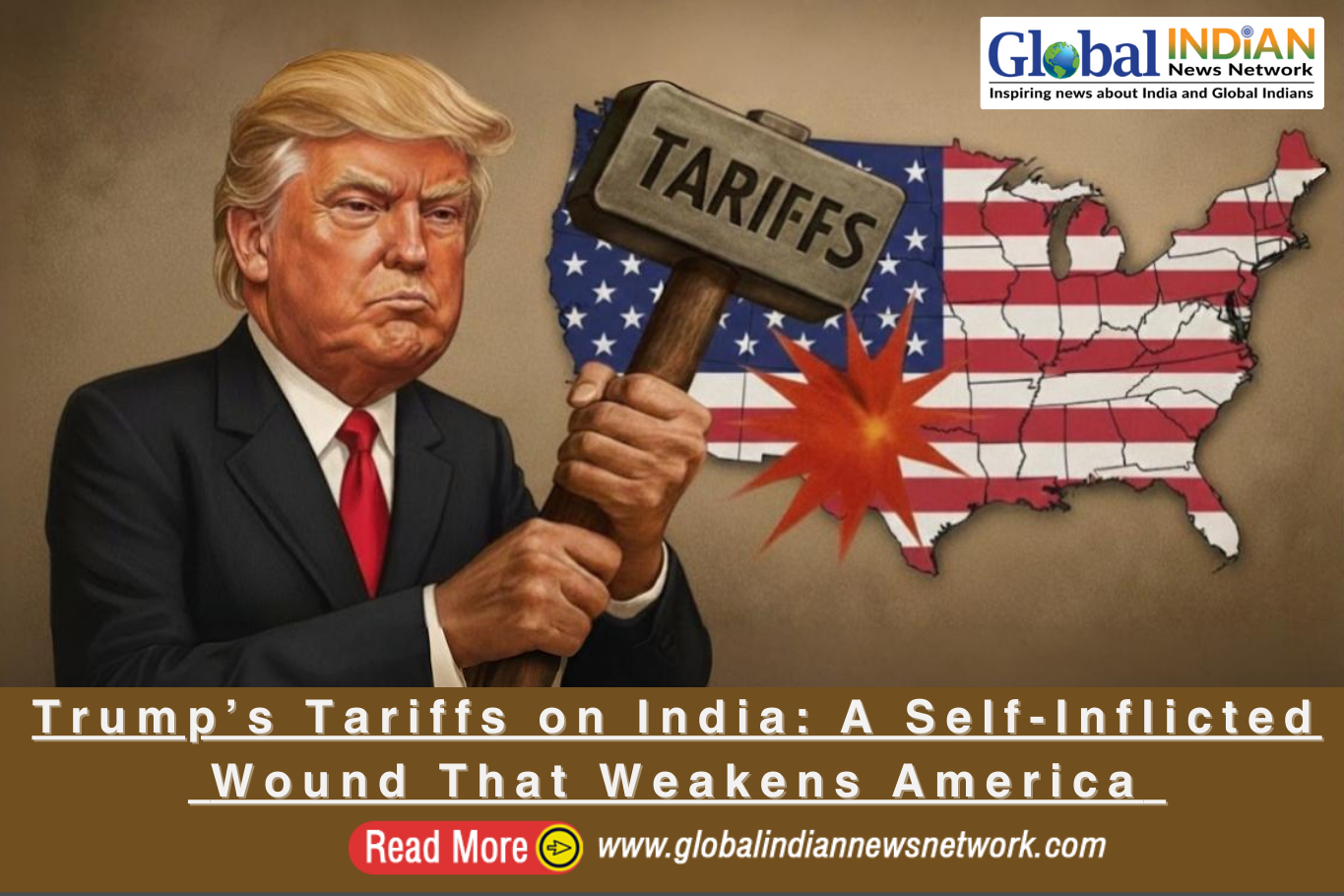
 When President Donald Trump slapped 50% tariffs on Indian imports last month, he billed it as a blow against unfair trade. In reality, it may be one of the most self-destructive moves in U.S. economic and foreign policy in decades. The tariffs may sting India in the short run, but the lasting damage will fall squarely on the United States—weakening supply chains, driving up inflation, alienating a key ally, and accelerating the global drift away from the dollar.
Alienating a Strategic Partner
For over two decades, Republican and Democratic administrations alike have worked painstakingly to cultivate India as a counterweight to China. Tariffs now put that progress at risk. By penalizing New Delhi for buying discounted Russian oil—an act for which China and the EU escaped punishment—Trump has made India feel unfairly targeted. The anger in India is real, and it is personal.
Geopolitical expert David Goldwyn has been especially vocal:
“What he’s learning in this fiasco, really, in terms of diplomatic relations with India, is that this oil weapon was not quite the tool of leverage that he thought it was. India is not as vulnerable… He underestimated the potency of that weapon and really misread Indian history.”
Goldwyn also defended India’s response:
“India is right to continue to exercise its sovereignty while hopefully at the same time negotiating seriously on issues like trade … There’s a lot to be gained here …”
Short-Term Pain for India, Long-Term Damage for the U.S.
Yes, India will suffer short-term losses. The U.S. is its largest trading partner, taking in one-fifth of Indian exports. With exemptions only for pharmaceuticals and electronics, nearly two-thirds of Indian goods shipped to the U.S. are now taxed at 50%. Labor-intensive sectors such as textiles, shrimp, diamonds, and auto components—industries clustered in small towns—are expected to be hit the hardest. The inevitable job losses will make it even more difficult for India’s youth to secure productive employment.
Analysts estimate India could see its GDP growth trimmed by 0.3 to 0.6 percentage points under sustained tariffs. Financial institutions like Goldman Sachs and Nomura warn that this might further slow India’s growth outlook.
From the Indian side, Chief Economic Adviser V. Anantha Nageswaran has attempted to put the damage in perspective: he estimated the potential GDP loss to be between 0.2% and 0.3% due to the tariffs, mitigated somewhat by domestic offsets such as strong agricultural harvests, tax adjustments, and GST rationalization.
The U.S. Economy: Paying the Hidden Costs
Higher duties on goods from India that are essential to American supply chains—leather, auto parts, precision engineering—will inevitably increase costs for producers and consumers. Inflation is already a political sore point for Trump, and these tariffs risk stoking it further.
Industrialist Gautam Singhania puts it bluntly:
“I think it’s going to cause hyper-inflation in the US.”
From the global financial side, authorities are sounding alarm bells. The IMF has said that U.S. tariffs are contributing to inflationary pressures and straining the economy.
And influential voices like the U.S. Treasury Secretary Lawrence Summers have warned that tariffs of this magnitude constitute a self-inflicted wound—raising prices without delivering trade or diplomatic gains.
The Russian Oil Penalty Backfires
The additional 25% penalty imposed because of India’s ongoing purchases of discounted Russian crude was meant to punish what Washington sees as support for Moscow. But analysts say the move may boomerang.
India saved around $17 billion by increasing Russian oil imports from early 2022. The new U.S. measures could wipe out much of those gains. It is projected that exports might be slashed by $37 billion in the coming fiscal year if the tariffs persist.
Ignoring the Full Balance Sheet
Trump’s fixation on the bilateral trade deficit with India overlooks massive other flows. Investment income, defense contracts, royalties, and education are significant positives for the U.S. Indian students, now the largest group of foreign students in the U.S., bring in billions annually.
Experts note that U.S. tech firms depend heavily on Indian talent, and India’s global capability centers drive profits by offering cost-efficient services like customer support, software engineering, accounting, design, etc. These interdependencies risk rupture under steep tariffs, yet much of the public debate ignores them.
Losing the Market of the Future
The long-term loss may be America’s most costly. India’s middle class is expected to exceed 800 million people by 2030. This demographic represents one of the fastest-growing consumer markets on the planet. Alienating it could mean forfeiting enormous opportunities for U.S. companies.
A Geopolitical Gift to China and the Rise of Alternatives
At the Shanghai Cooperation Organization summit, Prime Minister Modi met Vladimir Putin and Xi Jinping, signaling India’s readiness to pursue a multi-aligned foreign policy. Tariffs from Washington only strengthen India’s incentive to look east rather than west.
“Trust between the United States and India is running low,” warns Richard M. Rossow of the Center for Strategic and International Studies. He argues that in its drive to pressure India, Washington is failing to appreciate New Delhi’s red lines in agriculture, market reciprocity, and strategic autonomy.
Financial institutions are also warning of cost shifts. In “Beyond Tariffs: Strategic Realignment in U.S.-India Relations,” analysts point to possible drops of 0.3-0.6 percentage points in India’s growth, but more importantly a weakening of the strategic integration that has underpinned U.S. Indo-Pacific strategy.
India Will Adapt—But Can America Mend the Rupture?
For India, the path forward is clear: diversify exports, deepen ties with Asia, Europe, Africa; strengthen domestic firms; reduce dependency on any single market. These adjustments may be painful, but they may render India more resilient.
For the U.S., repairing trust will be far harder. India is not a small economy that’s easy to coerce. With 1.46 billion people and global ambitions, New Delhi will not easily forgive punitive tariffs imposed by a strategic partner.
Trump’s tariffs may deliver short-term political theatre, but the cost is very real: alienating a rising partner, raising inflation, disrupting supply chains, undermining trust, and jeopardizing America’s long-term strategic and economic interests.
About the Author
Dr. Arvind Sharma is a distinguished economist and policy advisor, widely recognized for his expertise in the Indian economy and its intersections with the global economic landscape. With over three decades of experience spanning academia, government, and international policy circles, he has earned a reputation as a leading voice on economic strategy, trade dynamics, and fiscal reform.
Holding a Ph.D. in economics, Dr. Sharma has advised major corporations and played a significant role in shaping policies on taxation, foreign investment, and sustainable growth. On the global stage, he has collaborated with prominent international institutions, offering insights into South Asia’s growth trajectory and the wider implications of India’s rise in the global economy.
A prolific writer, he has authored numerous books and scholarly papers on subjects such as India’s pathway to a $5 trillion economy, digital finance, and the shifting balance of global trade. His commentary is frequently sought in policy forums and international media, where he addresses issues such as inflation, monetary policy, and inclusive development.
Currently, Dr. Sharma is engaged in research and teaching with leading think tanks and academic institutions, where his work bridges theoretical analysis with practical policy applications. His contributions continue to shape debates on how emerging economies can drive sustainable and equitable growth in an increasingly interconnected world.