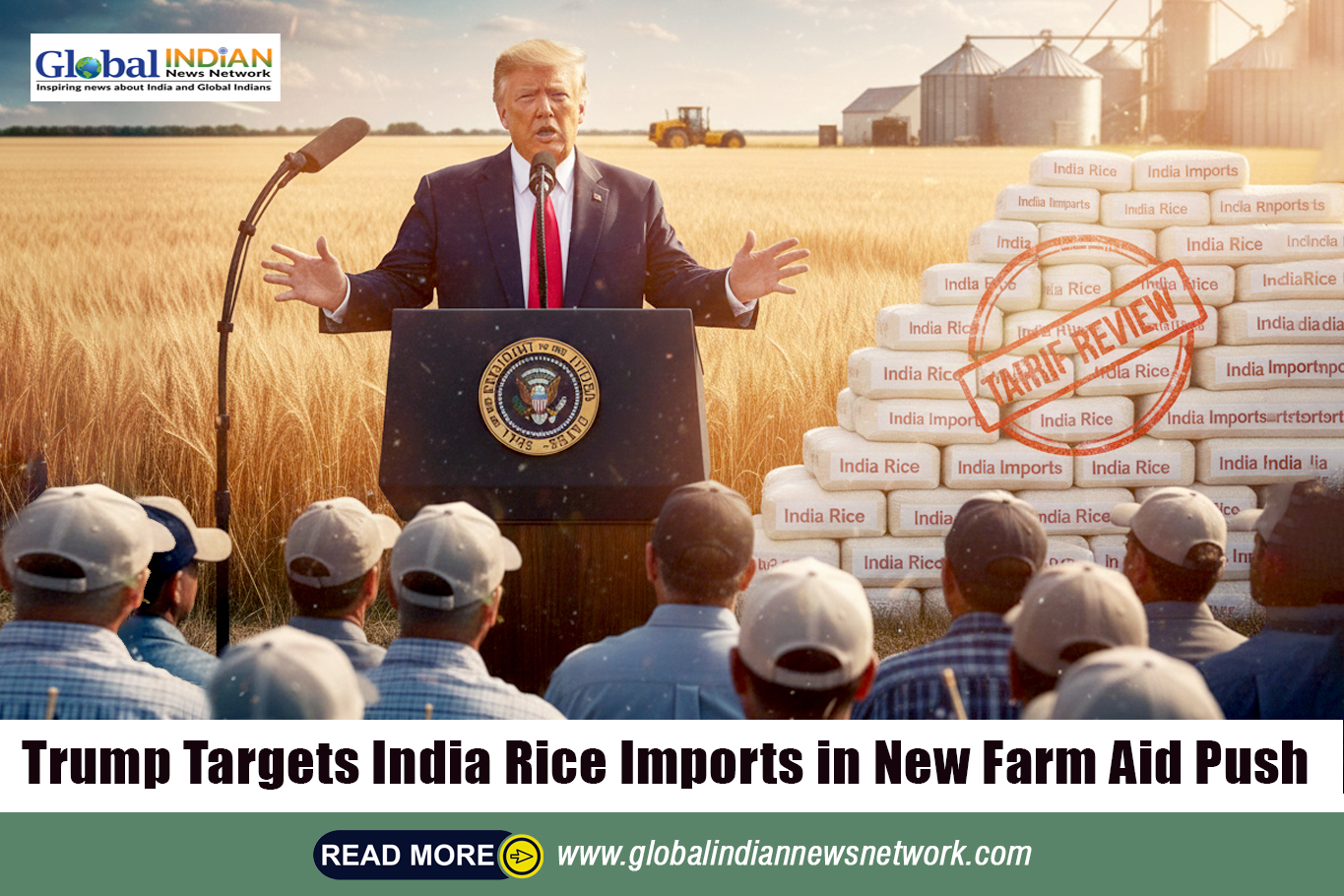
 US President Donald Trump unveiled a multi-billion-dollar farm relief package while intensifying criticism of agricultural imports from India and other Asian suppliers. Speaking at a White House roundtable with farmers, lawmakers and senior officials, he said the administration would provide $12 billion in financial assistance funded through tariff revenues collected from US trading partners. Trump argued that the support was essential for stabilising the rural economy and described farmers as “an indispensable national asset.”
India featured prominently in the discussion as producers voiced concerns about rising volumes of foreign rice entering the US market. Meryl Kennedy, CEO of Kennedy Rice Mill, told the President that subsidised rice from India, Thailand and China was causing severe distress to southern growers. She said imports were at their highest levels and urged the administration to intensify restrictions, noting an active WTO case against India’s subsidies.
Trump pressed officials on why Indian rice brands dominated US retail shelves and directed Treasury Secretary Scott Bessent to examine potential responses. He said tariff tools were central to addressing what he described as unfair practices, adding that stronger measures could resolve the situation “in two minutes.”
The conversation also broadened to include soybeans, a key export vulnerable to global price swings. Trump said he had recently spoken with Chinese President Xi Jinping and expected China to make significant new purchases. Bessent told the gathering that commitments secured under the Busan framework included at least 12 million metric tons of soybean imports this season and 25 million tons annually for the next three years. He described the farm support programme as a necessary “liquidity bridge” and said the administration was laying the foundation for a stronger agricultural economy.
Farmers at the event linked concerns over India to broader anxieties about global competition. Kennedy said rice should be treated as a national security issue, arguing that it functions as an economic lever in many exporting countries and that subsidised grain was displacing US products, including in Puerto Rico. Several participants urged the administration to act more quickly, while highlighting opportunities to boost domestic markets through policies such as E15 fuel expansion.
Senior officials used the meeting to fault the previous administration for what they characterised as a steep decline in the rural economy. National Economic Council Director Kevin Hassett said more than 150,000 farms had closed and interest burdens had increased, creating financial strains that required urgent intervention.
India-US agricultural trade has expanded in recent years, with India exporting basmati rice, processed rice, spices and marine goods while importing American almonds, cotton and pulses. However, recurring disputes over subsidies, market access and WTO complaints—particularly concerning rice and sugar—have continued to complicate bilateral engagement. China remains the largest buyer of US soybeans, and tariff-linked shifts have reshaped global commodity flows since 2018. Trump’s renewed emphasis on tariff pressure signals potential turbulence for Asian agricultural exporters in the months ahead.