

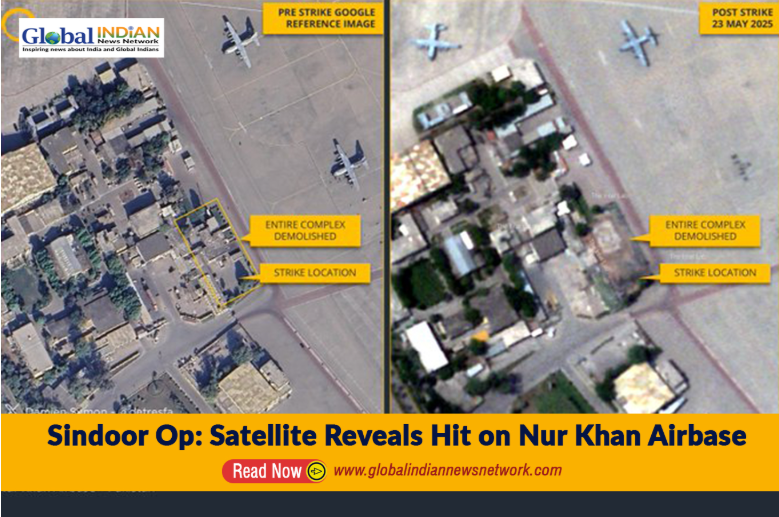
 Recent satellite imagery has provided new insights into the damage inflicted on Pakistan’s strategically vital Nur Khan airbase during India’s Operation Sindoor. The latest visuals suggest that destruction extends beyond the previously reported damage to two special-purpose vehicles, with a large complex near the strike area completely demolished.
The Intel Lab, which published the latest satellite imagery, noted that the extent of the damage is wider than previously estimated. Defence analyst Damien Symon shared on X that the entire complex adjacent to the strike location has been razed, pointing to a more extensive impact of the Indian Air Force’s precision attacks.
Earlier satellite reports had confirmed that between May 8 and 10, India targeted key infrastructure and ground support systems at the Rawalpindi airbase. Nur Khan’s strategic importance lies in its proximity to Pakistan’s Army headquarters and its role as a command centre for air mobility operations. The base houses critical assets such as Saab Erieye early warning aircraft, C-130 transport planes, IL-78 refuelling tankers, and serves as a hub for Pakistan’s drone fleet including Bayraktar TB2 and Shahpar-I UAVs.
Situated only 25 km from Islamabad, the Nur Khan airbase plays a vital role in Pakistan’s drone warfare capabilities and VIP transport, including operations involving the presidential aircraft. The revealed scale of damage highlights weaknesses in Pakistan’s air defence infrastructure.
Pakistan’s Prime Minister Shehbaz Sharif recently admitted he was alerted in the early hours of May 11 by Army Chief General Syed Asim Munir that Indian ballistic missiles had struck multiple airbases, including Nur Khan. Sharif stated he received a secure call at 2:30 am informing him of the missile strike. He further mentioned Pakistan’s retaliatory strikes on Indian targets such as Pathankot and Udhampur during a public speech on Youm-e-Tashakur (Day of Thanks).
This development underscores the heightened tensions and strategic exchanges between the two countries and points to an escalation in aerial warfare capabilities and vulnerabilities.










2 Comments
mobile slots no deposit bonus
References:
airfac.cat
References:
Caesars palace las vegas nv
References:
http://www.dailymunwha.com